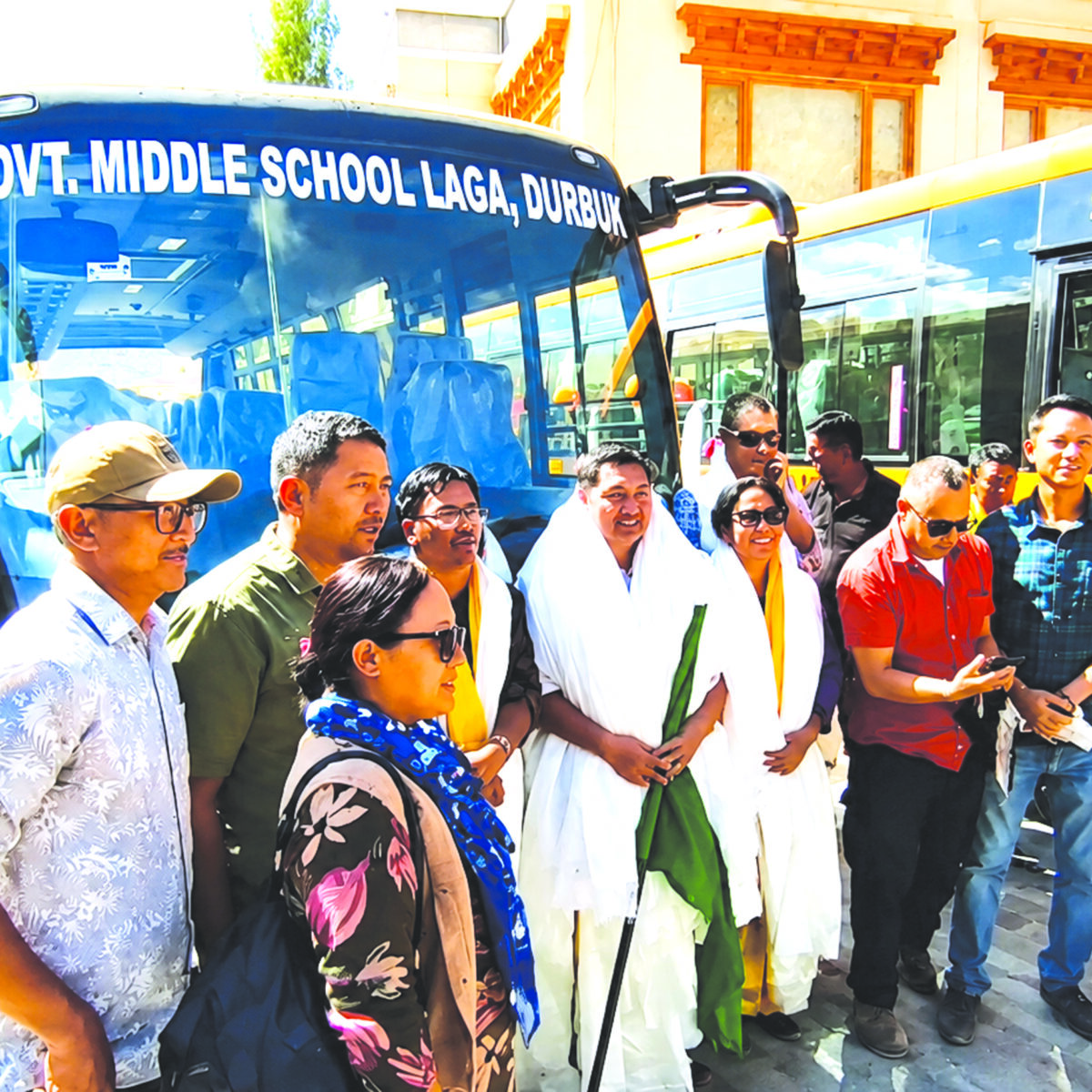
LEH: Thirteen school buses funded through the Members of Parliament Local Area Development Scheme (MPLADS) allocation of former Ladakh MP Jamyang Tsering Namgyal were flagged off from the District Motor Garage in Leh on Thursday, with 11 buses allotted to government schools across Ladakh and two handed over to the Central Institute of Buddhist Studies (CIBS).
The buses have been provided through the Education Department, primarily to schools in areas where rising student enrolment has increased the demand for reliable public transport. The initiative is expected to improve school access for students, particularly those living and studying in remote and far-flung parts of the Union Territory.
Speaking at the flag-off ceremony, Namgyal said the buses were part of his efforts during his tenure to support education and public welfare across Ladakh. He said he had pursued the utilisation of the unspent portion of his MPLADS allocation with the concerned authorities in Delhi after completing his term as MP, with the objective of preventing the funds from being surrendered.
According to Namgyal, an overall allocation of around ₹34 crore was involved, a portion of which was utilised for procuring the school buses.
The former MP recalled that buses provided to schools during the initial years of his tenure had coincided with increased student enrolment and expressed hope that the latest fleet would similarly help improve access to education, particularly in areas where transportation remains a constraint.
He also credited the UT Ladakh Education Department, under the leadership of Education Secretary Bhanu Prabha, and other officials for measures aimed at strengthening government schools and advancing the Ladakh Model School approach.
Namgyal said the broader objective should be to expand educational opportunities within Ladakh so that families are less dependent on sending their children outside the Union Territory for schooling in cities such as Delhi, Jammu and Chandigarh.
The allocation of the 13 buses covers both institutional and government-school requirements, with the majority directed towards schools in locations where increased enrolment has created a greater need for transport facilities.
The initiative was also attributed to sustained follow-up by former councillors and local party representatives, besides coordination among the Education Department and other stakeholders.