Banks achieve 29% of annual credit target in Q1; CS pushes monthly lending camps to boost credit flow and simplifying loan applications; banks disburse Rs 834 cr during April–June quarter
LEH: With Ladakh’s Credit-Deposit (CD) ratio standing at 45.74%, considerably below the 60% benchmark highlighted by NABARD, Chief Secretary Ashish Kundra has directed banks to intensify lending activities, strengthen their outreach in remote areas and improve access to institutional finance, particularly for agriculture, MSMEs and other priority sectors.
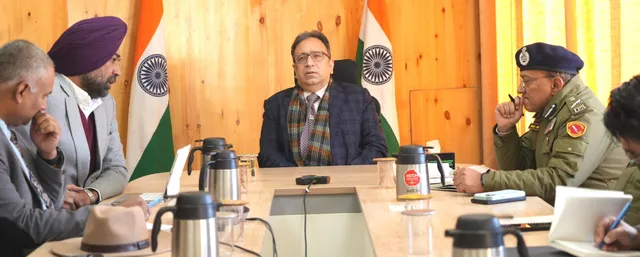
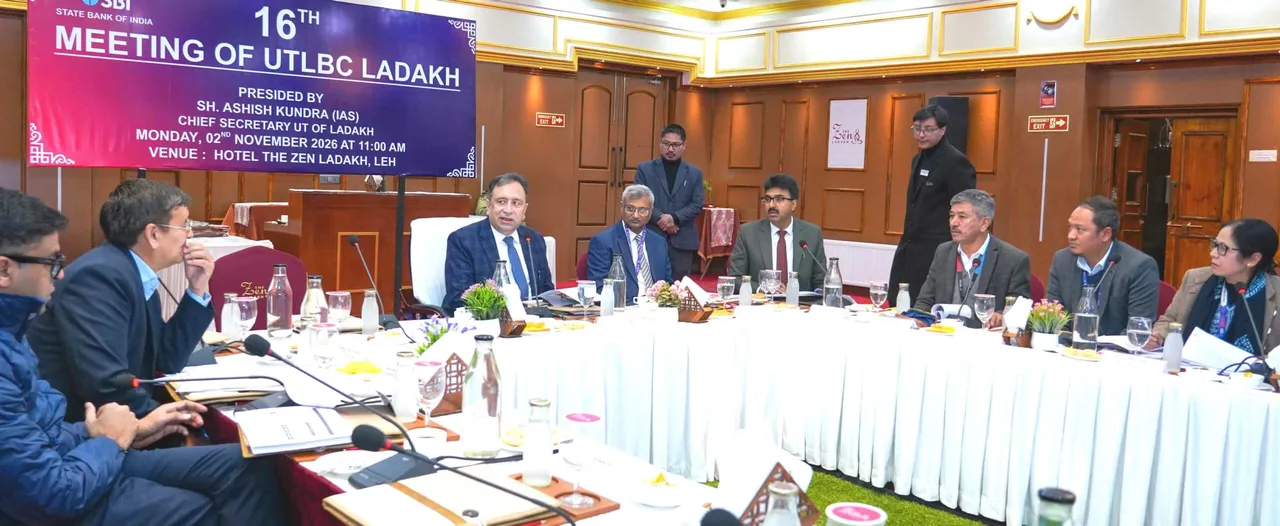
Chairing the 16th Union Territory Level Bankers Committee (UTLBC) meeting here on Monday to review the banking performance for the quarter ending June 2026, the Chief Secretary called for a more proactive approach by financial institutions to ensure that deposits mobilised in Ladakh translate into greater credit support for local economic activities and entrepreneurship.
The meeting reviewed the progress of banks in credit disbursement, deposit mobilisation, credit growth, CD ratio and implementation of various government-sponsored financial inclusion and lending schemes.
The meeting began with a welcome address by Assistant General Manager, SBI Administrative Office Jammu, Chander Mohan Bhat, followed by a detailed presentation on the performance and achievements of banks by Assistant General Manager and UTLBC Convenor Bank representative Tsering Wangmo.
The meeting was attended by Commissioner Secretary Tsewang Tharchin (IA&AS), Administrative Secretary Himanshu Gupta, Deputy Secretary, Department of Financial Services, Ministry of Finance, Government of India, Dheeraj Bhaskar, through video conferencing, Deputy Commissioner Leh Romil Singh Donk, Deputy Commissioner Kargil and officers representing Sham, Changthang, Nubra, Zanskar and Drass through video conferencing.
RBI Regional Director Prabhakar Jha, NABARD General Manager Vikas Mittal, RBI Deputy General Manager Vibha Gupta, SBI Assistant General Manager C.M. Bhat, J&K Bank Zonal Head Tsewang Dorjay, NABARD AGM Tsewang Dorjay, directors and joint directors of concerned departments, and senior representatives of member banks and financial institutions also participated.
According to the performance indicators presented during the meeting, banks disbursed Rs 834 crore during the first quarter of 2026–27, achieving 29% of their annual credit target across priority and non-priority sectors. Of this, Rs 373 crore was extended under Priority Sector Advances, representing 26% of the annual target.
The banking sector recorded a year-on-year deposit growth of 12.32%, taking total deposits in the Union Territory to Rs 11,630.35 crore as of June 2026. Total credit outstanding also registered a growth of 10.48% to reach Rs 5,319.22 crore. However, the overall CD ratio remained at 45.74%, indicating considerable scope for expanding institutional lending within the Union Territory.
Highlighting the gap between the existing CD ratio and the prescribed benchmark, General Manager NABARD Vikas Mittal informed the meeting that the benchmark CD ratio was 60%.
RBI Regional Director Prabhakar Jha, meanwhile, pointed out that loans pertaining to borrowers in Ladakh should be counted while calculating the Union Territory’s CD ratio even if such loans are sanctioned by bank head offices located outside Ladakh. The clarification assumes significance in assessing the actual flow of institutional credit to Ladakh-based borrowers and ensuring that lending figures adequately reflect the region’s economic activity.
In a significant direction aimed at improving credit penetration, Kundra instructed all banks to organise at least one banking camp every month in each district in coordination with the Department of Industries and Commerce.
The camps will focus on facilitating credit support in agriculture, Micro, Small and Medium Enterprises (MSMEs), renewable energy, education, housing and other priority sectors. The objective is to bring banks, government departments and prospective beneficiaries onto a common platform, enabling eligible applicants to access financial assistance under various government-sponsored schemes without unnecessary procedural delays.
The Chief Secretary further directed that the outcomes of these camps be placed before subsequent UTLBC meetings in consultation with the concerned line departments. The review mechanism, he said, should help assess actual progress, identify bottlenecks in loan processing and ensure effective follow-up so that the initiatives result in tangible improvements in credit disbursement.
Recognising the geographical challenges faced by residents of remote and border areas, the Chief Secretary specifically asked the State Bank of India and Jammu and Kashmir Bank to strengthen their banking infrastructure in the Vibrant Villages.
He called for opening bank branches and banking outlets, deploying Business Correspondents (BCs) and installing ATMs to improve the accessibility of financial services in these strategically located settlements.
The initiative is expected to reduce the dependence of residents on distant banking facilities and improve access to formal financial services, particularly in areas where geographical remoteness continues to pose challenges to financial inclusion.
In another important measure to facilitate access to institutional finance, Kundra asked the UTLBC Convenor Bank to prepare a common, bank-wise loan application form covering various government-sponsored schemes.
The proposed common application format is intended to simplify the loan application process, reduce procedural complexities, improve outreach among potential beneficiaries and facilitate timely disposal of loan cases.
The move is particularly relevant for small entrepreneurs, farmers, youth and other beneficiaries who often face difficulties navigating different documentation and application requirements across financial institutions and government schemes.
During the meeting, Administrative Secretary Himanshu Gupta also informed that trading and service-sector activities, including Pashmina-related activities up to a specified limit, could be considered for coverage under the Mission Yuva scheme, thereby potentially widening the scope of financial assistance for local livelihood and enterprise activities. The meeting concluded with a vote of thanks by SBI Chief Manager Phuntsog Angchok.