Main excavation achieves historic breakthrough; focus shifts to tunnel lining, ventilation shafts, safety systems and allied infrastructure
HABEEL SAGAR
KARGIL: The ambitious Zojila Tunnel project, which promises to provide year-round road connectivity between Kashmir and Ladakh, has entered a crucial phase of construction, with Union Minister for Road Transport and Highways Nitin Gadkari announcing that nearly 70 per cent of the overall project has been completed and the remaining work is expected to be finished within the next six to eight months.
The latest announcement, made by Gadkari while addressing the 7th World Landslide Forum (WLF-7) on November 24, has brought renewed attention to one of India’s most strategically significant infrastructure projects in the Himalayan region. If the latest timeline is achieved, the 13.153-km tunnel could be completed around May–July 2027, potentially bringing forward its opening compared with earlier projections.
The announcement comes nearly six months after the project achieved its historic main-tunnel breakthrough on June 9, 2026, when excavation teams working from the Baltal side in Kashmir and Minamarg side in Ladakh successfully connected the two ends of the tunnel.
The breakthrough marked the completion of the principal excavation work and shifted the focus towards the remaining engineering, structural, mechanical and safety-related components required before the tunnel can be opened for public traffic.
The Zojila Tunnel is being constructed by Megha Engineering and Infrastructures Limited (MEIL) under the supervision of the National Highways and Infrastructure Development Corporation Limited (NHIDCL).
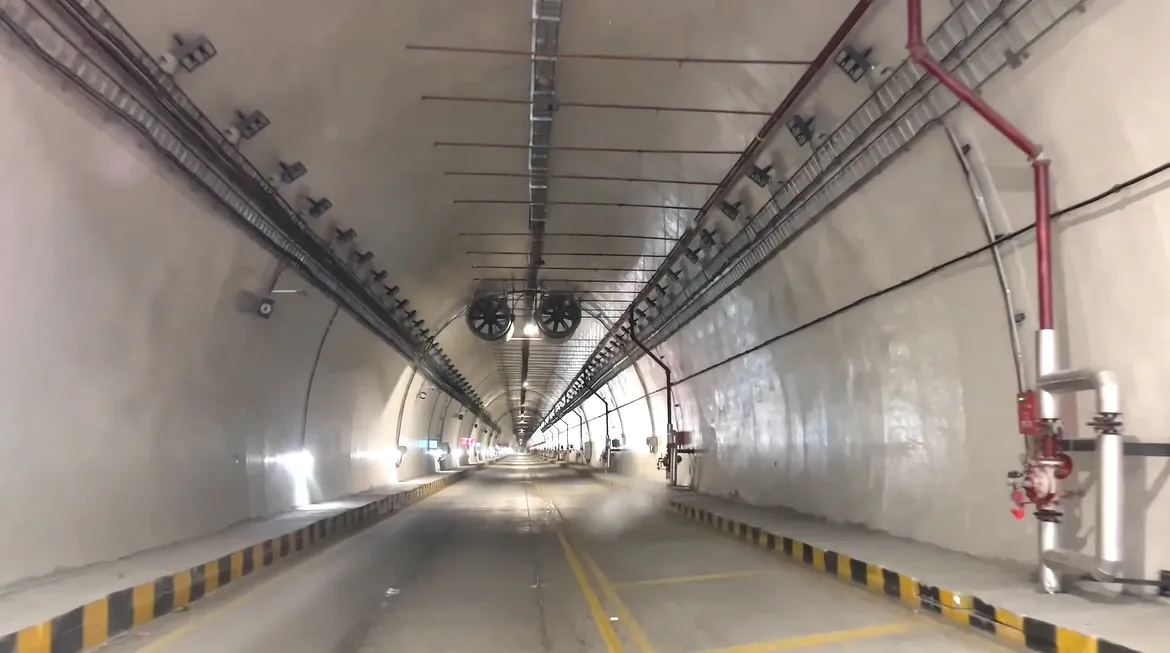
The main tunnel, measuring 13.153 km, is a single-tube, two-lane, bi-directional road tunnel designed to pass beneath the Zojila Pass at an altitude of approximately 11,578 feet.
Following the June breakthrough, construction activities entered a new phase, with particular emphasis on concrete lining, ventilation infrastructure and installation of safety and traffic-management systems.
According to project-related information shared by MEIL officials following the breakthrough, three ventilation shafts are being constructed to facilitate air circulation inside the tunnel and support its safe operation. The shafts are particularly important because the main tunnel does not have a separate parallel escape passage.
The ventilation system will help maintain air quality by removing vehicle emissions and supplying fresh air. It will also be an essential component of the tunnel’s emergency management arrangements.
Concrete lining is another major component of the remaining work. The lining provides structural stability, protects the tunnel interior and helps ensure its long-term durability under the difficult geological and climatic conditions of the Zojila region.
Earlier project updates had highlighted progress on the ventilation shafts, which represent some of the technically challenging components of the construction.
A report published around the time of the main-tunnel breakthrough quoted project officials as saying that two of the three planned ventilation shafts had achieved breakthrough and were connected to the surface.
One of the shafts involved approximately 430 metres of pilot excavation using raise-climber technology, a specialised technique employed for vertical excavation in difficult underground conditions. The remaining shaft work, concrete lining and associated ventilation arrangements are among the important components that must be completed and integrated before commissioning.
The tunnel will also have automatic fire-detection and suppression arrangements, CCTV surveillance, Variable Message Signs (VMS), a Supervisory Control and Data Acquisition (SCADA) system and other modern traffic-management facilities.
These installations will be essential for monitoring traffic, detecting emergencies and ensuring safe movement through the long underground corridor.
The scale of the excavation achievement becomes clearer from the construction updates issued before the final breakthrough. In January 2026, MEIL reported that excavation from the Baltal side had been completed, while approximately six kilometres had been excavated from the Minamarg side. Around 925 metres of excavation remained at that stage.
Subsequent updates from the eastern portal indicated that approximately 6.3 km of heading excavation and 4.4 km of benching had been completed from the Ladakh side, alongside around 2.8 km of final lining.
The excavation was undertaken through the New Austrian Tunnelling Method (NATM), involving controlled excavation, rock support and stabilisation rather than simply creating an underground passage. The main tunnel finally achieved its breakthrough on June 9, 2026, bringing together the excavation fronts from both sides.
With the main excavation now completed, the remaining challenge is to complete the tunnel’s structural lining, ventilation and electrical installations, safety infrastructure and associated road works.
Construction of the Zojila Tunnel has involved some of the most challenging engineering conditions encountered in India’s high-altitude infrastructure development. The project is situated in a region characterised by extreme winter temperatures, heavy snowfall, unstable geological formations and difficult working conditions.
The eastern portal at Minamarg has presented particular challenges because of the difficult rock formations, water ingress and the downward gradient of the tunnel alignment.
Earlier reports quoting construction officials highlighted the need for continuous dewatering through pumping arrangements beyond 750 metres inside the eastern section. Maintaining electricity supply, voltage stability and adequate ventilation for workers and heavy machinery deep inside the tunnel also posed considerable operational challenges.
Temperatures in the region can fall to extremely low levels during winter, restricting outdoor construction activities, particularly work associated with ventilation shafts and approach infrastructure.
Gadkari, while announcing the latest progress, also emphasised the importance of understanding local geology, hydrology and slope stability, stating that infrastructure development in fragile Himalayan terrain must maintain a balance between construction requirements and environmental protection.
The Zojila Tunnel project has an approved cost of approximately ₹6,808.69 crore and forms part of the larger Sonamarg–Kargil connectivity corridor on National Highway-1. The project comprises the 13.153-km main tunnel and approximately 16.964 km of approach roads and associated infrastructure.
Besides the main tunnel, the wider project includes two twin-tube, uni-directional Nilgrari tunnels with a combined length of approximately 4.8 km, eight cut-and-cover sections measuring around 2.35 km, four bridges with a combined length of approximately 810 metres and 40 culverts. It also incorporates snow galleries, catch dams, deflector dams, air-blast walls and other avalanche-protection structures to improve the safety and reliability of the highway. The project is being implemented by NHIDCL, with MEIL serving as the executing agency.
For Ladakh, particularly Kargil and Drass, the Zojila Tunnel represents a fundamental improvement in regional connectivity.
The Srinagar–Leh highway is the principal road link connecting Ladakh with Kashmir and the rest of the country. However, the Zojila Pass remains vulnerable to heavy snowfall and avalanches, resulting in prolonged seasonal closures that disrupt the movement of passengers, essential commodities, fuel, medicines and other supplies.
The tunnel is expected to provide an all-weather alternative beneath the snowbound pass, significantly reducing the region’s dependence on seasonal road openings.
According to the Ministry of Road Transport and Highways, the project is expected to reduce travel time between Sonamarg and Minamarg from approximately two hours to around 30 minutes. It will also improve the movement of defence personnel, military equipment and supplies, strengthening strategic connectivity in the sensitive border region.
For residents of Kargil and Drass, the benefits could extend beyond shorter travel times. More reliable road connectivity would facilitate access to healthcare, education, employment opportunities and markets, while providing greater continuity in the supply of essential goods during winter.
The project is also expected to strengthen tourism and trade by making travel between Kashmir and Ladakh more dependable throughout the year.
The latest six-to-eight-month timeline announced by Gadkari is particularly significant in view of the earlier completion projections.
In November 2025, during a visit to the eastern portal, the then Ladakh Chief Secretary, Dr Pawan Kotwal, was informed that approximately 12 km of the tunnel had been completed, with around 1,200 metres remaining. Officials then indicated February 2028 as the project completion target.
Following the main-tunnel breakthrough in June 2026, MEIL officials told *The Tribune* that the tunnel was expected to be completed by December 2028, citing the remaining ventilation shafts, concrete lining and other construction requirements.
In September 2026, a separate update attributed to an NHAI Project Director indicated that the tunnel could become operational by December 2027. Gadkari’s November 24 announcement of completion within six to eight months now places the projected timeline considerably earlier, potentially around the middle of 2027.
However, the minister’s announcement concerns completion of the overall project, and the actual opening to traffic will also depend on the completion of finishing works, installation and testing of safety systems, and commissioning procedures.
With the principal excavation milestone achieved and the remaining construction activities progressing, the coming months will be crucial in determining whether the ambitious revised timeline can be met.
For Ladakh, the completion of the Zojila Tunnel would mark a historic transformation of its road connectivity, potentially ending one of the most persistent geographical barriers affecting its year-round connection with Kashmir.