Kundra seeks better visitor facilities at Murgi’s ancient Petroglyph site
NUBRA: Calling for the preservation of Ladakh’s archaeological heritage alongside the sustainable development of its high-altitude medicinal plant resources, Chief Secretary Ashish Kundra reviewed the ancient petroglyph site near Murgi village and assessed the region’s medicinal flora on the concluding day of his three-day visit to Nubra district.
At the Murgi petroglyph site, Kundra was briefed by archaeologist Prof. Tashi Ldawa on the historical importance of the rock engravings, believed to be thousands of years old. The engravings depicting ibex, human figures, masks and hunting scenes were described as one of Ladakh’s largest concentrations of prehistoric rock art, offering insights into the region’s early civilisation.
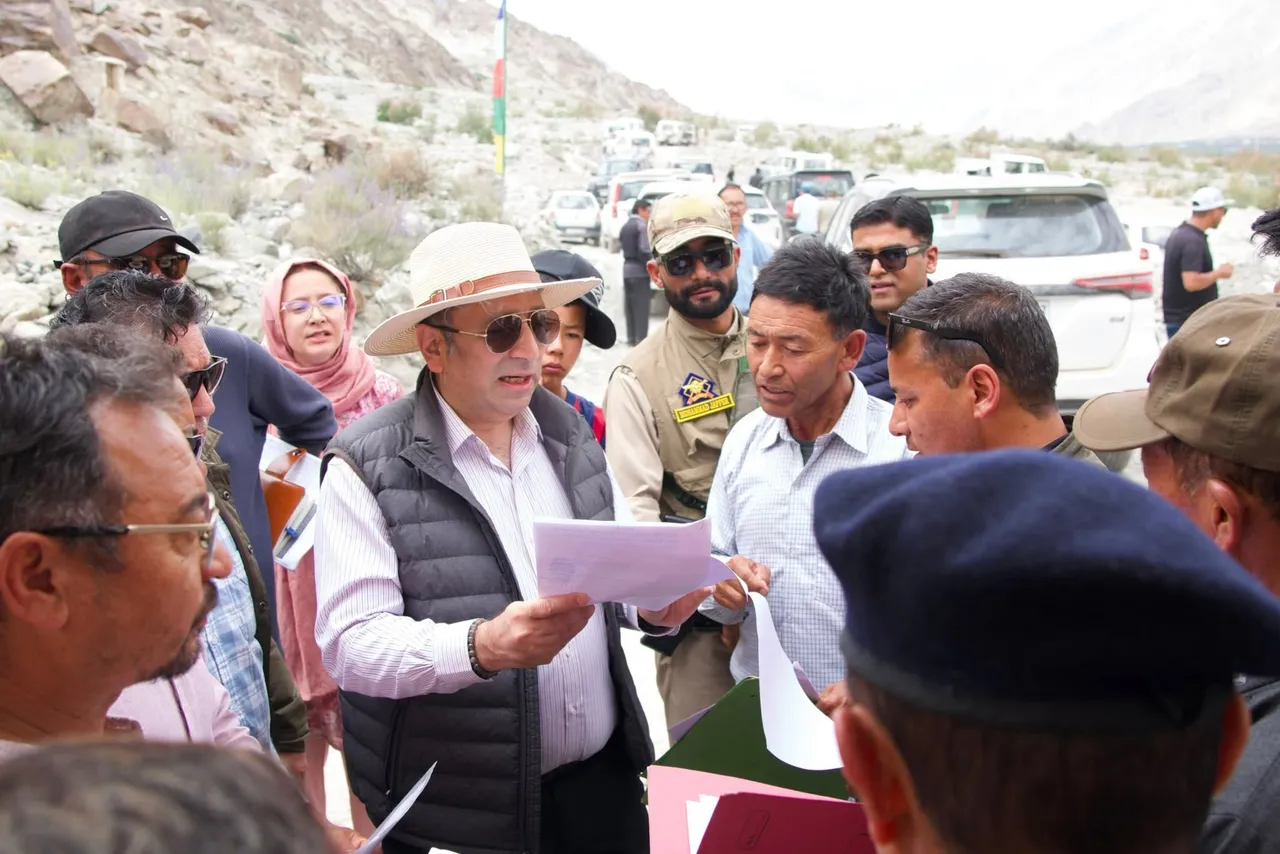
Interacting with local residents, the Chief Secretary reviewed tourist footfall and conservation measures at the site. Stressing the need to improve the visitor experience without compromising the site’s archaeological value, he proposed better pedestrian access, informative signages explaining the historical significance of the engravings and appropriate lighting. Residents also submitted a memorandum seeking improved road connectivity, construction of a bridge, enhanced healthcare facilities and other civic amenities, to which Kundra assured that the concerns would be examined by the concerned departments.
The Chief Secretary later reviewed the medicinal plant resources of the Warila mountain region in the presence of Divisional Forest Officer, Leh, Vishal, and Dr. Punchok Angmo, Consultant, State Medicinal Plant Board, UT Ladakh. He was introduced to several naturally occurring high-altitude medicinal plant species and briefed on their medicinal properties, ecological importance and applications in the traditional Sowa-Rigpa system of medicine.
During a visit to a medicinal plant cultivation field, Kundra inspected cultivation practices, irrigation facilities, seed production and post-harvest management. He also interacted with farmers and officials on cultivation techniques, marketing opportunities, commercial viability and the scope for expanding medicinal plant cultivation in the region.
Emphasising the economic and ecological potential of Ladakh’s medicinal flora, the Chief Secretary called for greater scientific research, conservation, value addition and stronger market linkages to promote the sector while ensuring sustainable harvesting. He also explored the feasibility of introducing additional medicinal plant varieties suited to the region’s agro-climatic conditions and underscored the importance of integrating traditional knowledge with scientific research to unlock the sector’s full potential.
The Chief Secretary was accompanied by Secretary, Planning, Development and Monitoring Department Himanshu Gupta, Deputy Commissioner Nubra Mukul Beniwal, Sub-Divisional Magistrate Nubra Tashi Jorgais, the Superintendent of Police, Nubra, the Divisional Forest Officer, Leh, the Director of Health Services, the Officer on Special Duty to the Chief Secretary, and other senior officials.