Justice Surya Kant says Ladakh-origin cases will be heard virtually on a designated day, allowing lawyers to argue before the apex court without travelling to Delhi
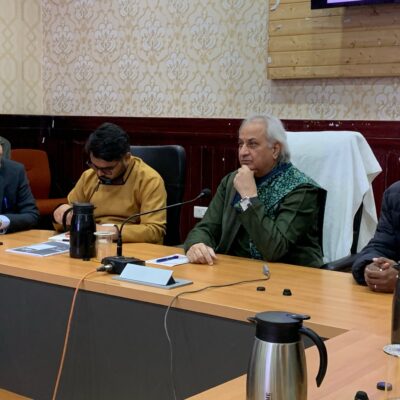
LEH: Chief Justice of India Justice Surya Kant on Sunday announced plans to enable lawyers from Leh and Kargil to argue cases before the Supreme Court through video-conferencing from the Ladakh Bench of the High Court of Jammu and Kashmir and Ladakh, reducing the need for costly and arduous travel to Delhi.
Inaugurating the High Court’s Ladakh Bench in Leh, the CJI said all matters originating from Ladakh would be listed on a single day and heard virtually once the necessary video-conferencing facilities were established at the bench.
The arrangement would allow members of the Leh and Kargil bar associations to appear before the country’s highest court without leaving the Union Territory, he said.
Describing the inauguration as a historic step towards improving access to justice, Justice Kant recalled the establishment of a Special Court in Leh in 1870, noting that geographical barriers had restricted access to judicial institutions for generations.
“For close to a century, the high court that served Ladakh sat beyond the Great Himalayas, reachable in winter only by air,” he said.
The CJI said the inclusion of Ladakh in the name of the High Court after the region became a Union Territory in 2019 was an important step, but its impact remained largely symbolic without a judicial institution closer to the people.
“A name on a court’s letterhead is not the same as a court at one’s doorstep,” he said.
Justice Kant stressed that the Ladakh Bench belonged equally to Leh and Kargil, the Union Territory’s two districts, and said its purpose would be fulfilled only when people across the region developed a sense of ownership over the institution.
He said technology and legal aid were essential to overcoming the challenges posed by Ladakh’s vast distances and difficult terrain.
“In a land of such vast distances, technology can do what no road ever could,” he said.
Emphasising the constitutional commitment to equal access to justice, the CJI said no citizen should be denied legal assistance because of poverty or disability. He called for legal awareness camps, the deployment of para-legal volunteers, affordable legal representation, lok adalats and timely compensation for victims of crime.
He expressed confidence that the Ladakh Legal Services Authority and the court’s Legal Services Committee would work together to reach people in remote areas who were awaiting justice.
“Access to justice, after all, begins not in the court’s compound, but at the litigant’s door,” he said.
Justice Kant also acknowledged the role of village institutions and customary practices in resolving disputes, noting that community-based mechanisms had long helped settle grievances and uphold fairness in the region.
He said the true measure of a court lay not in its geographical elevation but in how accessible it was to the people it served.
“We are some 3,500 metres above the sea, and I am told no high court in our country has ever sat higher. Of course, what matters today is not how high this court sits. What is important is how close it now stands to the people it serves,” he said.
Looking ahead, the CJI spoke of a child studying in a classroom in Kargil or Nubra who might one day argue a case before the court or serve as a judge on its bench. “When that day comes, we will know that this bench has not merely arrived in Ladakh, but taken root here,” Justice Kant said.