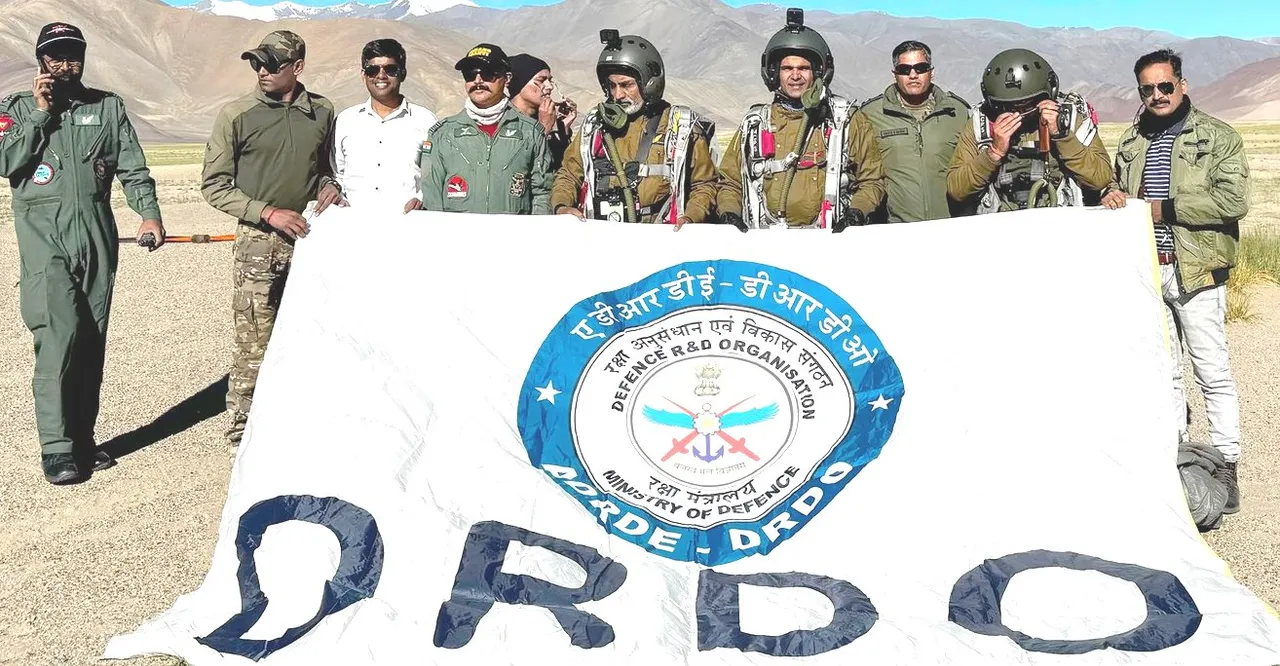
LEH: India has achieved a significant milestone in indigenous military aviation and airborne operations with the successful high-altitude testing of the Military Combat Parachute System (MCPS), designed and developed by the Aerial Delivery Research and Development Establishment (ADRDE), DRDO, at the Nyoma–Mudh Drop Zone in Ladakh.
The trial was conducted at one of the world’s highest-altitude drop zones, providing a demanding test environment for the system under extreme operational conditions. ADRDE test jumpers Wg Cdr Rahul Jha, Chief Test Jumper, MWO R J Singh, VM(G), and MWO Vivek Tiwari executed the jump from an altitude of 22,000 feet above mean sea level (AMSL).
At the time of the jump, temperatures were around minus 15°C, subjecting the parachutists and equipment to severe high-altitude conditions. The test team employed the indigenous MCPS along with its associated sub-systems, including the indigenous para computer, oxygen system and specialised jumpsuits.
The parachute was deployed at approximately 20,000 feet, following which the jumpers descended safely and completed their landing at an altitude of around 13,700 feet.
The successful demonstration is significant because operations at such altitudes impose exceptional demands on parachute systems, personnel and supporting equipment, including extremely low temperatures, reduced atmospheric pressure and limited oxygen availability. The trial therefore provided an important validation of the MCPS and its integrated sub-systems in conditions closely aligned with demanding high-altitude military requirements.
The test demonstrated the efficacy, reliability and tactical employability of the indigenous parachute system in an extreme high-altitude environment. Beyond validating the equipment’s performance, the exercise also highlighted the ability of Indian defence research and development institutions to integrate critical airborne systems and supporting technologies for specialised military operations.
The successful trial marks another step towards strengthening self-reliance in critical defence technologies, reducing dependence on imported systems and enhancing the operational preparedness of India’s armed forces for missions in some of the country’s most challenging terrains.
The achievement assumes particular significance for high-altitude regions such as Ladakh, where military operations require specialised equipment capable of functioning reliably in severe climatic and atmospheric conditions. The successful MCPS trial at Nyoma–Mudh thus underscores the growing indigenous capability to develop and validate advanced systems for India’s unique operational environment.