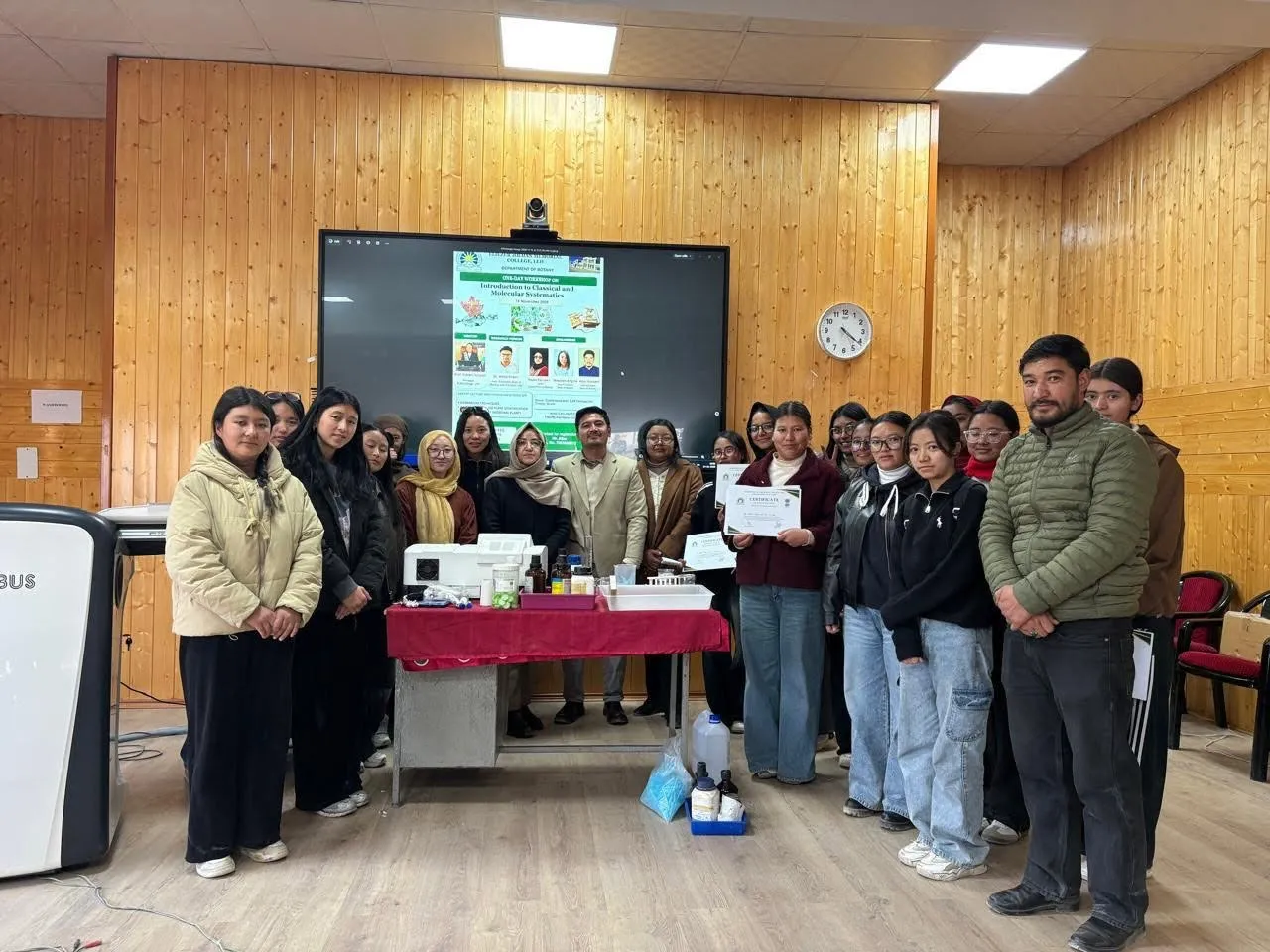
LEH: From identifying plant species through DNA sequencing to examining the chemical compounds that could hold medicinal value, Eliezer Joldan Memorial (EJM) College, Leh, has introduced students and faculty members to emerging scientific tools for exploring Ladakh’s distinctive botanical wealth through a one-day workshop on classical and molecular systematics.
Organised by the Department of Botany at the college Conference Hall, the workshop brought together 40 participants, including students and faculty members, for academic deliberations and practical sessions on traditional plant classification, molecular identification and phytochemical analysis.
Held under the mentorship of Prof. Stanzin Yangdol, Principal, EJM College, the programme featured Dr. Mohd Shabir, Assistant Professor, Department of Botany, Leh Campus, University of Ladakh, as the resource person. He was accompanied by Ms Padma Lanzes, Laboratory Bearer, CISIC Lab, University of Ladakh.
The workshop sought to familiarise participants with the application of classical and contemporary scientific approaches to plant research, with particular emphasis on DNA barcoding and the study of phytochemicals. The techniques are relevant to documenting Ladakh’s unique flora, identifying medicinal plant species and exploring their potential through systematic scientific investigation.
The technical sessions covered classical and molecular systematics, besides bioprospecting, introducing participants to the scope of botanical research beyond conventional methods of plant identification.
A major component of the workshop was the hands-on exposure to DNA barcode-based plant identification, a molecular technique that uses characteristic DNA sequences to distinguish and identify plant species. Participants were also introduced to preliminary phytochemical analysis through chromatographic and spectroscopic techniques, which help examine the chemical constituents present in plant samples.
The practical sessions provided an opportunity to understand how conventional botanical classification can be supplemented by molecular tools and laboratory-based analysis, particularly in research involving region-specific biodiversity and medicinal plants.
The programme commenced with an inaugural session, followed by expert lectures and practical demonstrations. Participants described the sessions as informative and interactive, appreciating the exposure to research-oriented methodologies and their potential applications in botanical studies.
The workshop concluded with the distribution of certificates among participants and a vote of thanks.