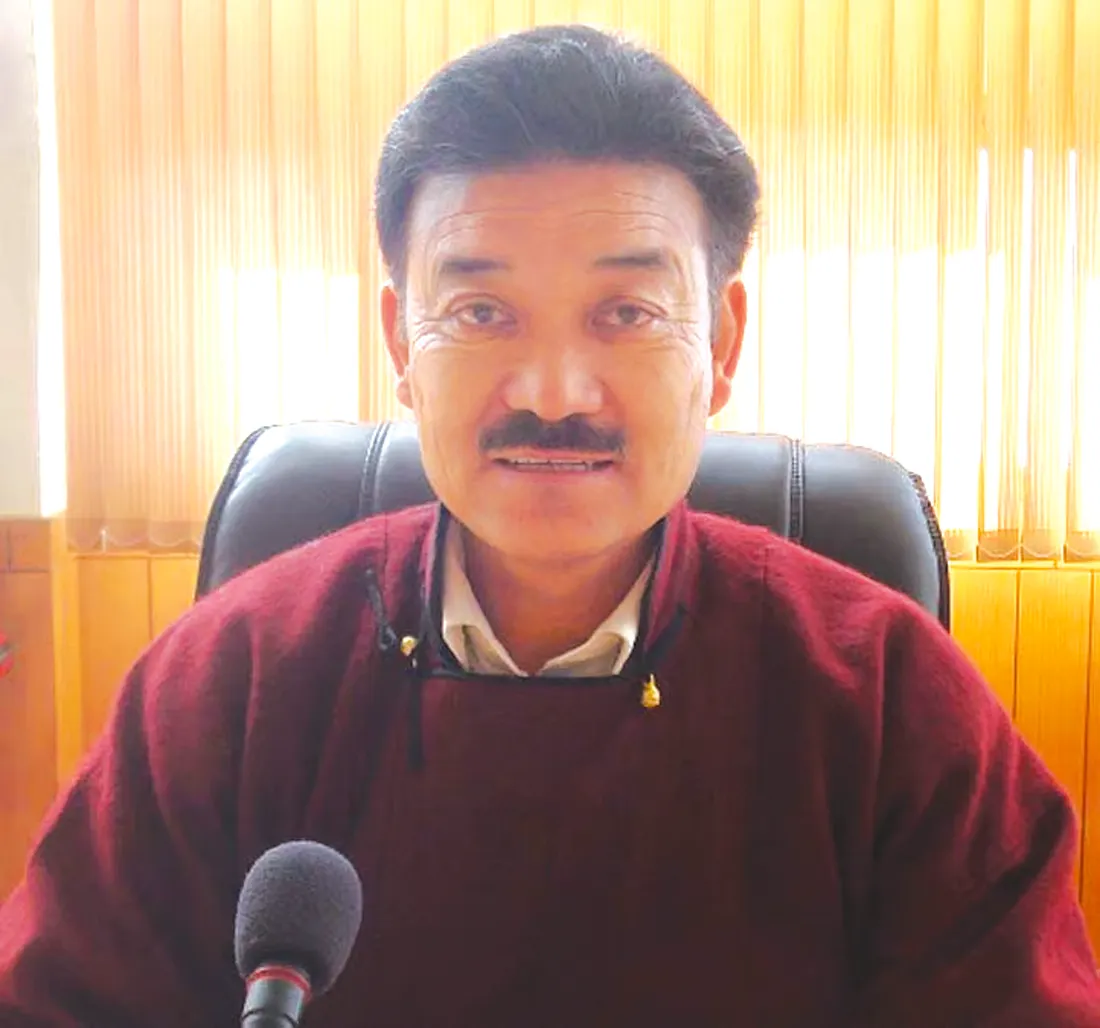
LEH: Former Chairman and Chief Executive Councillor of the Ladakh Autonomous Hill Development Council (LAHDC), Leh, Rigzin Spalbar on Wednesday welcomed the reported in-principle consensus reached on constitutional safeguards for Ladakh but expressed strong concern over the exclusion of provisions for creating Autonomous District Councils (ADCs) for the proposed districts in the evolving framework.
In a statement, Spalbar appreciated the efforts of the Government of India, the Apex Body, the Kargil Democratic Alliance (KDA) and other stakeholders for moving towards a consensus on the long-pending demands of Ladakh. He said the development reflected the Centre’s commitment to addressing the aspirations of the people of the Union Territory.
However, he objected to the reported deletion of the provision for establishing Autonomous District Councils for the intended districts during the July 3 meeting held in Leh with the Chief Secretary of the Union Territory of Ladakh and the Additional Secretary, Ministry of Home Affairs.
Spalbar said the reported omission had disappointed people in Leh, Zanskar, Drass, Sham, Nubra, Changthang and other remote areas, who had consistently supported the movement for constitutional safeguards.
Reiterating his long-standing support for extending Sixth Schedule protections to Ladakh, he maintained that grassroots empowerment and protection of land, culture and identity have remained central to the region’s demands.
Explaining his position, Spalbar argued that Autonomous District Councils are indispensable for strengthening local self-governance by transferring decision-making powers to tribal and local communities. He said Ladakh’s vast geographical expanse, difficult terrain, scattered population and challenging weather conditions make decentralised governance essential, adding that a single administrative structure cannot effectively address the diverse developmental needs of different regions.
He further contended that elected district councils would promote equitable distribution of resources, reduce bureaucratic delays and political interference, and safeguard the land, language, culture and employment opportunities of tribal communities while contributing to long-term communal harmony in the strategically located border region.
Describing the exclusion of ADCs as inconsistent with the objective of constitutional safeguards, Spalbar said it would be illogical to seek legal protections for Ladakh without creating institutions capable of implementing those safeguards at the grassroots level.
He urged the Government of India to begin drafting the proposed Ladakh safeguards framework in consultation with representative bodies of the region and called for the inclusion of provisions for Autonomous District Councils for the intended districts in accordance with public aspirations.
Stating that Ladakh requires a governance model suited to its distinct geography, demography and Himalayan character, Spalbar expressed hope that the Centre would reconsider its position and incorporate the provision for Autonomous District Councils into the final constitutional safeguards framework for the Union Territory.