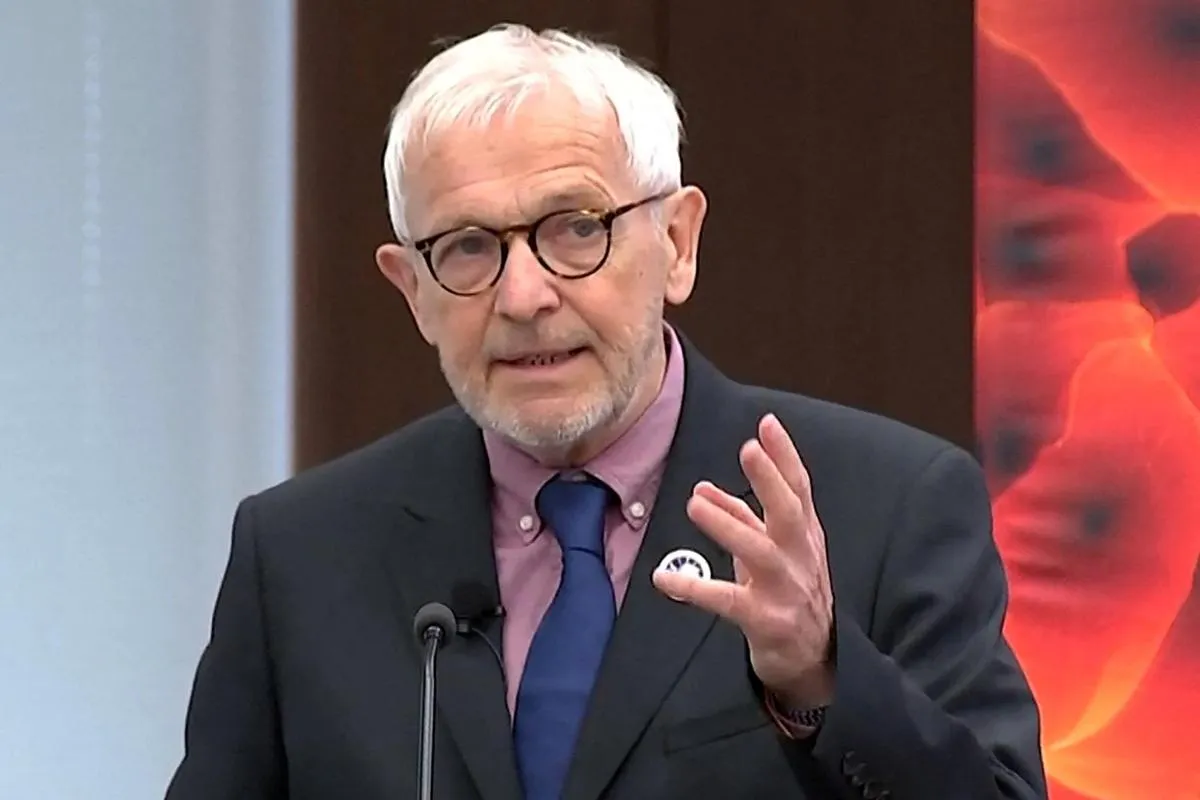
STOCKHOLM: Belgian-American particle physicist Francis Halzen won the 2026 Nobel Prize in Physics for his work creating an observatory to detect some of the universe’s most elusive particles – high-energy neutrinos – and trying to establish how they are made.
Halzen, 82, realised that ice at the South Pole could be used to track neutrinos, sometimes known as “ghost particles” for the way they pass through the Earth and our bodies without a trace, and only interact with matter extremely rarely.
“The messengers bring information from the cosmos,” Eva Olsson, of the Royal Swedish Academy of Sciences, told a press conference. “They open the door to distant galaxies and tell us about the processes of exploding stars.”
The neutrino interactions collected by the IceCube observatory in Antarctica provide information about how high-energy neutrinos are created and may even reveal previously unknown phenomena, the Academy said.
In 2014, the US-based Smithsonian magazine dubbed Halzen “Neutrino Man” when giving him one of its Ingenuity Awards, acclaiming him for an “amazing experiment (that) heralds the beginning of a new era in astronomy”.
It even published a comic illustrating his life: “How One Physicist’s Pursuit of the Cosmos Took Off in Antarctica”. The particle detector is set in a cubic kilometre of pristine Antarctic ice, which extends to a depth of 2,500 metres below the surface, near the Amundsen-Scott South Pole Station.
The observatory searches for the nearly massless high-energy neutrinos in the hope of tracing their paths back to exploding stars, gamma-ray bursts, and cataclysmic phenomena involving black holes and neutron stars. It can expect to register about one per day.
Halzen first presented his idea for capturing neutrinos, which unlike other particles do not lose energy or change direction, at the South Pole in 1988, winning over others to a project that was eventually completed in 2011.
“I have to emphasise how lucky I was because, when we started this project, everybody realised this was maybe a good idea, but very few thought it would work, including myself,” Halzen told the press conference by telephone.
Neutrinos are electrically neutral, undisturbed by even the strongest magnetic field, which means that, in contrast to electromagnetic waves such as visible light, the direction from which they arrive points directly back to their source.
The icebound observatory has been able to determine that high-energy neutrinos originate within but also far outside our own galaxy, setting in motion an interstellar quest to find the objects and processes that create them.
Halzen, a professor at the University of Wisconsin–Madison in the United States, said the main fruits of his discoveries were yet to be enjoyed and that it was too early to say exactly what could be learned about the universe through his method. “The real excitement is that I cannot answer that question yet,” he said. “This is just an introduction to the science, the astronomy is still to come.”