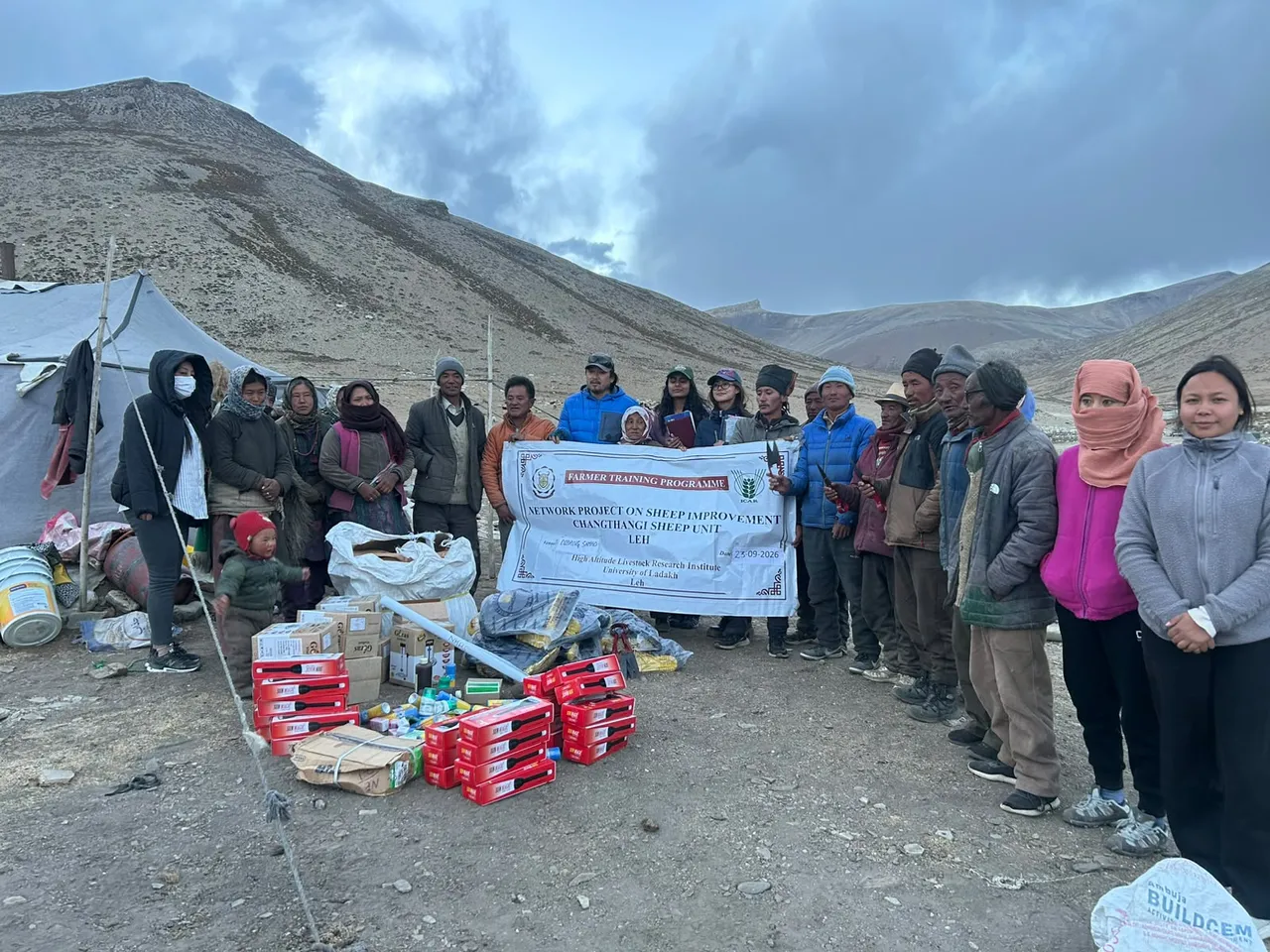
LEH: A team of scientists from the High-Altitude Livestock Research Institute (HALRI), University of Ladakh, conducted a five-day field outreach programme in Changthang, providing livestock management training to pastoral communities and assessing degraded pasturelands for possible restoration.
Led by Dr Feroz Din Sheikh, Professor and Chief Scientist and Principal Investigator of various projects, the team visited Kharnak, Samad, Angkung, Hanley and Chumathang, where it interacted with livestock farmers, nomadic pastoralists and local communities.
The programme focused on improving animal health, nutrition, breeding, husbandry practices and livestock productivity under the challenging high-altitude conditions of Changthang. Technical guidance was provided under the All India Coordinated Research Project on Goat (AICRP-CG) and the Network Project on Sheep Improvement (NWPSI).
The team also conducted field visits under the Pasture Development Project of the National Mission on Himalayan Studies (NMHS) to identify and make preliminary assessments of degraded pasturelands that could be considered for restoration.
During the field visits, soil and pasture grass samples were collected from different locations for scientific analysis. The studies are expected to provide information on soil characteristics, pasture quality and forage availability, and help assess the scope for improving degraded grazing areas through appropriate interventions.
Scientists also held need-based training and discussions with nomadic pastoralists on the conservation and sustainable use of high-altitude pasture resources. Particular emphasis was placed on preserving native pasture grasses, which are an important source of livestock feed in Changthang.
The interactions also allowed the scientific team to understand challenges faced by pastoral communities at the field level and discuss practical solutions suited to local conditions.
As part of HALRI’s outreach and technology-transfer initiatives, the team distributed modified Pashmina combs, hand torches, butter churner machines, gumboots, wool-clipping scissors and veterinary medicines among nomadic communities.
The inputs were provided under institute projects including the AICRP on Pashmina and the Network Project on Changthangi Sheep, with the aim of supporting animal care, Pashmina harvesting, wool management, dairy processing and routine livestock husbandry.
The field programme sought to strengthen the link between scientific research and traditional pastoral practices in Changthang, with the scientific team encouraging the adoption of improved livestock management practices alongside conservation of the region’s livestock resources and fragile high-altitude pastures.
The outreach programme also reflected HALRI’s efforts to take research-based technologies and livestock management practices directly to remote pastoral communities in Ladakh.
Such field-based interventions are expected to support livestock productivity and pastoral livelihoods while promoting sustainable management and conservation of Changthang’s pasture resources and wider high-altitude ecosystem.