*Gitanjali Angmo alleges administrative obstruction, says six unanswered letters delayed school approvals; Wangchuk calls action a “witch-hunt”
LEH: The Himalayan Institute of Alternatives, Ladakh (HIAL), has strongly contested a notice issued by the UT Administration seeking suspension of activities at its newly established Desert Flower School, alleging that the action is based on administrative confusion, contradictory interpretations of approval requirements and a land dispute in which the High Court has already passed an interim order in its favour.
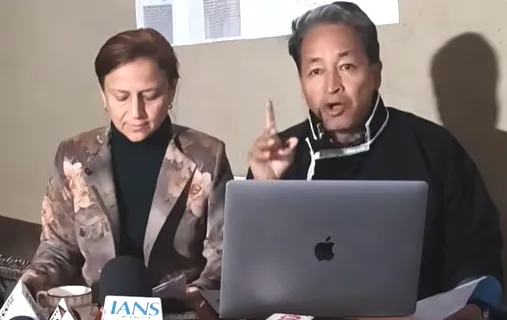
Addressing a press conference, HIAL CEO and Founder Gitanjali J. Angmo, accompanied by HIAL Founder Sonam Wangchuk, said the notice, delivered on November 2, directed the institution to halt activities at Desert Flower School, citing two grounds: alleged absence of requisite approvals and the pending litigation concerning the land on which HIAL is operating.
Angmo termed both grounds unjustified and presented documents to support the institution’s position, alleging that the administration had failed to resolve issues despite repeated correspondence over several months.
On the land issue, Angmo said the Deputy Commissioner’s office had issued a notice in August last year questioning the non-execution of the lease deed and seeking the return of the land to the government after eight years.
She maintained that HIAL had made repeated efforts to execute the lease, including writing five letters, making numerous visits to government offices and holding several telephone conversations. However, the lease policy and necessary documentation had not been finalised by the administration.
According to Angmo, the Deputy Commissioner’s office and the Assistant Commissioner Revenue had subsequently provided written assurances that several institutions, including government institutions, were yet to execute their lease deeds and that HIAL could continue construction after receiving a No Objection Certificate.
She said these assurances enabled HIAL to secure funding from donors and public sector undertakings after due diligence, resulting in the construction of approximately 2.5 lakh square feet of passive-solar-heated infrastructure on the campus.
Angmo further stated that HIAL approached the Jammu and Kashmir High Court in September 2026 after the land-related issues remained unresolved despite assurances that they would be addressed.
Referring to an order dated September 11, she said the High Court had observed that the delay in executing the lease deed was attributable to the respondents, namely the UT Administration, despite repeated reminders from the petitioner.
She said the court had restrained the administration from creating third-party rights over the land and allowed HIAL to continue its existing activities until disposal of the case. Angmo argued that the administration could not use the pendency of the case as a justification for stopping the institution’s activities when the court had specifically protected the existing position.
On the second objection concerning regulatory approvals, Angmo alleged that the institution had been caught between conflicting interpretations of the requirements under SRO-2010.
She explained that HIAL had initiated the process in September by approaching the Director of School Education for submission of Form A. However, the Director reportedly asked the institution to obtain an NOC from the Deputy Commissioner certifying that members of its managing committee were non-political.
Questioning the requirement, Angmo said the relevant provisions referred to the managing committee not being composed exclusively of family members and did not prescribe that its members must be non-political.
She said the Deputy Commissioner’s office maintained that no such NOC was required, while the School Education Department insisted on it, leaving the institution caught between two government offices.
Angmo stated that she had written six letters to the concerned authorities since September, including a reminder on October 30, but had received no conclusive response. She also alleged that the required application concerning the managing committee had been pending with the Deputy Commissioner since September 22.
Questioning the timing of the notice, she said it was prepared on November 1, a Sunday, and delivered on November 2, just as the school had commenced its academic activities.
According to Angmo, the registration process had already been initiated, while the final approval was to follow inspection of the school’s infrastructure, classrooms, furniture, teaching staff and other facilities after commencement of operations.
She said HIAL had no objection to the authorities inspecting the school and completing the approval process, but demanded that the administration first clarify the contradictory requirements and respond to its pending correspondence.
Emphasising the implications of the notice for students and parents, Angmo disclosed that 46 children had enrolled in the kindergarten section of Desert Flower School. She said parents had been waiting for nearly two years for the school to become operational, while teachers selected earlier had also been waiting for an opportunity to join the institution.
The school building, whose construction began in 2023, had been completed last year. However, its opening was postponed following the events of September 24, 2025, and the institution eventually decided to commence its academic session on November 2, 2026.
Angmo said parents had submitted representations to the administration, including the Divisional Commissioner and Deputy Commissioner’s offices, urging the authorities not to interfere with the functioning of the school. She claimed that parents had also assessed the school’s facilities and rated them highly, with around 90 per cent giving it a rating of 10 out of 10.
Calling for an independent assessment, she challenged the administration to constitute an inquiry commission to evaluate the infrastructure and facilities of schools across Ladakh on uniform parameters. She said the institution was grateful to parents, teachers and local supporters who had stood by the school despite the uncertainty created by the notice.
Clarifying the institutional structure, Angmo said Desert Flower was part of HIAL and not a separate initiative or a continuation of SECMOL. She explained that HIAL was developing nine schools and departments based on Ladakh’s geographical, ecological and cultural context. These include the School of Ecoresponsive Architecture, School of High Altitude Ecology, School of Tourism, School of Energy Studies and School of Experiential Education.
Desert Flower falls under the School of Experiential Education and is envisioned as a teacher-training institution alongside a school that will eventually cater to students from kindergarten to Class 12. The current academic session has begun with pre-primary classes for children aged three, four and five years.
Angmo said the school would eventually have a residential model, although young children would continue to live with their parents rather than in hostels. She also clarified that Desert Flower, like HIAL and SECMOL, operates on a not-for-profit basis, with resources reinvested in improving educational facilities rather than distributed as profit.
Joining the issue, Sonam Wangchuk described the action against HIAL and Desert Flower as part of what he termed a wider “witch-hunt” against individuals and institutions raising questions about the policies of the UT Administration.
He alleged that those questioning recent administrative decisions were being targeted, particularly after Lieutenant Governor Vinai Kumar Saxena assumed office.
Wangchuk linked the developments to criticism raised by him and others on several policy issues, including liquor and bar regulations, tourism policy, Nautor land rules and environmental projects involving the Indus River.
Referring to the ongoing protests by women’s organisations against liquor and bar policies, he alleged that the administration had made it easier to obtain licences for liquor establishments while creating unnecessary hurdles for educational institutions.
He contrasted what he described as the reduction in liquor-related documentation requirements with the demand for an additional NOC for the school’s managing committee, which he said was not prescribed under the applicable rules. “Schools are being stopped while liquor is being promoted,” was the thrust of his criticism of the administration’s approach.
Wangchuk also questioned the implementation of rock-dam projects along the Indus River, alleging that some structures had failed and were causing damage to riverbanks and the surrounding environment. He said HIAL’s criticism of these policies, rather than any genuine regulatory concern, appeared to have triggered the action against the institution.
Describing HIAL as an internationally recognised initiative, he referred to its work being featured in TIME magazine’s TIME100 Solutions and its educational pedagogy being showcased at the Victoria and Albert Museum in London. He also cited appreciation received from the University Grants Commission leadership and a Parliamentary Committee for HIAL’s educational model.
Wangchuk challenged the Lieutenant Governor and senior officials to establish an institution comparable to Desert Flower within five years, arguing that the administration should facilitate innovative educational initiatives instead of obstructing them.
During the interaction, Wangchuk was also asked about allegations concerning the commercial sale of liquor by members of his family, particularly in the context of his opposition to the administration’s liquor policy.
Responding to the issue, he clarified that the matter concerned an earlier entrepreneurial experiment by his brothers involving apple wine, undertaken with encouragement from the then administration. He said the initiative was intended to explore the potential of local fruit-based products and that the family had applied for the necessary permissions and paid the prescribed fees.
However, after the departure of the then Excise Commissioner, the initiative reportedly failed to receive the expected encouragement and remained limited to a trial involving a few batches. Wangchuk maintained that the experiment was not pursued commercially thereafter. He further clarified that both SECMOL and HIAL campuses were completely vegetarian and non-alcoholic.
Rejecting attempts to involve family members in the controversy, he said the issue should not be allowed to divide Ladakhis and urged the administration to concentrate on governance rather than personal allegations.
Angmo said HIAL had already submitted its reply to the notice issued by the Tehsildar, with copies forwarded to the concerned Divisional Commissioners and other authorities.
She maintained that the school would continue its activities, subject to the directions of the court, and said the next hearing in the land-related matter was scheduled for December 7 before the High Court of Ladakh. She asserted that the administration could not independently intervene in a matter already before the court and that HIAL would abide by whatever final decision the judiciary takes.
Demanding a written response to the six letters submitted since September, Angmo said the administration must either clarify the approval requirements or communicate its position formally. She said the institution was not seeking any exemption from applicable laws but wanted clarity, consistency and timely decisions from the concerned departments.