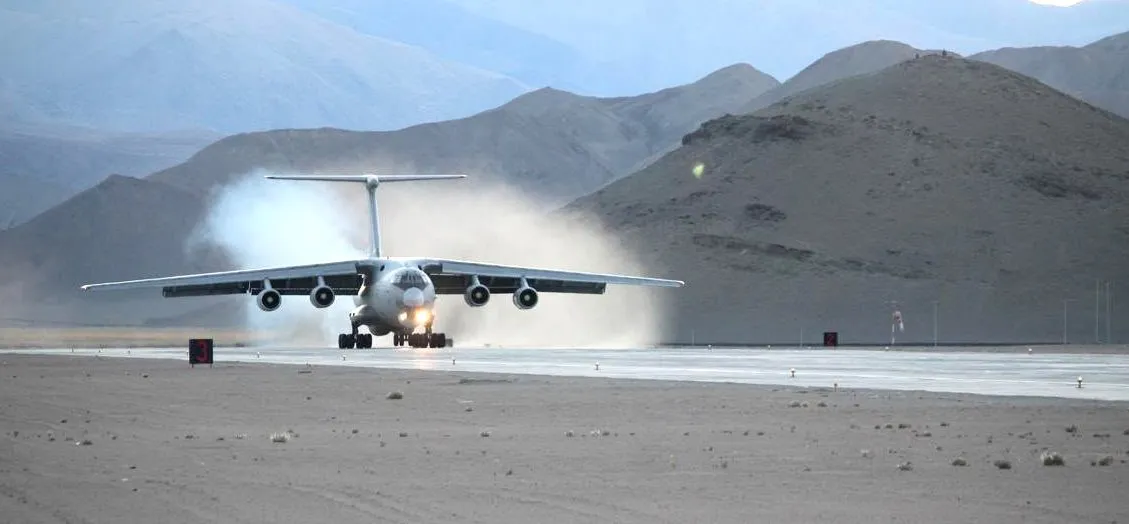
LEH: In a major boost to India’s strategic airlift capability along the China border, the Indian Air Force (IAF) has scripted a new chapter in aviation history by successfully landing its massive IL-76MD heavy-lift transport aircraft, popularly known as ‘Gajraj’, at the newly developed Mudh-Nyoma airbase in eastern Ladakh at an altitude of 13,629 feet.
The historic touchdown, announced by the Indian Air Force on Saturday, marks the highest-altitude landing ever achieved by an IL-76MD aircraft anywhere in the world, establishing a significant operational milestone for India’s military aviation capabilities in one of the most challenging high-altitude environments.
The achievement is particularly significant as Nyoma, situated in the strategically sensitive eastern Ladakh region, is close to the Line of Actual Control (LAC) with China. The successful operation demonstrates the IAF’s ability to deploy its heavy strategic transport aircraft at an exceptionally high-altitude forward airbase, substantially enhancing its capacity to move troops, military equipment and essential supplies closer to the northern frontier.
Announcing the achievement through its official social media handle, the IAF described the landing as a “new height in aviation history”, highlighting the aircraft’s enduring operational capabilities and the exceptional skill, precision and professionalism of its crew.
“A milestone that reinforces India’s strategic airlift capability,” the IAF stated, adding that the achievement reflected its determination to continue pushing operational boundaries and redefining aviation limits.
The significance of the landing becomes clearer when viewed against the extraordinary challenges involved in operating a heavy transport aircraft at such elevations.
At 13,629 feet above sea level, the atmospheric conditions are considerably different from those encountered at conventional airfields. The reduced air density at high altitudes affects both engine performance and aerodynamic lift, making aircraft operations, particularly take-offs and landings, considerably more demanding.
For a four-engine strategic transport aircraft of the IL-76MD’s size and weight, operating from such an elevated airfield requires meticulous flight planning, precise handling and a high degree of coordination between the flight crew and ground personnel.
The successful touchdown therefore represents not merely an aviation record but also a demonstration of the operational readiness of the aircraft, the preparedness of the Nyoma airbase and the proficiency of the IAF personnel involved.
The Russian-origin IL-76MD, designated ‘Gajraj’ in the Indian Air Force, is among the country’s principal heavy strategic airlift platforms. Powered by four turbofan engines, the aircraft can transport approximately 40–45 tonnes of cargo, depending on its configuration and operating conditions.
Its ability to carry heavy military equipment, including tanks, armoured vehicles, artillery and other essential operational assets, makes it an important component of India’s military logistics infrastructure.
The aircraft has played a crucial role in transporting heavy military equipment and personnel to forward locations, particularly during periods of heightened military preparedness in Ladakh and other strategically important regions.
The record-setting landing also highlights the growing strategic importance of the Mudh-Nyoma airbase, which has undergone a major transformation from a relatively limited Advanced Landing Ground into a full-fledged military airfield capable of supporting fighter aircraft, transport planes and helicopters.
Located in the eastern part of Ladakh, Nyoma has long been recognised for its strategic importance because of its proximity to the Chinese border and its position in relation to sensitive areas along the LAC.
The decision to upgrade the existing airfield gained particular urgency following the 2020 India-China military confrontation in eastern Ladakh, which underscored the importance of strengthening forward infrastructure and ensuring the rapid movement of troops, equipment and supplies.
The Border Roads Organisation (BRO) undertook the development of the airfield under a strategically important infrastructure project involving the construction of a 2.7-kilometre runway and associated operational facilities.
According to information released by the Ministry of Defence, the Nyoma-Mudh airfield project was sanctioned at a cost of approximately Rs 219.39 crore in March 2023. The project was conceived to enhance the operational reach of the Indian Air Force in the Northern Sector.
The airfield was operationalised in November 2025, when then IAF Chief Air Chief Marshal A.P. Singh landed a C-130J Super Hercules aircraft there, marking a major milestone in the development of military aviation infrastructure in eastern Ladakh.
The latest IL-76MD landing takes the operational significance of the airfield several steps further by demonstrating its ability to accommodate a much heavier class of strategic transport aircraft.
The development carries considerable strategic implications for India’s defence preparedness in eastern Ladakh, where challenging terrain, extreme weather conditions and long distances have historically made military logistics particularly demanding.
The ability to operate heavy transport aircraft from Nyoma provides the armed forces with an additional option for moving personnel, equipment and essential supplies into the forward region.
It can potentially reduce dependence on lengthy surface transportation routes for certain categories of military logistics and provide greater flexibility in responding to operational requirements.
The significance is particularly pronounced in areas such as the Pangong Tso region, Demchok and Depsang, where maintaining adequate logistical support and operational preparedness remains essential.
The 2020 military standoff with China had already demonstrated the importance of strategic airlift operations. During that period, the IAF played a critical role in rapidly transporting thousands of troops, heavy equipment and military platforms into eastern Ladakh.
The latest achievement reinforces the importance of maintaining such capabilities and developing infrastructure that can support increasingly demanding military aviation operations in high-altitude border regions.
Nyoma’s operationalisation, followed by the landing of the IL-76MD, also represents a significant addition to the IAF’s network of military airfields in Ladakh, complementing existing facilities at Leh, Thoise and Kargil.
The achievement is also a testament to the growing importance of infrastructure development in Ladakh’s border areas, where military requirements and geographical challenges have necessitated sustained investment in advanced connectivity.
For decades, Nyoma remained a relatively modest landing ground, with operations largely limited to smaller transport aircraft and helicopters. Its transformation into an advanced airbase capable of supporting fighter aircraft and heavy transport operations reflects the scale of infrastructure development undertaken in the strategically important region.
The successful landing of the IL-76MD now demonstrates that the upgraded facility can support an aircraft with substantially greater payload capacity and operational requirements.
While the IAF has previously demonstrated its ability to operate transport aircraft at even higher elevations, including the C-130J landing at Daulat Beg Oldie at 16,614 feet in 2013, the Nyoma achievement is distinct because it establishes a new world record specifically for the IL-76 aircraft type.
The latest accomplishment, therefore, should not be confused with the highest-altitude aircraft landing overall. It is the highest-altitude landing ever achieved by an IL-76MD anywhere in the world.
For Ladakh, the successful operation marks another major milestone in the transformation of its strategic infrastructure, further strengthening India’s ability to maintain military preparedness and logistical reach along one of its most sensitive international frontiers.