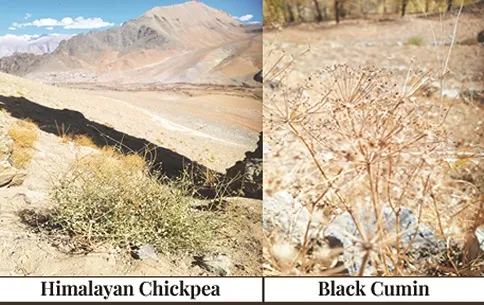
KARGIL: An ICAR scientist has explored and documented two valuable plant species — Himalayan chickpea and black cumin — in Batalik village of Ladakh’s Kargil district, highlighting their potential for climate-resilient agriculture, livestock fodder and traditional medicinal use.
The research team, comprising scientist Dr Prabakaran S from Tamil Nadu and senior technician Mohd Raza, studied Cicer microphyllum, commonly known as Himalayan chickpea, and Bunium persicum, or black cumin, in the remote mountainous region near the Line of Control (LoC).
Himalayan chickpea is a wild relative of cultivated chickpea (Cicer arietinum) and belongs to the Fabaceae family. The species is valued for potentially useful genetic traits, including cold and drought tolerance and resistance to other biotic and abiotic stresses. These traits could support efforts to develop crops better suited to challenging climatic conditions.
The plant also contributes to soil fertility by fixing atmospheric nitrogen through its root nodules. Locally, it is used as fodder for sheep and goats, adding to its value for pastoral communities.
The second species, black cumin, locally known as kala zeera, belongs to the Apiaceae family and is among the region’s prized culinary spices. Often referred to as “black gold” because of its high market value, it is also valued for its essential oil and traditional medicinal uses. Local communities have traditionally used it to relieve digestive discomfort.
The cold-arid climate of the region is associated with the spice’s distinctive flavour and aroma, enhancing its culinary appeal.
Situated at an altitude of approximately 9,009 to 9,035 feet, Batalik is known for its rugged terrain and strategic location. The area was a major battleground during the 1999 Kargil War, fought under Operation Vijay, and is home to the Brokpa community.