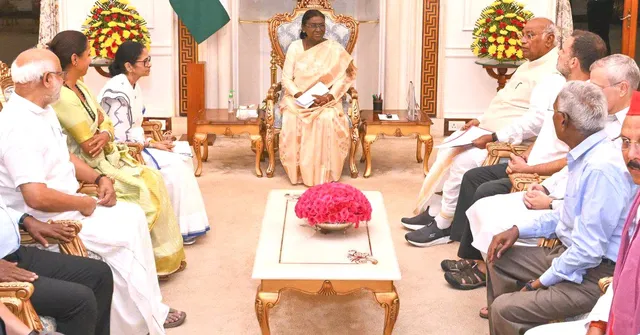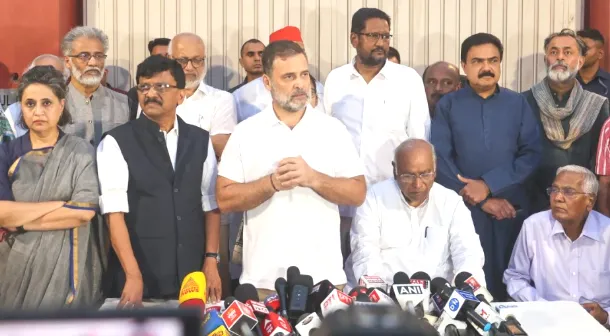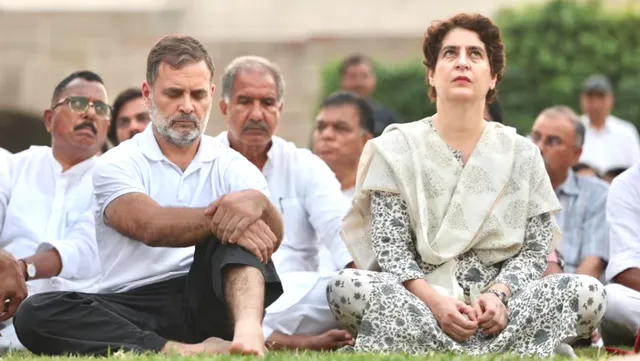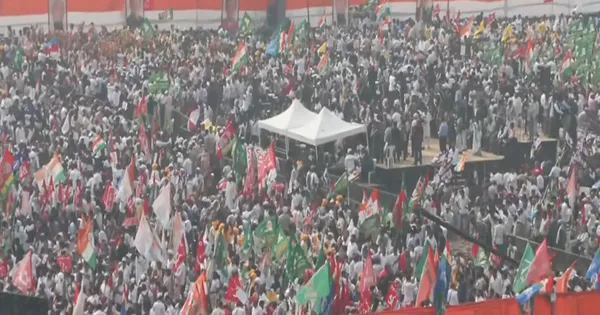
NEW DELHI: Leaders of the Opposition INDIA bloc on Sunday staged a major political rally at Delhi’s historic Ramlila Maidan, escalating their confrontation with the BJP-led Central Government and the Election Commission of India over alleged irregularities in the Special Intensive Revision (SIR) of electoral rolls.
Held under the banner of ‘Vote Bachao, Desh Bachao’, the rally brought together prominent leaders of several Opposition parties, including Congress president Mallikarjun Kharge, Leader of Opposition in the Lok Sabha Rahul Gandhi, Congress general secretary Priyanka Gandhi Vadra, Samajwadi Party chief Akhilesh Yadav, Trinamool Congress supremo Mamata Banerjee, National Conference president Farooq Abdullah and PDP president Mehbooba Mufti.
The principal demand of the gathering was the resignation of Chief Election Commissioner (CEC) Gyanesh Kumar, whom Opposition leaders accused of presiding over an electoral revision exercise that they claim has undermined the credibility and independence of the country’s electoral process.
The Opposition also demanded cancellation of the ongoing SIR exercise and advocated a return to paper-ballot-based elections, arguing that free and fair elections are fundamental to the survival of parliamentary democracy.
The rally represented a coordinated attempt by the INDIA bloc to turn its allegations of ‘vote chori’ into a wider political movement, bringing together national and regional parties under a common campaign focused on electoral integrity and democratic accountability.
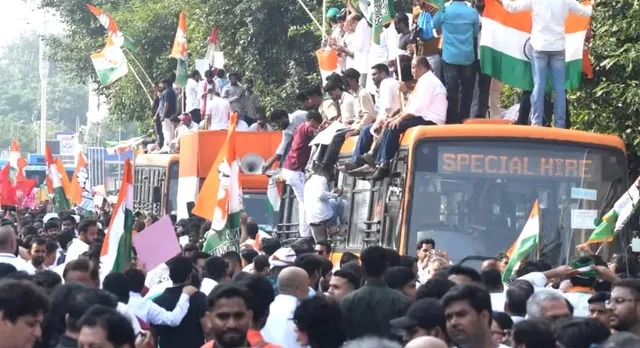
The rally followed a procession that began around noon from the Minto Road–Connaught Place junction. Several Opposition leaders travelled in an open vehicle, accompanied by party workers and supporters carrying national and party flags, placards and banners denouncing the Election Commission and the BJP government.
The procession was led by Rahul Gandhi and included leaders from the Congress, Samajwadi Party, Trinamool Congress, National Conference, PDP, CPI, CPI(M), CPI(ML) Liberation and other constituents of the Opposition alliance. The gathering at Ramlila Maidan swelled as the procession reached the venue around 1.30 pm. Thousands of supporters participated in the demonstration.
Addressing the gathering, Rahul Gandhi launched a direct attack on Prime Minister Narendra Modi, Union Home Minister Amit Shah and Chief Election Commissioner Gyanesh Kumar, alleging that the ruling establishment was manipulating the electoral process to retain political power.
He asserted that Gyanesh Kumar would eventually be removed from office and face legal consequences, warning that Modi and Shah would also be held accountable over the alleged electoral irregularities. “After Gyanesh Kumar, we will stand against you,” Gandhi said, asserting that legal action would follow over what he described as vote theft.
He accused the Election Commission of depriving citizens of their constitutional voting rights and described the alleged manipulation of electoral rolls as a betrayal of the nation. Gandhi maintained that the Opposition’s campaign was not merely against an individual office-holder but was aimed at defending the Constitution, democracy and the people’s right to elect their representatives.
He also reiterated that the Opposition would continue its agitation until accountability was established in the functioning of the Election Commission.
Congress president Mallikarjun Kharge described the gathering as a historic political mobilisation and accused the Prime Minister and Home Minister of attempting to steal the votes of women, youth and Dalits.
He declared that the Opposition would continue its political struggle until Gyanesh Kumar vacated the office of Chief Election Commissioner. Kharge alleged that the electoral process was being manipulated to determine the outcome of elections rather than allowing voters to freely exercise their democratic choice.
His address sought to position the SIR controversy as an issue affecting the voting rights of ordinary citizens rather than merely a dispute between political parties.
West Bengal Chief Minister and Trinamool Congress chief Mamata Banerjee strongly criticised the SIR exercise, alleging that West Bengal had become a victim of the process. She accused the Election Commission of undermining democratic rights and alleged that the electoral mandate in Bengal had been hijacked.
“We didn’t lose; we were made to lose,” she said, reiterating her party’s opposition to the exercise. Banerjee called upon people across communities and political affiliations to unite against the BJP, asserting that the Opposition would continue its fight to restore democratic accountability.
She also appealed to the judiciary and the media to play an active role in safeguarding democracy.
Samajwadi Party president Akhilesh Yadav described Ramlila Maidan as the “Haldighati of democracy”, asserting that the large gathering reflected growing public opposition to alleged electoral manipulation.
He claimed that the BJP was increasingly concerned about the deletion of voters’ names, including those of its own supporters, and alleged that the ruling party wanted only its supporters to remain on electoral rolls.
National Conference president Farooq Abdullah, addressing the gathering, rejected attempts to question the patriotism of Muslims and said the community had contributed to the country and would continue to do so.
PDP president Mehbooba Mufti also urged people to recognise what she described as growing threats to democracy and constitutional rights. She criticised the Government over its economic policies and alleged that national assets were being handed over to influential business interests.
RJD leader Tejashwi Yadav invoked the Mahabharata to describe the political confrontation, comparing the alleged manipulation of elections to the rigging of a dice game and calling for a united struggle against what he termed electoral wrongdoing.
The immediate trigger for the Opposition’s mobilisation has been the controversy surrounding the Special Intensive Revision of electoral rolls and allegations of irregularities in the deletion and verification of voters’ names. The Opposition has argued that the exercise risks disenfranchising genuine voters and disproportionately affecting marginalised communities and sections of the electorate.
The controversy gained further momentum following an Indian Express report concerning concerns reportedly raised by senior election officials over voter-list revisions, registration procedures and digital systems.
According to Opposition, the voter-roll revision has involved the removal of more than 130 million names, with Opposition parties alleging that the deletions have disproportionately affected Muslim voters and other minorities. The Election Commission, however, maintains that the exercise is intended to remove duplicate and ineligible entries, has denied political bias and said that voters whose names have been wrongly deleted can seek re-enrolment.
The Opposition has demanded greater transparency, accountability and safeguards to ensure that no eligible citizen is deprived of the right to vote.
The rally also triggered a sharp counter-offensive from the BJP, with senior party leader and Union Health Minister J P Nadda accusing the Congress and Rahul Gandhi of pursuing a political agenda under the cover of defending democracy.
Describing the demonstration as an “orchestrated drama”, Nadda alleged that the Opposition was attempting to create unrest, disrupt normal administrative functioning and destabilise an elected government.
He outlined what he termed a four-stage “anarchy model”, accusing the Opposition of spreading misinformation about elections, mobilising street protests, disrupting economic activity and ultimately attempting to destabilise the Government with alleged foreign support.
Nadda also questioned the timing of the rally, pointing out that November 1 marks the anniversary of the 1984 anti-Sikh riots that followed the assassination of former Prime Minister Indira Gandhi. He accused the Congress of insensitivity towards the Sikh community and said the party had failed to adequately address the atrocities committed during the riots.
The BJP also argued that the Opposition was undermining the credibility of constitutional institutions by questioning the Election Commission’s functioning without accepting the legitimacy of established electoral procedures.
The rally was held under extensive security arrangements, with more than 4,000 police personnel, Central Armed Police Forces contingents and over 200 CCTV cameras deployed to monitor the venue and surrounding areas, according to advance arrangements reported by The Tribune.
The venue was divided into 14 security zones, while surveillance arrangements included CCTV monitoring and other security measures.
Delhi Traffic Police had also announced restrictions and possible diversions across several important stretches of central Delhi, including Bahadur Shah Zafar Marg, JLN Marg, Minto Road and areas around ITO and Delhi Gate.
The November 1 rally is part of a broader INDIA bloc campaign against the SIR exercise and what the alliance describes as systematic erosion of electoral safeguards. The Opposition has been demanding the resignation of the Chief Election Commissioner, cancellation of the contentious revision exercise and a return to paper-ballot-based elections.
The gathering at Ramlila Maidan also followed a symbolic public impeachment programme against Gyanesh Kumar organised by Opposition leaders a day earlier, reflecting their decision to intensify the campaign both inside and outside Parliament.