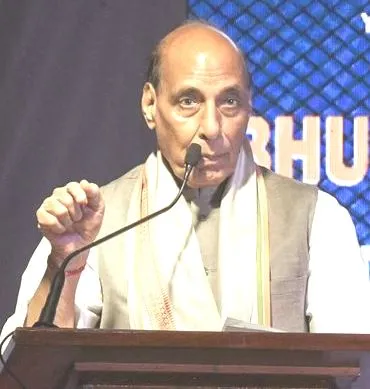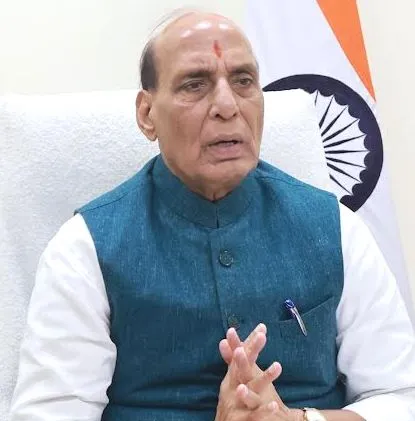
NEW DELHI: Defence Minister Rajnath Singh on Sunday called for transforming India from a user of advanced technologies into a developer, innovator and global leader in critical domains. He stressed the need to strengthen the country’s Non-Destructive Testing (NDT) ecosystem to boost defence preparedness and self-reliance.
Virtually addressing the 36th Annual Conference on Non-Destructive Evaluation & Enabling Technologies and the 15th International Symposium on Non-Destructive Testing in Aerospace—hosted in Hyderabad—Singh asserted that there can be no compromise on the accuracy, reliability and integrity of testing results in strategic applications.
“We must strengthen our indigenous capabilities in advanced inspection technologies, specialised sensors, evaluation equipment and associated software. Developing domestic capabilities in these areas is essential for reducing technological dependencies and securing critical defence supply chains,” Singh said.
He urged Public Sector Undertakings (PSUs), private manufacturers, start-ups and MSMEs to promote consistent, traceable quality assurance practices backed by robust standards and qualified professionals across the entire defence industrial ecosystem.
Explaining the role of NDT, the Defence Minister compared it to medical ultrasound and X-rays, noting that it enables the detection of internal defects in critical components without dismantling or damaging them. As Indian defence platforms—ranging from missiles and aircraft to naval vessels and spacecraft—grow increasingly sophisticated, he called for a cultural shift from merely identifying defects to actively preventing them by embedding quality at every manufacturing stage.
“Hidden defects can affect operational availability, increase maintenance requirements, reduce the service life of equipment, and, in critical situations, jeopardise mission success,” he cautioned.
Terming ‘Aatmanirbharta’ (self-reliance) in defence a strategic necessity rather than just an economic goal, Singh pointed to India’s strides in missile development, aerospace engineering, radar systems and the commissioning of the first indigenous aircraft carrier, INS Vikrant, as milestones of the nation’s expanding industrial prowess. He also lauded institutional initiatives like Innovations for Defence Excellence (iDEX) and the Technology Development Fund (TDF) for fostering experimentation and continuous technological upgrades.
Highlighting the ongoing digital shift in Non-Destructive Evaluation, Singh noted that Artificial Intelligence (AI), Machine Learning (ML), Robotics, Advanced Sensors, Digital Twins, and Predictive Analytics are revolutionising structural health monitoring by enabling faster, more consistent inspections and complex data analysis.
He urged stakeholders to intelligently integrate these digital tools with established inspection methods to create indigenous solutions capable of capturing international markets. Calling for a ‘whole-of-government and whole-of-ecosystem’ approach, Singh concluded that true innovation thrives when the government, industry, academia, and research laboratories collaborate toward strategic self-reliance.