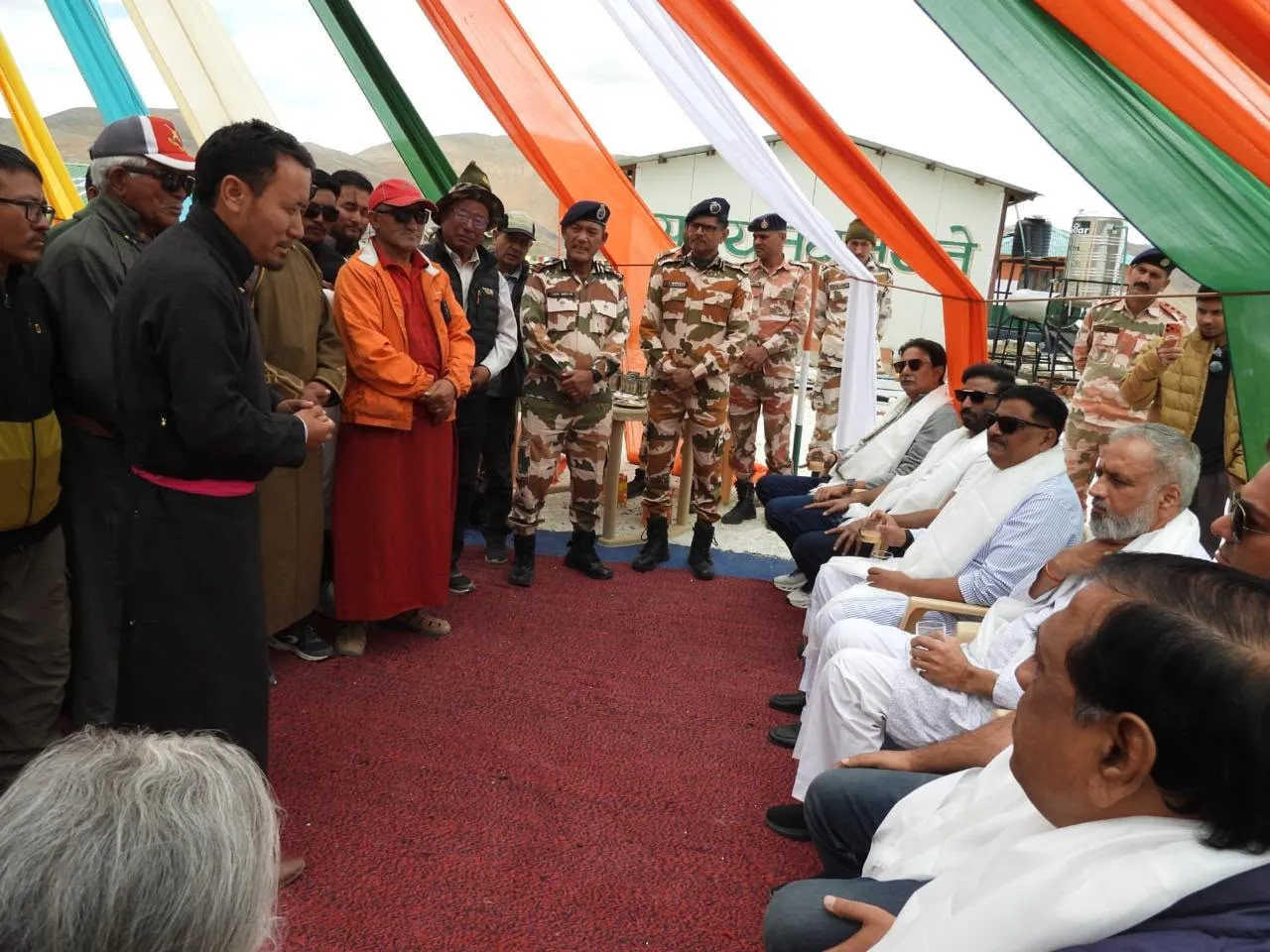
Konchok Stanzin led delegation seeks policy interventions on tourism, grazing rights, strategic infrastructure and cultural preservation.
PANGONG: Residents of the border villages of Maan Pangong A and B on Wednesday urged the Parliamentary Standing Committee on Tourism, Transport and Culture to recommend policy interventions addressing long-pending concerns over tourism, traditional grazing rights, border infrastructure and cultural preservation, arguing that sustainable development in frontier areas must go hand in hand with national security.
The demands were placed before the Committee during its visit to Pangong through a detailed memorandum submitted by former Ladakh Autonomous Hill Development Council (LAHDC), Leh, Councillor Konchok Stanzin on behalf of the border communities.
The delegation told the Committee that residents of Ladakh’s frontier villages have historically played an important role in supporting the Indian Armed Forces during the conflicts of 1962, 1971 and 1999, besides extending assistance during the India-China border standoff in 2020. It urged the Committee to recommend formal recognition of the contribution and sacrifices of border communities in national and regional war memorials.
A substantial part of the memorandum focused on livelihood concerns arising from restrictions under the Changthang Cold Desert Wildlife Sanctuary. The delegation sought suitable regulatory relaxations for genuine border residents to enable tourism-related activities and requested greater access to government incentive programmes, financial assistance and youth development schemes to promote sustainable economic opportunities in the region.
The residents also highlighted the difficulties faced by nomadic pastoralists following the loss of access to traditional grazing grounds after the 2020 border tensions. They proposed that controlled access to India’s traditional grazing areas be permitted in consultation with security agencies, contending that the continued presence of local pastoral communities in forward areas strengthens the country’s frontier management.
The memorandum further called for the preservation and restoration of traditional sheep pens, corrals and nomadic shelters located in forward areas, describing them as tangible evidence of Ladakh’s pastoral heritage and long-established patterns of habitation.
Seeking greater institutional support for the region’s cultural legacy, the delegation urged the Ministry of Culture to create dedicated funding for monasteries across Ladakh, noting their contribution to preserving the region’s religious traditions, education and cultural identity.
The delegation also flagged the condition of the strategically important Phobrang-Tsogtsallu Road and sought its transfer from the Ministry of Home Affairs to the Ministry of Defence, maintaining that such a move would facilitate improved funding for maintenance and upgradation while serving both defence logistics and civilian connectivity.
Reiterating another longstanding demand, the memorandum called for the rationalisation of the Changthang Cold Desert Wildlife Sanctuary boundary to strike a balance between environmental conservation and the traditional rights, livelihood needs and developmental aspirations of border communities.