Under new framework, all weights and measuring instruments used in trade or for consumer protection must conform to prescribed standards regarding accuracy, construction, performance and permissible limits.
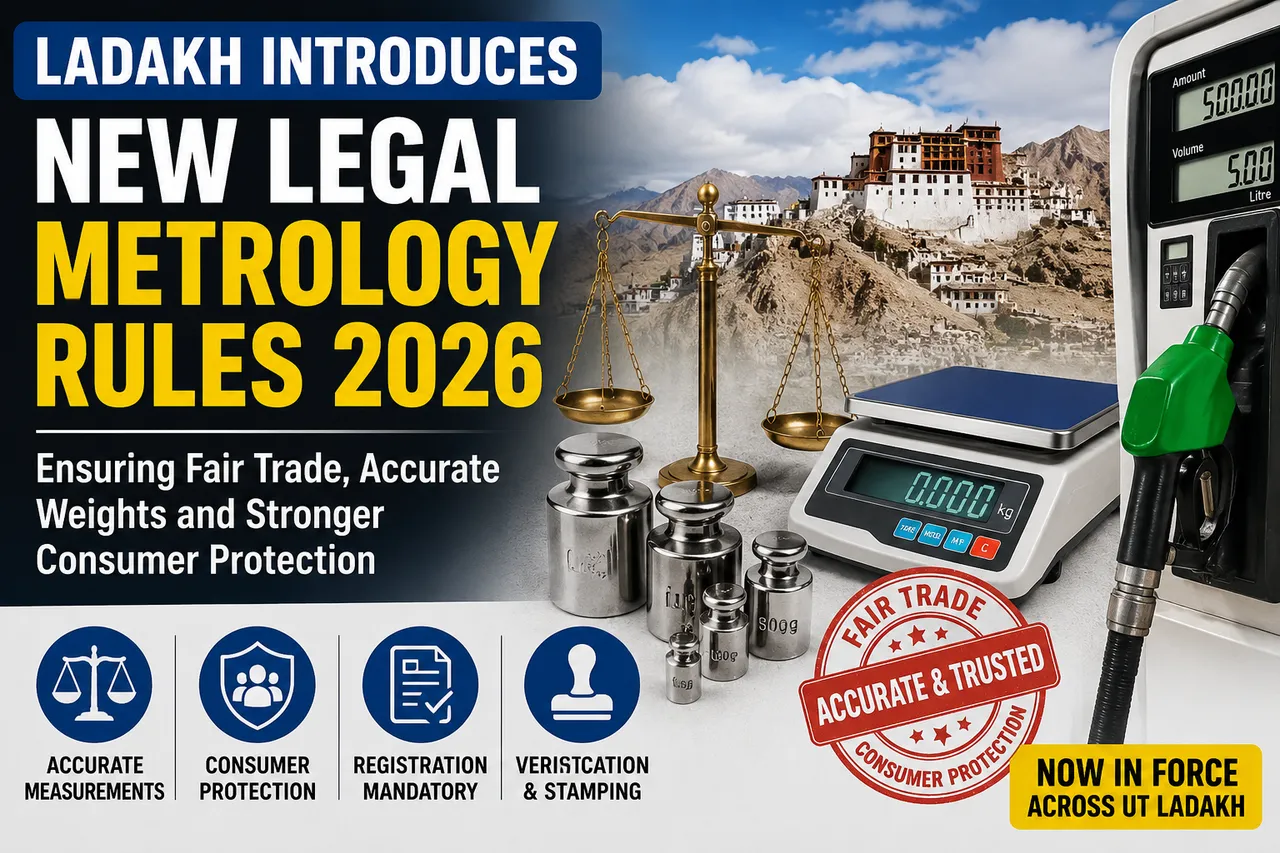
LEH: Strengthening consumer protection and ensuring transparency in commercial transactions across the Union Territory, the Administration of Ladakh has notified the Union Territory of Ladakh Legal Metrology (Enforcement) Rules, 2026 under the Legal Metrology Act, 2009. The new rules aim to regulate the use of weights and measures, prevent unfair trade practices and establish a robust mechanism for verification and enforcement throughout Ladakh.
The rules, notified by the Food, Civil Supplies & Consumer Affairs Department on July 7, 2026, have come into force from the date of their publication in the Official Gazette and will apply across the entire Union Territory of Ladakh.
Under the new framework, all weights and measuring instruments used in trade or for consumer protection must conform to prescribed standards regarding accuracy, construction, performance and permissible limits as laid down under the Legal Metrology Act and the Ladakh rules.
The new rules make it mandatory for manufacturers, repairers and dealers of weights and measures to obtain registration from the Controller of Legal Metrology, UT Ladakh. The registration process will be based on self-declaration, with a one-time registration provision and no requirement for renewal.
Registered entities will have to maintain prescribed records, registers and submit periodic reports as specified by the authorities. They will also be required to display their registration certificates prominently at their business premises. The registration fee has been fixed at Rs 5,000 each for manufacturers, repairers and dealers of weights and measures.
The rules provide for regular verification and stamping of weights and measures by Legal Metrology Officers or authorised testing centres. Any instrument used for commercial transactions must be verified and stamped within the prescribed period to ensure accuracy.
In cases where instruments cannot be moved, such as large weighing machines or fixed equipment, verification will be carried out at the place of installation after prior intimation to the Legal Metrology Officer. The verified instruments will carry official stamps indicating the year and quarter of verification, while certificates of verification will be issued to users.
The rules introduce strict standards for transactions involving precious metals and stones. Only approved bullion weights, carat weights and high-accuracy weighing instruments can be used for such transactions. Sellers of gold and precious items must mention purity in terms of “Karat”, along with net weight and price details, in cash receipts.
Petrol pump operators will also be required to maintain verified measures of 2, 5, 10 and 20 litres to check fuel delivery accuracy on a daily basis. In case of short delivery, the dealer must stop the pump operation and inform the Legal Metrology Officer for recalibration.
The rules empower Legal Metrology Officers to inspect weighing instruments, seize non-compliant equipment and take action against violations. Traders using weights and measures will also be required to provide bills or receipts mentioning quantity and amount charged to consumers.
Any violation of provisions where separate punishment is not provided under the Act may attract a fine up to Rs 5,000. The Administration has also laid down qualifications and training requirements for Legal Metrology Officers to ensure professional enforcement of the rules across Ladakh.
With the implementation of the new Legal Metrology framework, residents of Ladakh are expected to benefit from more transparent markets, accurate measurements and stronger safeguards against unfair trade practices. The move marks an important reform towards building consumer confidence and improving regulatory standards in the rapidly developing Union Territory.