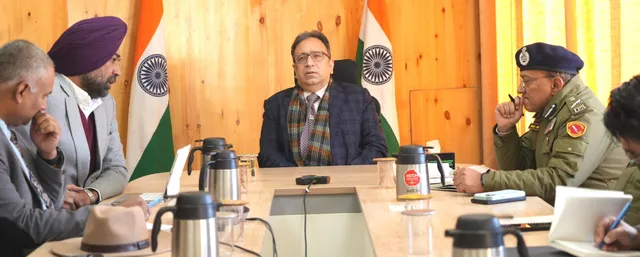
AgriStack initiative to integrate Farmer IDs, land records and crop survey data; district panels tasked with identifying gaps and developing technology-driven solutions for farmers
LEH: In a step towards digitising its agricultural sector, the Union Territory Administration of Ladakh has set in motion an exercise to build an integrated digital information framework covering farmers, agricultural land holdings and crop-related data, with a focus on improving the delivery of government services and making agricultural planning more evidence-based.
The Agriculture Department has constituted a State-Level Task Force and District-Level Task Forces across all districts under the AgriStack initiative, assigning them the responsibility of identifying gaps in existing agricultural databases, integrating land records with digital crop survey information and developing practical technology-based solutions to address farmers’ needs.
The move assumes significance as the exercise goes beyond digitising records to exploring how verified farmer and farm-related information can be used for targeted delivery of government schemes, agricultural credit, crop planning, insurance, market access and other services.
A key component of the exercise will be ensuring comprehensive coverage of the Farmers’ Registry and Farmer IDs, alongside validation and integration of agricultural land parcels and Digital Crop Survey data. The task forces will identify inconsistencies and data gaps and assess how different databases can be integrated to create a reliable foundation for digital agriculture.
At the district level, the respective Deputy Commissioners will head the task forces, bringing together officials from Agriculture, Horticulture, Revenue, Rural Development, Planning, Public Health Engineering and NIC, besides representatives of NABARD, KVKs, the University of Ladakh and banking institutions.
The State-Level Task Force will be chaired by the Commissioner/Secretary, Agriculture and Horticulture Department, with the Administrative Secretaries of key departments, including Revenue, Finance, Information Technology, Rural Development and Social and Tribal Welfare, among its members.
The proposed framework also seeks to explore the application of Artificial Intelligence and other digital technologies in agriculture. Thematic areas identified for deliberations include personalised crop and farm advisories based on soil, weather, location and irrigation conditions; early detection of agricultural risks; improved crop insurance assessment; and better planning of agricultural production.
The task forces will also examine how integrated digital information can help map agricultural production, identify potential raw-material clusters, improve post-harvest infrastructure, strengthen cold-chain and logistics facilities and connect farmers and Farmer Producer Organisations with processors and buyers.
Importantly, the framework envisages using verified Farmer IDs and land/crop data to facilitate need-based access to agricultural inputs such as seeds and fertilisers, improve credit assessment and reduce repeated documentation for farmers seeking government benefits and services.
However, the effectiveness of the initiative will depend on the accuracy, completeness and regular updating of agricultural and land-related records, as well as their successful integration across departments. The order specifically directs the task forces to assess data quality, implementation feasibility, expected benefits and privacy and security safeguards before recommending individual applications.
The Agriculture Department will function as the nodal department, while the Revenue Department will provide land-record validation and NIC will extend technical support. The Joint Director/Head of Agriculture, along with the UT-level AgriStack Nodal Officer, will coordinate the exercise, monitor progress and consolidate proposals for submission to the Ministry of Agriculture and Farmers Welfare.
The initiative follows the Centre’s directions after the PRAGATI review of AgriStack held on August 25, 2026, which called for structured brainstorming beginning at the district level and progressing to the State/UT and national levels.
The task forces are expected to identify district-specific agricultural challenges, shortlist high-impact applications and submit thematic proposals to the Ministry. The broader objective is to develop implementable digital solutions that can subsequently be taken up for pilot implementation or wider adoption.
For Ladakh, where agricultural planning must account for distinct agro-climatic conditions, irrigation constraints, scattered settlements and geographically dispersed farming areas, the proposed integration of farmer, land and crop data could provide an important foundation for more targeted interventions. The actual benefits, however, will depend on how effectively the proposed digital framework is translated into accessible services and tangible improvements in farmers’ livelihoods.