Unasked Sixth Schedule commitment made during 2020 Hill Council polls a hit wicket for party; six years later, growing public discontent, stalled negotiations and winter election controversy confront BJP
YASH KHAJURIA
LEH: The Bharatiya Janata Party (BJP) is approaching the December 4 elections to all eight Ladakh Autonomous Hill Development Councils (LAHDCs) with an uncomfortable political question hanging over it: will the promises it made to secure electoral support in 2019 and 2020 now become its biggest political liability?
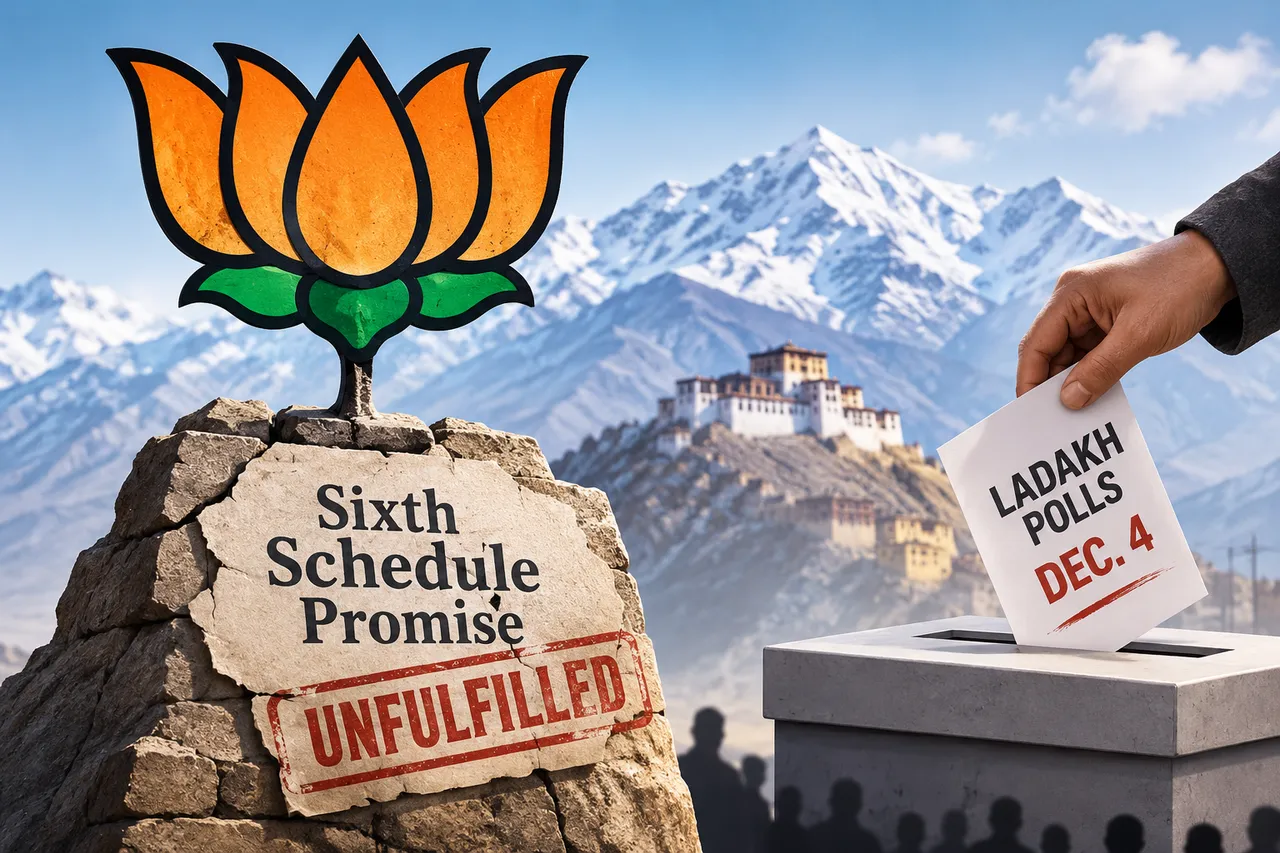
At the centre of the controversy is the BJP’s commitment to bring Ladakh under the Sixth Schedule of the Constitution, a promise that figured prominently in its 2019 Lok Sabha election manifesto and was reiterated during the 2020 LAHDC Leh elections. Six years later, the promised constitutional protection remains unfulfilled, while the demand for safeguards for land, employment, culture and identity has evolved into a sustained political movement across Leh and Kargil.
What makes the issue particularly consequential is that the BJP is being questioned not merely for failing to fulfil an expectation raised by its political opponents, but for not delivering on an assurance contained in its own electoral manifestos.
The commitment helped the party project itself as the political force capable of fulfilling Ladakh’s long-standing aspirations following the region’s separation from Jammu and Kashmir in 2019. However, the subsequent years have witnessed growing dissatisfaction over the absence of the promised constitutional safeguards and a broader demand for statehood and meaningful democratic representation.
The December 4 elections, therefore, are taking place against a political backdrop in which the BJP’s past assurances are likely to be revisited and its performance since 2019 placed under scrutiny.
The BJP’s 2019 Lok Sabha manifesto for Ladakh explicitly committed the party to pursuing the declaration of Ladakh as a tribal area under the Sixth Schedule of the Constitution. The promise was reiterated in the party’s October 2020 manifesto for the LAHDC Leh elections, which assured constitutional safeguards to protect Ladakh’s land, jobs, environment and distinct linguistic and ethnic identity.
The timing of these commitments is significant. They came when the region was undergoing a major political transition following the abrogation of Article 370 and the creation of Ladakh as a separate Union Territory.
The BJP projected the reorganisation as a historic opportunity for Ladakh’s development and political empowerment. The promise of Sixth Schedule protection further strengthened expectations that the region’s distinct demographic, cultural and ecological character would receive constitutional guarantees.
However, the passage of six years has not brought the promised Sixth Schedule status.
The National Commission for Scheduled Tribes had recommended in September 2019 that Ladakh be brought under the Sixth Schedule, citing the need to protect its distinct culture, land rights and traditional livelihoods. Yet the Centre subsequently pursued alternative administrative and constitutional arrangements rather than granting the specific status demanded by the region.
For the BJP, the political contradiction is difficult to overlook. A commitment that once served as an important electoral assurance has now become a recurring question about the credibility of its promises.
The party may highlight the development of infrastructure, creation of new districts and expansion of administrative institutions, but these achievements do not directly answer why the constitutional protection it repeatedly promised remains undelivered.
The failure to resolve the constitutional question has contributed to the emergence of a wider political movement, bringing together the Leh Apex Body (LAB) and Kargil Democratic Alliance (KDA).
The two organisations have consistently demanded Sixth Schedule status, statehood, protection of land and employment, and a democratically empowered legislature for Ladakh.
Their movement has also exposed the limitations of the existing governance arrangement, under which Ladakh continues to function as a Union Territory without an elected legislature. Repeated negotiations with the Ministry of Home Affairs have failed to produce an agreement acceptable to the regional representatives.
The October 15 round of discussions further exposed the differences between the Centre and LAB-KDA, particularly over the proposed constitutional framework under Article 371(K), the powers of a proposed elected legislature and the nature of safeguards to be provided.
While the Centre has explored an alternative constitutional arrangement, LAB and KDA have maintained that their fundamental demands cannot be diluted. The continuing deadlock has strengthened the political argument that the expectations generated in 2019 remain unfulfilled despite several years of negotiations.
For the BJP, this is particularly significant because the party’s political fortunes in Ladakh are inevitably linked to the performance and decisions of the Union Government, which is responsible for determining the region’s constitutional and administrative framework.
The BJP’s political difficulties are further compounded by the controversy surrounding the decision to hold the LAHDC elections during the peak winter season.
LAB and KDA have demanded postponement of the December 4 elections until April-May 2027, arguing that extreme temperatures, snowfall, road closures and seasonal migration could seriously affect voter participation, particularly in remote and snowbound areas.
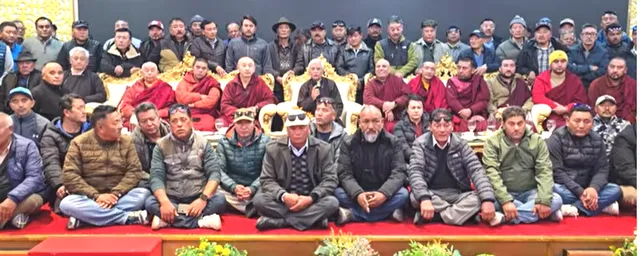
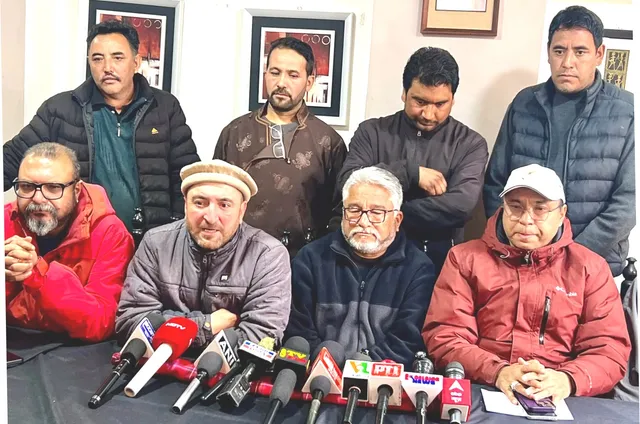
The demand has developed into an organised agitation. Kargil observed a complete shutdown on November 10 following a KDA call, while LAB began an indefinite dharna at NDS Memorial Park in Leh on November 12. The agitation subsequently witnessed hunger strikes by LAB leaders and supporters.
The organisations have also questioned the rationale of proceeding with elections when negotiations over Ladakh’s constitutional future remain inconclusive.
Climate activist Sonam Wangchuk has emerged as a prominent voice in the campaign for postponement, joining LAB and KDA leaders in appealing to the President, Prime Minister, Union Home Minister and Leader of Opposition Rahul Gandhi to intervene.
Wangchuk has cited the harsh winter and seasonal migration as major concerns, arguing that the timing could prevent a substantial section of the population from participating in the electoral exercise.
The controversy has placed the BJP in a politically sensitive situation, with the principal organisations spearheading the constitutional safeguards movement opposing the election schedule itself.
In an attempt to strengthen its organisational position, the BJP has brought several prominent regional leaders into its fold ahead of the elections.
The joining of former LAHDC Kargil CEC Dr Mohammad Jaffer Akhoon on October 31 is among the most significant developments. Previously associated with the National Conference, Akhoon joined the BJP following a prolonged political confrontation within the Kargil Hill Council over the power-sharing arrangement between the National Conference and Congress. He is now contesting from Sankoo.
In Leh, the BJP has placed considerable importance on former Lok Sabha MP Jamyang Tsering Namgyal, who has filed his nomination from Solar Colony.
The reported political realignment of former Chushul councillor Konchok Stanzin is another development that the party would seek to utilise in Changthang.
These developments indicate the BJP’s efforts to consolidate its political network across the expanded eight-council structure. However, the induction of influential individuals cannot automatically be equated with wider acceptance of the party’s political position.
The more fundamental question remains whether the BJP can convince voters that its approach to Ladakh’s political future is consistent with the assurances it made when seeking their support.
The party’s challenge is especially pronounced because several of the issues now being raised by LAB and KDA were already part of its own electoral commitments. The BJP is expected to highlight the creation of six additional districts and expansion of the Hill Council structure from two to eight councils, covering 100 constituencies, as major achievements.
The government has projected these measures as steps towards decentralisation and improved administrative access for people living in remote areas. However, administrative expansion and constitutional empowerment are two different questions.
The creation of additional districts may bring governance closer to the people, but it does not automatically provide the constitutional protection of land, employment and cultural identity sought by Ladakh’s representatives.
Nor does the expanded Hill Council arrangement fulfil the demand for a democratically empowered legislature at the Union Territory level.
This distinction is likely to remain a major point of political contention during the campaign. The BJP will have to explain why its earlier commitment to Sixth Schedule inclusion has not materialised and how the alternative arrangements being discussed would adequately address the concerns that originally prompted the demand.
The electoral landscape is further complicated by the absence of a pre-poll alliance between Congress and the National Conference in Kargil, the large number of Independent candidates and distinct political equations across the eight councils.
The BJP may seek to benefit from fragmented opposition forces and its organisational expansion, but the larger political debate cannot be reduced to conventional party arithmetic.
In Leh, the constitutional safeguards movement has significantly shaped public discourse, while Kargil has its own political alignments and concerns over representation and delimitation.
The December 4 elections will consequently take place in an environment where the BJP’s record since 2019 is likely to be an important subject of political debate.
The most striking aspect of the contest is that the party is now confronted with questions arising from promises it made when it was seeking votes. The Sixth Schedule commitment, which once helped strengthen its political appeal, has become an issue on which its opponents can challenge its credibility.
Promises made during electoral campaigns may generate immediate political expectations, but their long-term credibility depends on delivery. In Ladakh, the gap between the BJP’s assurances and the constitutional outcome has become increasingly difficult to ignore.
For a party that sought public support by promising constitutional protection, the December 4 elections present a particularly important test of its political credibility. The central question is no longer simply what the BJP promises for Ladakh’s future, but what it has delivered on the commitments made in the past.
The political consequences of that unanswered question are likely to remain central to the Hill Council election debate.