Three-year policy seeks to expand Changthangi goat population, improve fibre quality and revive pastoral economy; entire annual Pashmina production to be routed through cooperatives
YASH KHAJURIA
LEH: In a major intervention to safeguard Ladakh’s traditional Pashmina economy and strengthen the livelihoods of Changthang’s pastoral communities, the Union Territory Administration has introduced an additional financial incentive of 25 per cent on the value of raw Pashmina procured from eligible herders, with a mandatory provision requiring 60 per cent of the assistance to be reinvested in livestock development.
The Livestock Development Incentive Policy for Sustainable Pashmina Production, approved by Lieutenant Governor Vinai Kumar Saxena and notified by the Cooperative Department on September 10, 2026, marks a shift from conventional procurement-based assistance towards a structured model that links financial incentives with the health, productivity and genetic improvement of the indigenous Changthangi Pashmina goat.
Under the policy, eligible herders will receive an additional amount equivalent to 25 per cent of the applicable government-notified procurement value of their raw Pashmina, over and above the actual procurement price. The incentive will be calculated on the basis of the certified quantity and approved quality grade of the fibre and transferred directly into beneficiaries’ Aadhaar-linked bank accounts through Direct Benefit Transfer (DBT).
However, the assistance comes with a clear reinvestment obligation. Of the additional incentive, 60 per cent must be utilised for livestock development, 20 per cent for infrastructure improvement and only the remaining 20 per cent can be retained for personal consumption.
The prescribed allocation effectively makes the incentive more than an income-support measure, seeking to ensure that public financial assistance translates into tangible improvements in livestock management, animal health, Pashmina productivity and the infrastructure sustaining traditional pastoralism.
The livestock development component will cover better animal nutrition, supplementary feed, veterinary treatment, healthcare and overall herd upkeep. The infrastructure allocation can be used for improving livestock-related facilities and procuring better Pashmina-combing equipment to enhance fibre collection and yield.
In a significant condition governing access to the incentive, the Administration has made membership of recognised Primary Pashmina Cooperative Societies and exclusive marketing through the cooperative network mandatory.
Only bona fide residents of Ladakh engaged in Pashmina goat rearing and registered as active members of recognised Primary Pashmina Cooperative Societies affiliated with the Apex Cooperative Society will qualify.
More importantly, beneficiaries must market their entire annual production of raw Pashmina exclusively through the recognised cooperative procurement system. Herders who sell even part of their annual production independently or outside this network will not qualify for the incentive.
This provision seeks to bring Pashmina procurement under a more organised and traceable institutional mechanism, while strengthening cooperative societies as the principal link between pastoral households and the larger Pashmina market.
The quantity and quality of fibre will be verified, graded and certified under procedures prescribed by the Administration. The eligible procurement value will be assessed jointly by the Cooperative Department and Sheep Husbandry Department, with detailed quality-grading and valuation methodologies to be notified separately.
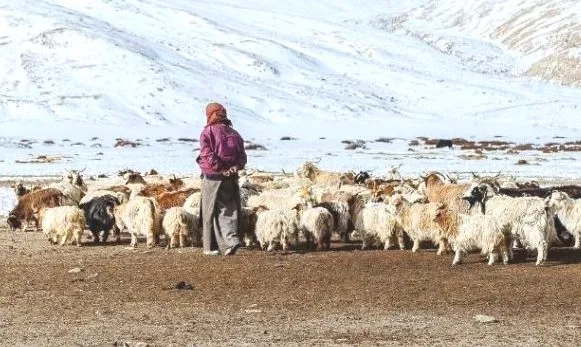
The policy identifies the deteriorating economic viability of traditional pastoralism as a major concern, pointing to rising costs of livestock rearing, expensive supplementary feed, veterinary medicines, transportation and labour, alongside shrinking grazing resources, harsh climatic conditions and fluctuating market returns.
These pressures, it acknowledges, have affected herders’ ability to invest adequately in animal nutrition, preventive healthcare, vaccination and scientific breeding, raising concerns over livestock health, mortality, reproductive performance and the quality of Pashmina fibre.
Against this backdrop, the Administration has set the objective of substantially increasing the population of healthy Pashmina goats over the next three years, while simultaneously improving fibre yield and the production of premium-quality raw Pashmina.
The emphasis on the indigenous Changthangi goat is particularly significant, given that the animal constitutes the biological foundation of Ladakh’s globally recognised Pashmina industry. The policy seeks to protect its genetic quality and improve its productivity without undermining the traditional pastoral practices and fragile ecology of Changthang.
Another important feature is the mandatory preparation of an Annual Livestock Development Plan by every recognised Primary Pashmina Cooperative Society for its member herders.
Prepared in consultation with the Cooperative and Sheep Husbandry Departments, these plans will assess existing livestock resources, identify development requirements and establish measurable annual targets.
The prescribed areas include livestock census and herd expansion, scientific breeding and genetic improvement, supplementary feeding, vaccination schedules, veterinary healthcare, mortality reduction, winter fodder reserves, improved livestock shelters and insurance coverage.
The plans will also incorporate capacity-building programmes, annual Pashmina procurement projections and digital record maintenance to ensure transparency and traceability. The Cooperative Department will approve these plans in consultation with the Sheep Husbandry Department and undertake annual performance reviews.
The Cooperative Department has been designated as the nodal agency for implementation, coordination and overall administration of the policy, while the Sheep Husbandry Department will provide technical support in livestock verification, breeding programmes, veterinary care, disease surveillance, quality assessment and monitoring.
Recognised cooperative societies will be responsible for beneficiary registration, procurement, quality grading, record maintenance, preparation of livestock development plans and submission of incentive claims. Following verification, the incentive will be released through DBT.
The expenditure will be met from the Cooperative Department’s budget under the appropriate subsidy head or any other budgetary provision notified by the Administration. The policy also envisages convergence with Central and UT Government schemes relating to livestock health, breeding, fodder development, insurance, rural livelihoods, skill development and value addition.
The policy will remain in force for three years across Ladakh, with its performance assessed annually against indicators including beneficiary households, procurement volumes, incentives released, growth in the Changthangi goat population, livestock mortality, kidding percentage, vaccination coverage, fibre yield and quality, and changes in household incomes.
The Administration has retained the flexibility to revise the incentive rate, eligibility conditions and quality-grading parameters or introduce additional performance-linked incentives following annual assessments. Assistance will remain subject to approved budgetary allocations and will not constitute a permanent or vested entitlement.
The policy’s larger significance lies in its attempt to address the structural challenges confronting Ladakh’s Pashmina economy rather than limiting government intervention to procurement prices.