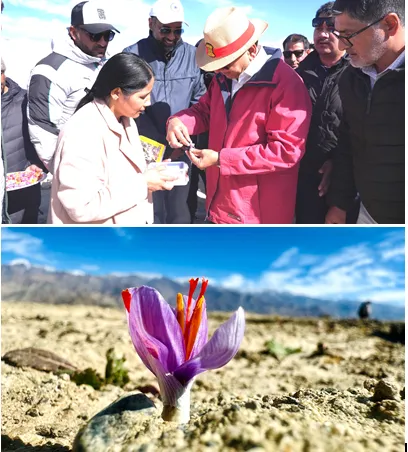
Lt Governor of Ladakh, Vinai Kumar Saxena, today visited the experimental saffron field in Leh to witness the first flowering and review the progress of the pioneering initiative
LEH: Ladakh’s high-altitude agricultural landscape has witnessed an encouraging development, with an experimental saffron cultivation project recording its first bloom in less than 30 days of plantation, significantly ahead of the approximately two-month period generally required for flowering.
Lieutenant Governor of Ladakh, Vinai Kumar Saxena, today visited the experimental saffron field in Leh to witness the first flowering and review the progress of the pioneering initiative, which is aimed at exploring the feasibility of introducing high-value saffron cultivation in the cold desert region.
During the inspection, the LG was informed that the field was currently recording an average of 20 to 25 blooming flowers daily, while a peak of 72 flowers was witnessed on the morning of November 1. The early flowering has also resulted in the collection of nearly 22 grams of pure saffron within just four days, marking an encouraging beginning for the experimental cultivation.
The pilot project involves plantation of nearly 800 kg of premium Iranian saffron corms, numbering approximately 90,000, across 4,000 square metres of land in Leh. Significantly, the site was previously barren and has recently been restored and rejuvenated under Project Him Sarovar, an initiative being undertaken under the guidance of the Lieutenant Governor.
The saffron corms were planted on October 1, and the emergence of the first flowers within less than a month has provided an early indication of the crop’s potential under Ladakh’s distinctive climatic and geographical conditions.
The initiative is part of the broader effort to diversify traditional agricultural practices and identify economically viable crops capable of generating additional income for farmers and creating new livelihood opportunities for local youth. It also aligns with Prime Minister Narendra Modi’s vision of promoting agricultural diversification, financial sustainability and economic empowerment in the region.
The experiment builds upon the UT Administration’s earlier initiatives in high-value floriculture, particularly the cultivation of Lilium and Gladiolus in Leh, which have opened new avenues for employment and entrepreneurship involving farmers, Self-Help Groups and local entrepreneurs.
Describing the early flowering as a significant achievement, LG Vinai Kumar Saxena said the development demonstrated the potential of Ladakh’s local environment for high-altitude farming and could lay the foundation for future commercial-scale saffron production.
He observed that the successful outcome of the pilot project could open new avenues for lucrative crop cultivation and agro-based entrepreneurship, contributing towards a stronger and more self-reliant local economy.
Saffron, one of the world’s most expensive spices, commands a premium market price and is considered a high-value agricultural crop with considerable income-generating potential. In India, Jammu and Kashmir remains the principal saffron-producing region, accounting for approximately 90 per cent of the country’s total production.
The introduction of saffron cultivation in Ladakh is therefore being undertaken as an experimental initiative to assess the crop’s adaptability to the region’s climatic conditions, flowering behaviour, productivity and long-term economic viability.
If the encouraging initial results are sustained through subsequent stages of cultivation and harvesting, the experiment could provide an alternative high-value agricultural option for farmers in Ladakh, while also opening possibilities for expanding the region’s horticultural and agro-based economy.
The Lieutenant Governor also appreciated the Agriculture Department officials and field staff for their technical expertise, dedication and contribution towards implementing the pilot project.
The early flowering, however, represents an initial milestone, with the crop’s long-term suitability and commercial viability in Ladakh to be established through further assessment of yield, quality and cultivation performance over subsequent seasons.