





Ladakhi-language film selected from 358 entries; Leena Yadav and Aseem Bajaj recount extraordinary 15-day shoot, local actors and cultural experiences at press conference; Japanese music maestro Shigeru Umebayashi impressed by the film
LEH: In a significant moment for Ladakh’s cultural and cinematic identity, a film rooted in the region’s Buddhist philosophy, reincarnation traditions and indigenous landscape has opened the Non-Feature Films section of Indian Panorama 2026 at the 57th International Film Festival of India (IFFI) in Goa.
The 12-minute Ladakhi-language film Becoming, written and directed by acclaimed filmmaker Leena Yadav, was screened on November 21 at INOX Panjim, following the formal inauguration of Indian Panorama. Its screening was followed by an interactive session with the filmmakers, bringing a story inspired by Ladakh’s spiritual heritage to one of India’s most prestigious cinematic platforms.
The distinction is particularly noteworthy for Ladakh. Of the 358 non-feature film entries received for this year’s Indian Panorama, only 20 were selected, with Becoming earning the honour of opening the entire non-feature section. The film’s selection places Ladakhi language, Buddhist traditions and the region’s cultural landscape at the forefront of a national cinematic showcase.
More significantly, the film does not merely use Ladakh as a picturesque Himalayan backdrop. Its narrative draws directly from the region’s spiritual beliefs and lived cultural experiences, making Ladakh itself central to the story.
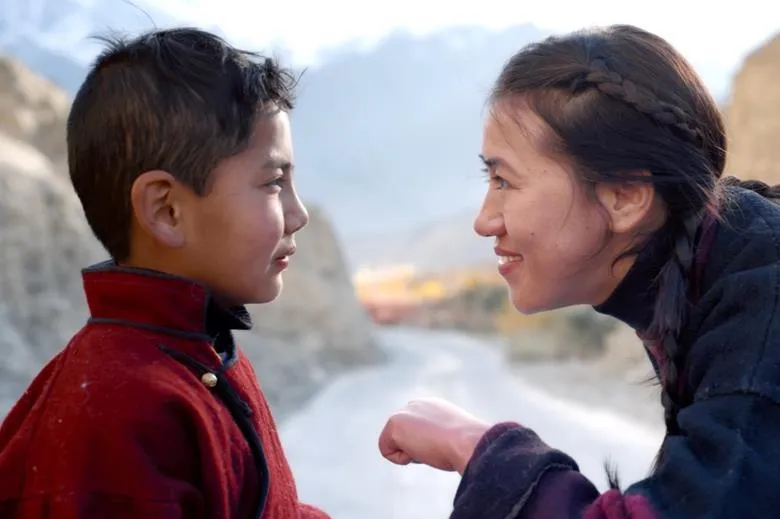
At the heart of Becoming is Agyal, a young Ladakhi boy whose unusual connection with nature and memories seemingly belonging to another lifetime lead him towards the ancient Likir Monastery.
When the boy identifies belongings associated with a revered Rimpoche inside the monastery, the monks begin to believe that he could be the reincarnation of the spiritual teacher.
Through this narrative, the film explores rebirth, identity, destiny and the relationship between past and present, drawing upon Buddhist traditions that have been an integral part of Ladakh’s spiritual and cultural life.
Addressing a press conference at IFFI on November 21, Yadav described Becoming as a spiritual journey that continues at every moment. Explaining the significance of its title, she said becoming is not a destination or a final state but an ongoing process of transformation in human life.
=She also spoke about how Buddhist philosophy and the distinctive landscape of Ladakh gradually shaped the film’s narrative and visual language.
Recounting the origins of the project, producer and cinematographer Aseem Bajaj revealed that the film initially emerged from an opportunity to test camera equipment under challenging conditions.
Rather than simply conducting an equipment test, Bajaj proposed making a short film in Ladakh. He gave Yadav three starting points — the title Becoming, the world of Buddhism and Ladakh as the setting. What followed was a creative process in which the location, people and cultural experiences gradually shaped the story.
Yadav explained that the project initially had a more visual approach, with limited dialogue and a small crew. However, as the filmmakers interacted with local people and learnt about their understanding of reincarnation, the narrative began taking a definite shape.
Recalling one particularly striking experience, she referred to a local account shared by the film’s line producer, Naam Gyal, who told her that his brother had been reborn in another family. Such experiences offered the filmmakers an insight into how reincarnation is understood not merely as a religious concept but as an accepted part of everyday cultural life in Ladakh.
The filmmakers said these encounters helped them approach the subject with greater sensitivity and allowed the story to develop organically rather than imposing an externally conceived narrative on the region.
One of the most interesting aspects highlighted during the press conference was Yadav’s experience of directing local, non-professional actors.
The filmmaker said she communicated largely in Hindi, while several performers spoke Ladakhi and had limited familiarity with Hindi. Despite the language difference, the actors were able to understand and express the emotions required by their characters.
Yadav observed that language is only one tool of communication and that human emotions can transcend linguistic barriers. The experience, she said, reinforced the importance of listening, sensitivity and communication beyond words.
For Ladakh, this aspect of the production is particularly relevant, as it demonstrates the potential of local talent and indigenous languages in cinematic storytelling, even when working with filmmakers and technical teams from outside the region.
Bajaj revealed that the film was made with a compact crew of 19 members from outside Ladakh, working alongside local collaborators. The entire shooting process was completed in just 15 days, including the period required for acclimatisation to the high-altitude environment.
The team faced considerable physical challenges, with temperatures falling to around minus 20 degrees Celsius during the shoot. The filmmakers said the production relied entirely on natural locations and on-location cinematography, without employing visual effects.
Both Yadav and Bajaj spoke about being humbled by the scale of Ladakh’s natural environment and the warmth and hospitality extended by local people.
An interesting detail about the film’s poster also emerged during the interaction. Yadav revealed that its striking image of a young boy draped in red, seen from behind, was not originally planned. It emerged from an unscripted moment during filming when the interplay of cloth, shadows and natural light created an image that the filmmakers felt captured the essence of the film.
The film has also attracted attention beyond the festival circuit.
Internationally acclaimed Japanese composer Shigeru Umebayashi, known for his work in films such as In the Mood for Love, A Single Man and The Grandmaster, reportedly loved Becoming and compared it to Albert Lamorisse’s celebrated fantasy short The Red Balloon, which won the Palme d’Or for Best Short Film at Cannes in 1956.
Yadav had long wished to collaborate with Umebayashi and had previously used some of his compositions as temporary musical references while editing her films.
Despite the limited budget of Becoming, the filmmakers approached the Japanese maestro, who appreciated the film and made the comparison. The appreciation is another indication of the film’s potential to connect with audiences beyond its regional and linguistic setting.
The significance of Becoming goes beyond its selection as an opening film at IFFI. At a time when Ladakh is seeking greater recognition of its distinct cultural, linguistic and regional identity, the film offers a representation of the region through its own spiritual traditions and lived experiences.
It brings the Buddhist understanding of reincarnation, the institution of monastic life, the Ladakhi language and the region’s landscape into a national cinematic conversation.
Its selection also demonstrates that stories emerging from smaller regions and indigenous cultural settings can command attention on major platforms without necessarily depending on large-scale productions or commercial filmmaking conventions.
Another Ladakhi production, Birds on Ice, directed by Sahil Shah, has also secured a place in the feature-film section of Indian Panorama 2026, further strengthening Ladakh’s presence at this year’s festival.
For Ladakh, therefore, the two selections represent an opportunity to move beyond being recognised merely as a filming destination and emerge as a source of original stories, local talent and distinctive cinematic expression.
Becoming has already made its IFFI debut, but its larger achievement may lie in taking a distinctly Ladakhi story — told in the language of the region and rooted in its spiritual worldview — to audiences far beyond the Himalayas.

