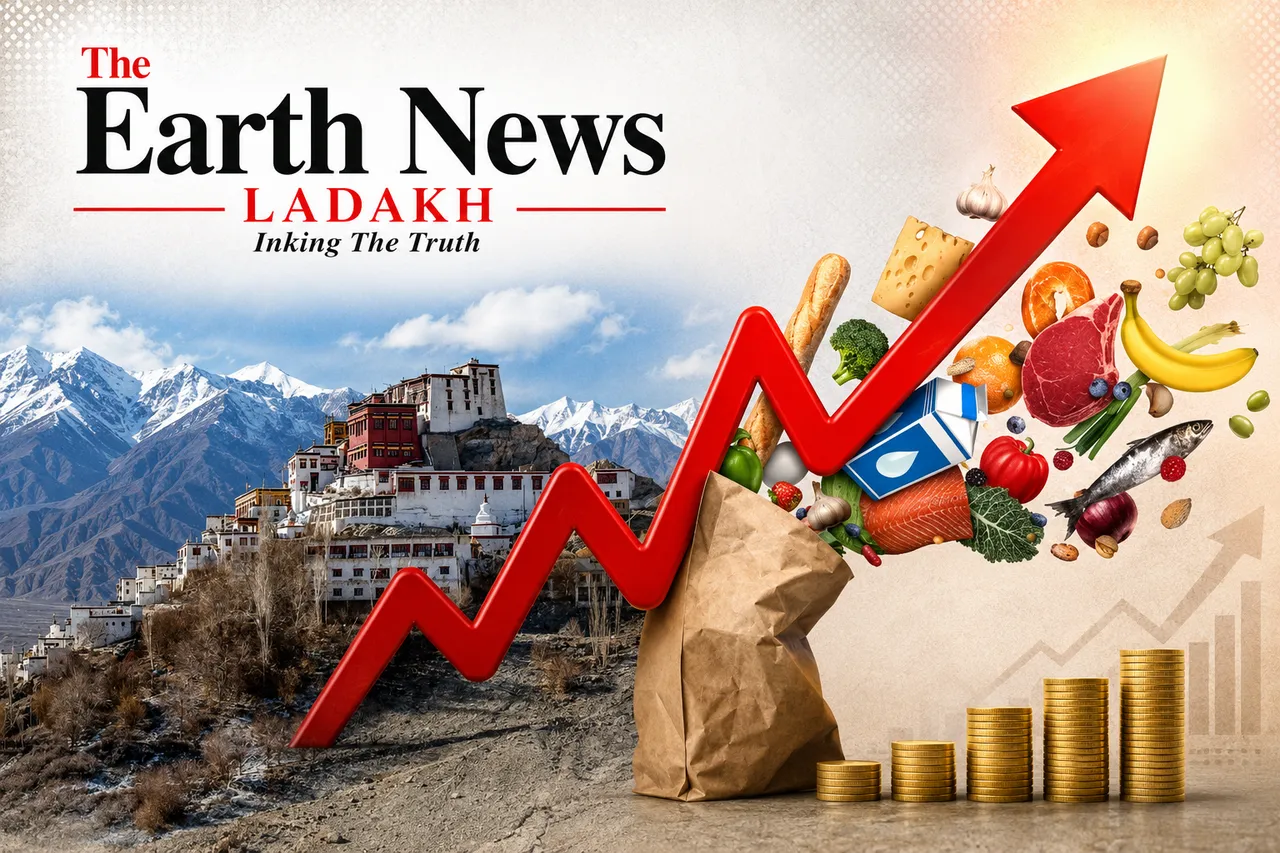
From 1.76% in January to 5.17% in July, Ladakh records one of India’s sharpest inflation accelerations.
LEH: Ladakh has emerged as one of the regions facing the sharpest rise in consumer prices in the country, with inflation accelerating to 5.17 per cent in July 2026, placing the Union Territory fifth among all States and Union Territories in terms of the highest Consumer Price Index (CPI) inflation recorded during the month.
The latest figures released by the Ministry of Statistics and Programme Implementation (MoSPI) show that Ladakh’s combined CPI inflation stood significantly above the all-India rate of 4.45 per cent in July. The pressure was particularly severe in rural Ladakh, where inflation reached 5.55 per cent, compared with 4.03 per cent in urban areas. The figures point to a significant rural-urban divide in the pace at which consumer prices are rising in the Union Territory.
The July numbers assume greater significance because they mark a sharp acceleration from the previous month. Ladakh’s combined inflation had stood at 4.03 per cent in June, with rural inflation at 4.16 per cent and urban inflation at 3.64 per cent. Within a month, the combined rate increased by 1.14 percentage points to 5.17 per cent. Rural inflation registered an even sharper rise of 1.39 percentage points, jumping from 4.16 per cent in June to 5.55 per cent in July, while the urban rate rose by 0.39 percentage point.
The latest increase also marks a dramatic shift in Ladakh’s inflation trajectory during 2026. The UT had recorded combined CPI inflation of only 1.76 per cent in January. The rate subsequently rose to 2.02 per cent in May, accelerated to 4.03 per cent in June and reached 5.17 per cent in July. This represents an increase of 3.41 percentage points between January and July, underlining the rapid acceleration in the pace of price increases during the first seven months of the year.
With an inflation rate of 5.17 per cent, Ladakh ranked fifth among States and Union Territories in July. Only Telangana, at 6.32 per cent, Andhra Pradesh, at 5.72 per cent, Tamil Nadu, at 5.44 per cent, and Puducherry, at 5.41 per cent, recorded higher combined inflation. Ladakh was therefore among only five States and UTs where headline inflation crossed the 5 per cent mark during the month.
The figure is equally striking when compared with neighbouring Himalayan regions. Uttarakhand recorded inflation of 4.21 per cent in July, Jammu and Kashmir 3.87 per cent and Himachal Pradesh 3.63 per cent. Ladakh’s inflation was consequently 1.30 percentage points higher than both Jammu and Kashmir and Himachal Pradesh, and 0.96 percentage point higher than Uttarakhand.
The most notable aspect of the July data, however, is the pressure being experienced in rural Ladakh. At 5.55 per cent, rural inflation was 1.52 percentage points higher than the urban rate of 4.03 per cent. It was also above the all-India rural inflation rate of 4.84 per cent. While Ladakh’s urban inflation was broadly close to the national urban rate of 3.96 per cent, the considerably higher rural figure pushed the UT’s overall inflation well above the national average.
The official figures, therefore, raise important questions about the nature of price pressures across Ladakh. For households, inflation translates into a gradual erosion of purchasing power when incomes do not increase at the same pace as prices. The impact can be particularly significant in rural and remote areas, where consumers may have fewer market options.
However, the headline CPI data alone do not establish the precise reasons for Ladakh’s sharp increase. A detailed commodity-wise examination would be required to determine whether the acceleration was driven primarily by food, transport, household goods, services or other components of consumer expenditure.
The national context also adds to the significance of Ladakh’s figures. India’s headline CPI inflation rose to 4.45 per cent in July, while food inflation stood at 5.52 per cent. Ladakh’s overall inflation of 5.17 per cent was thus 0.72 percentage point above the national headline rate, while its rural inflation of 5.55 per cent was 0.71 percentage point above the all-India rural rate.
The data also need to be interpreted correctly. The current CPI series uses 2024 as the base year, with 2024=100, but the reported inflation rate for July 2026 measures the year-on-year change in prices compared with July 2025. In other words, the 5.17 per cent figure does not mean prices are being directly compared with 2024 levels; it represents the annual rate at which the prices covered by the CPI basket increased between July 2025 and July 2026.
For Ladakh, where market conditions and consumer access can differ substantially between urban centres and far-flung rural settlements, the sharp gap between rural and urban inflation merits close attention. The official CPI data establish that rural consumers faced a substantially faster pace of price increases in July, though they do not by themselves identify the causes.
The figures also provide an important economic signal for policymakers as Ladakh continues to pursue infrastructure development, tourism growth and wider economic expansion. A close watch on the coming months’ CPI data will be necessary to determine whether July’s 5.17 per cent rate represents a temporary spike or the beginning of a more sustained inflationary trend. More detailed monitoring of essential commodities and price movements across rural and urban markets could also help identify where the greatest pressures are emerging.
MoSPI has described the July figures as provisional and has cautioned that some state-level item indices may be based on relatively thin samples, requiring careful interpretation at the disaggregated level. Nevertheless, the headline trend is unmistakable: Ladakh’s inflation has accelerated sharply from 1.76 per cent at the beginning of the year to 5.17 per cent in July, placing it among the highest-inflation regions in the country, with rural areas experiencing the greatest pressure.
For a Union Territory already characterised by vast distances, dispersed settlements and distinctive market conditions, the latest data make inflation and household purchasing power an increasingly important economic issue. Whether the July surge continues or moderates in the months ahead will now be closely watched, but the official figures leave little doubt that price pressures in Ladakh strengthened considerably during the first seven months of 2026.