Records third-highest inflation among UTs and 7th overall as price pressures accelerate for second straight month
LEH: Retail inflation in Ladakh accelerated to 5.26 per cent in August 2026, placing the Union Territory among the regions witnessing the sharper rise in consumer prices and pushing its inflation rate well above the national average of 4.82 per cent, according to the latest Consumer Price Index (CPI) data released by the Ministry of Statistics and Programme Implementation (MoSPI).
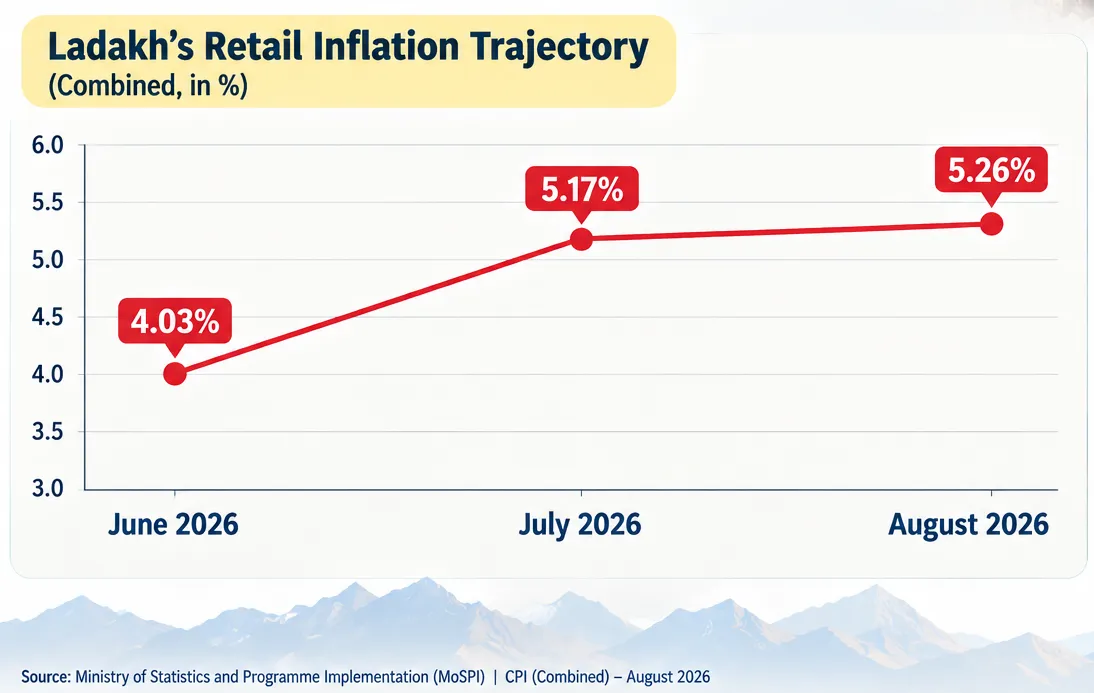
The August 2026 CPI data, based on the new 2024=100 series, shows that Ladakh’s combined inflation increased from 5.17 per cent in July to 5.26 per cent in August, marking the second consecutive monthly increase. In June, the UT’s retail inflation stood at 4.03 per cent.
At 5.26 per cent, Ladakh’s inflation was 0.44 percentage points higher than the all-India rate of 4.82 per cent in August. National retail inflation itself rose from 4.45 per cent in July to 4.82 per cent in August, while all-India food inflation increased to 5.95 per cent from 5.52 per cent.
The August figures place Ladakh at third among the Union Territories in terms of combined retail inflation, behind Dadra and Nagar Haveli and Daman and Diu (6.22 per cent) and Puducherry (5.85 per cent).
Ladakh’s inflation was also higher than that recorded in neighbouring Jammu and Kashmir (4.09 per cent) and Himachal Pradesh (3.85 per cent). Among other UTs, Delhi recorded 2.61 per cent, Lakshadweep 3.14 per cent, Andaman and Nicobar Islands 3.84 per cent and Chandigarh 4.02 per cent.
The divergence between Ladakh and Jammu and Kashmir is particularly notable: while Ladakh’s inflation accelerated to 5.26 per cent, J&K’s remained at 4.09 per cent in August. The data also reveals a clear rural-urban divide in Ladakh. Rural inflation stood at 5.59 per cent, compared with 4.24 per cent in urban areas.
The 1.35-percentage-point gap suggests that price pressures are considerably stronger in rural parts of the UT. It also mirrors the broader national pattern, where rural inflation at 5.23 per cent was substantially higher than urban inflation of 4.31 per cent.
For Ladakh, the rural differential assumes particular significance given the UT’s difficult terrain, long supply chains and dependence on supplies transported from outside the region. However, the CPI data itself does not establish the specific causes of Ladakh’s higher inflation, and item-level state/UT indices should be interpreted cautiously because some items are based on relatively thin price samples, MoSPI has cautioned.
Ladakh’s inflation trajectory during the first three months of the current quarter shows a steady upward movement i.e. from 4.03% in June to 5.17% in July to 5.26% in August.
Thus, compared with June, Ladakh’s inflation has risen by 1.23 percentage points in just two months. The increase comes at a time when prices nationally are also moving higher. MoSPI reported that all-India food inflation rose to 5.95 per cent in August, with particularly high year-on-year inflation recorded in various daily use vegetables.
However, these national item-level movements cannot automatically be applied to Ladakh, as the UT has its own CPI basket and local price movements.
The August figure also means Ladakh’s retail inflation remains above the Reserve Bank of India’s 4 per cent medium-term inflation target, while still remaining within the RBI’s broader 2–6 per cent tolerance band. At the national level, August inflation of 4.82 per cent marked the third consecutive month above the 4 per cent target.
For Ladakh, the continued rise warrants closer attention because the UT’s geographical isolation can make consumer prices particularly sensitive to transportation, supply and seasonal factors. The latest CPI figures, however, establish the scale and direction of the price movement rather than attributing it to any single factor.
MoSPI said its August CPI estimates were based on price data collected from 1,407 urban markets and 1,465 villages across States and UTs, with a 100 per cent response rate during the month. The August figures are provisional.