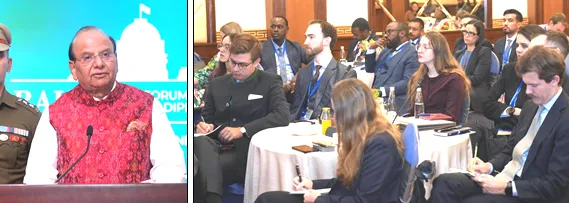
Forum brings diplomats, policymakers, business leaders and strategic thinkers from India and 39 countries; LG highlights Ladakh’s strategic frontier, fragile ecology and development model, expresses desire to host World Economic Forum
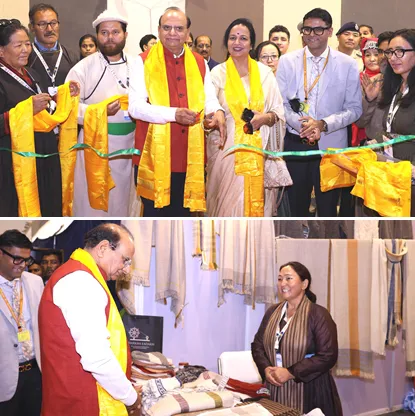
LEH: Leh stepped onto a new international diplomatic stage on Thursday as Lieutenant Governor Ladakh Vinai Kumar Saxena addressed the historic first Raisina Forum for the Future of Diplomacy in the region, using the gathering of diplomats, policymakers, business leaders and strategic thinkers from India and 39 countries to project Ladakh as a place where geopolitics, economic development, national security and ecological sustainability intersect.
The LG, in his address, underlined what he described as Ladakh’s unique strategic importance as a vital frontier, arguing that the Union Territory’s geopolitical significance cannot be viewed separately from its extraordinary ecology, harsh climatic conditions and distinctive cultural heritage.
More significantly, Saxena used the international platform to articulate an ambition that could potentially place Ladakh on the calendar of major global economic and policy gatherings: hosting the World Economic Forum in Ladakh in the future.
“Building on today’s forum, I also shared my vision and a strong desire to host the World Economic Forum in Ladakh soon, showcasing our sustainable growth model to the world,” Saxena said in a post following the event.
The proposal comes as Ladakh seeks to balance the demands of development and connectivity in a strategically sensitive, high-altitude region with the need to protect its exceptionally fragile environment and scarce natural resources.
The Raisina Forum itself forms part of the wider Raisina Platforms & Ideas Forum ecosystem administered by the Observer Research Foundation. The parent Raisina Dialogue is described by its organisers as India’s premier conference on geopolitics and geoeconomics, while the Forum for the Future of Diplomacy is specifically designed to engage and develop emerging diplomatic leaders and facilitate interaction with policymakers and experts.
The decision to hold the diplomatic gathering in Leh rather than confining such conversations to conventional metropolitan centres gave the proceedings an additional strategic dimension. Ladakh’s location along India’s northern frontier, its proximity to sensitive international boundaries and its combination of extreme geography and emerging infrastructure make it a distinctive setting for conversations on security, connectivity, climate resilience and sustainable development.
Saxena told the international gathering that Ladakh’s development strategy was centred on strengthening connectivity, expanding tourism infrastructure, strengthening the local economy and protecting the region’s ecology and water resources.
He also highlighted initiatives aimed at creating greater opportunities for local communities while ensuring that development does not come at the cost of Ladakh’s environmental vulnerability. The LG said these initiatives were being pursued under the leadership of Prime Minister Narendra Modi, with the stated objective of building an inclusive and resilient Ladakh.
The proposed WEF connection gives added significance to Saxena’s remarks. The World Economic Forum’s annual meeting in Davos brings together leaders from government, business, international organisations, civil society and academia. At its 2026 annual meeting, the Forum said nearly 3,000 participants from more than 130 countries were expected, including hundreds of political leaders and senior business executives.
Saxena’s suggestion to bring a WEF platform to Ladakh therefore goes beyond conventional tourism promotion. It signals an attempt to position the UT as a venue for discussions on the future of mountain economies, climate resilience, water security, sustainable tourism, renewable energy, border-region infrastructure and community-led development.
For Ladakh, such an international positioning would also be closely linked to the question of how connectivity and economic expansion can be pursued without placing unsustainable pressure on its fragile high-altitude environment.
Recent infrastructure initiatives have already been framed by the administration in this dual context. The LG has described projects such as the Zoji-La Tunnel as important not only for year-round connectivity and tourism but also for Ladakh’s strategic and economic integration.
Similarly, discussions on Leh’s road and urban infrastructure have linked improved connectivity with reduced congestion, tourism growth, economic activity and employment generation.
The Leh forum thus brought together two dimensions that are increasingly central to Ladakh’s public-policy narrative: its role as a strategically important frontier and its aspiration to develop a sustainable, locally beneficial economy.
By hosting diplomats and strategic thinkers from across the world, Leh provided an unusual setting for discussions that are normally associated with national capitals and major international conference centres.
For the administration, the event also offered an opportunity to present Ladakh not merely as a geographically remote border region or a global tourism destination, but as a potential living laboratory for sustainable development in an environmentally fragile and strategically sensitive region.
Saxena’s WEF proposal has now added a longer-term international dimension to that vision—seeking to transform Ladakh from a place discussed in global strategic and environmental conversations into a place where some of those conversations could themselves take place.