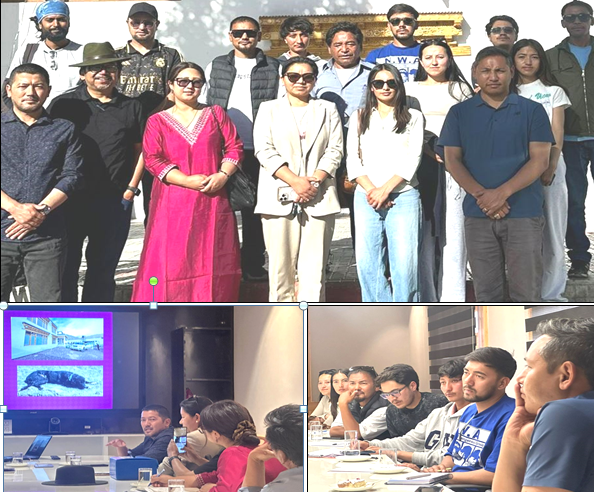
LEH: In pursuance of the decisions taken during the 9th Meeting of the Local Animal Birth Control Monitoring Committee (LABCMC), the Municipal Committee (MC) Leh today successfully organized a Capacity Building-cum-Training Programme on Animal Welfare and Stray Dog Management at the Conference Hall of Municipal Committee Leh.
The programme was aimed at strengthening the knowledge and capacity of all stakeholder departments and organizations associated with the humane management of stray animals in Ladakh. The training programme was attended by officials from the Animal Husbandry Department, Wildlife Department, representatives of Animal Welfare Organizations (AWOs)/NGOs including Chamba Animal Welfare Society and Live to Rescue, officials of Municipal Committee Leh, members associated with animal welfare initiatives, and the Project Coordinator and field staff currently engaged in the Dog Census Survey being conducted in Leh town.
Welcoming the participants, Stanzin Rabgais, Executive Officer, Municipal Committee Leh, emphasized the growing importance of coordinated efforts in addressing the issue of stray animals through scientific, humane and legally compliant approaches. He highlighted that the objective of the training was to enhance the technical capacity of all stakeholders involved in animal welfare and stray dog management so that effective implementation of the Animal Birth Control (ABC) Programme and related activities can be ensured across Leh town.
The Executive Officer further stated that the Government of Union Territory of Ladakh is in the process of formulating a comprehensive UT Ladakh Animal Welfare Policy, which is presently under development. Once approved and notified, the policy is expected to provide institutional support to registered Animal Welfare Organizations and NGOs working in the field of animal welfare. He also stressed that community participation, public awareness campaigns and active involvement of NGOs would play a vital role in ensuring sustainable and humane management of stray dog populations through Information, Education and Communication (IEC) initiatives.
Delivering a detailed technical presentation, Dr. Kesar, Livestock Development Officer, shared the activities and achievements of the Animal Husbandry Department in implementing the Animal Birth Control (ABC) Programme and Anti-Rabies Vaccination (ARV) Programme across Ladakh over the last decade. Through a PowerPoint presentation, he explained the department’s sustained efforts in sterilization, vaccination, disease control and collaborative interventions undertaken to reduce the stray dog population while ensuring animal welfare.
A practical session was conducted by Dr. Dolker, Veterinary Assistant Surgeon, who elaborated on the safety measures to be adopted while handling stray dogs. She provided detailed demonstrations on humane dog handling techniques, precautions to avoid dog bites, emergency response mechanisms, and first aid procedures for injuries sustained during rescue and handling operations. The session received active participation from field staff and stakeholders engaged in dog management activities.
Addressing the participants, Dr. Phuntsog, Consultant, Wildlife Department, highlighted the increasing threat posed by the growing stray dog population to Ladakh’s fragile wildlife ecosystem. He informed that while rescuing wildlife in recent years, six cases of dog bite injuries to wildlife had been confirmed, indicating the serious impact of free-ranging dogs on native wildlife. He further explained that increasing interactions and cross-breeding between stray dogs and wolves pose a significant threat to the genetic purity of wild wolf populations and adversely affect the ecological balance of the region.
Speaking on the occasion, Lobzang Visudhha, Member of the Wildlife Conservation and Birds Club of Ladakh, shared his observations regarding the ecological challenges arising from the unchecked increase in stray dog populations. He noted that although Ladakh possesses a rich diversity of mammalian wildlife, the ecosystem has witnessed considerable disturbance over the past decade due to attacks by stray dogs.
He highlighted reported incidents involving species such as the Pallas’s Cat, Eurasian Lynx, Blue Sheep (Bharal), Himalayan Brown Bear, Snow Leopard, Marmots, and the Black-necked Crane. He further informed that five serious incidents involving attacks on humans resulting in loss of lives had also been reported, underlining the need for scientific and coordinated management of stray dogs while balancing concerns of public safety, animal welfare and biodiversity conservation.
Ms. Skarma, Legal Assistant, Municipal Committee Leh, delivered a comprehensive presentation on the legal framework governing animal welfare with special reference to the Animal Birth Control Rules, 2023. She explained the statutory responsibilities of Urban Local Bodies, Animal Welfare Organizations and other stakeholder departments in implementing the provisions of the Rules while ensuring humane treatment of stray animals in accordance with prevailing legal provisions.
During the programme, it was also informed that the Dog Census Survey for Leh town is currently underway as part of the Municipal Committee’s efforts to develop a scientific database for planning future interventions under the Animal Birth Control Programme. The survey is being undertaken with a project implementation timeline of three months and is expected to be completed by the end of September 2026.
The training programme concluded with an interactive discussion, during which participants exchanged views on strengthening inter-departmental coordination, improving implementation of the ABC Programme, enhancing public awareness, and adopting scientific approaches for long-term stray dog management in Ladakh.
In his concluding remarks, Stanzin Rabgais, Executive Officer, Municipal Committee Leh, thanked all the resource persons, officers, Animal Welfare Organizations, departmental representatives and participants for their valuable contributions and active participation. He expressed confidence that the knowledge gained during the programme would significantly strengthen collaborative efforts towards ensuring humane animal welfare, public safety and ecological conservation in the Union Territory of Ladakh.