Festival links conservation of Ladakh’s only breeding habitat of the endangered alpine crane with sustainable livelihoods and community-led eco-tourism
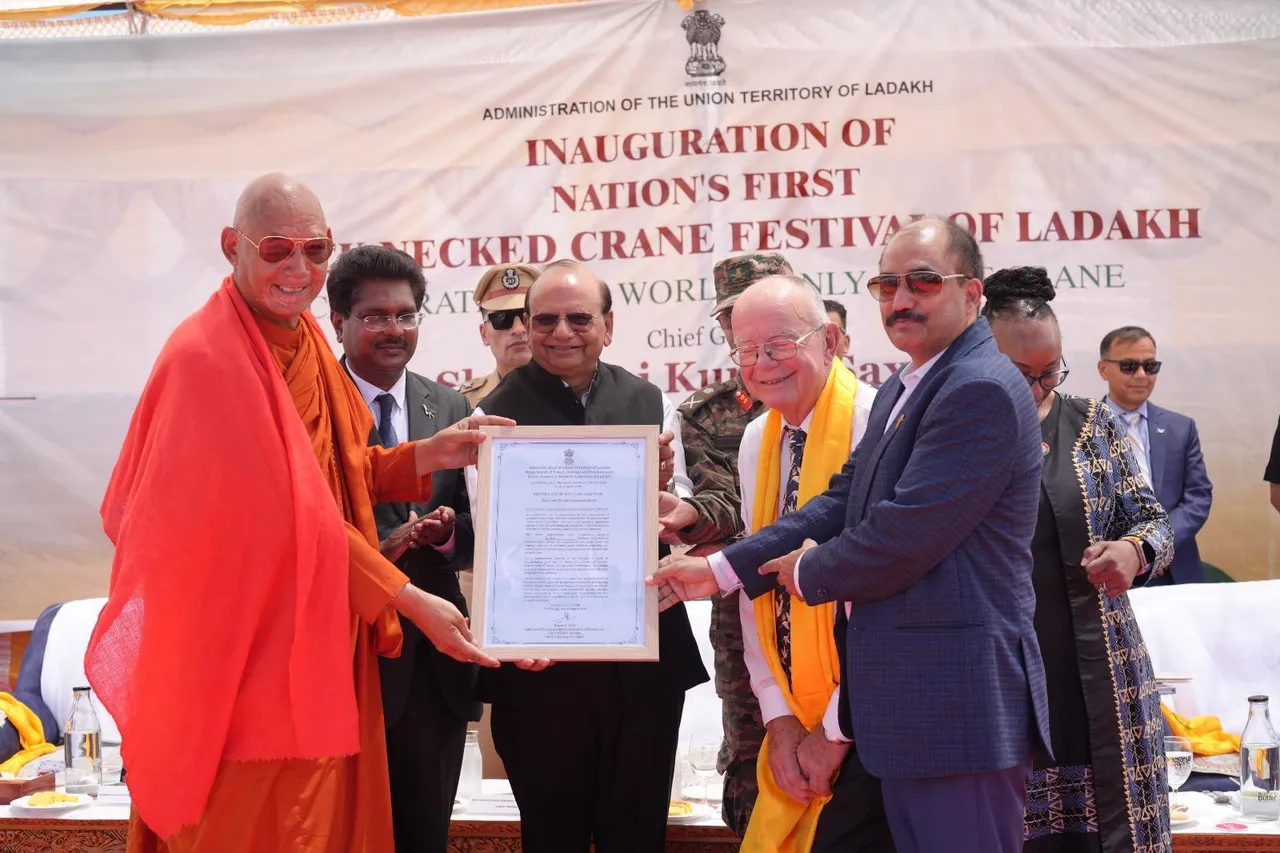
LEH: Lieutenant Governor Vinai Kumar Saxena on Tuesday inaugurated India’s first Black-Necked Crane Festival in Ladakh, calling for conservation of the endangered alpine bird alongside protection of wetlands, high-altitude ecosystems and the livelihoods of communities dependent on them.
The three-pronged focus of the festival is to strengthen wildlife conservation, promote sustainable livelihoods and develop community-led eco-tourism around the black-necked crane, for which Ladakh is the only breeding habitat in India.
The festival has brought together conservationists, researchers and experts from India and abroad, including representatives from the United Nations, as well as experts from Bhutan and Nepal, both of which have sizeable populations of the species.
Around 16,000 black-necked cranes are distributed across India, Bhutan, China and Nepal. Adapted to some of the highest and most challenging environments on earth, the species is described as the world’s only alpine crane.
The UT Administration has declared the black-necked crane as the State Bird of Ladakh. The bird is also regarded as a symbol of peace and an emblem of the region’s high-altitude natural heritage.
Addressing the festival, Saxena said conservation of the black-necked crane could not be separated from protection of Ladakh’s wetlands, grasslands and other high-altitude ecosystems.
He specifically referred to Tso Kar, Hanle and other breeding landscapes, saying these areas serve not only as wildlife habitats but also as ecological systems that support biodiversity, regulate water systems and sustain pastoral communities.
The Lieutenant Governor stressed that local communities should be treated as partners and custodians of conservation rather than merely beneficiaries of government programmes. He called for the integration of traditional knowledge with modern scientific methods to strengthen conservation efforts.
“The Black-Necked Crane is much more than a bird. It is a symbol of peace, an ambassador of our high-altitude ecosystem and a bridge between wildlife conservation and the well-being of our communities,” Saxena said.
He also called for responsible development of birdwatching, nature tourism and wildlife photography, along with promotion of local handicrafts and traditional products, to create economic opportunities without placing additional pressure on fragile ecosystems.
The Community Knowledge Circle and Community Eco-Market organised during the festival were highlighted as initiatives linking conservation with local culture and livelihoods.
Saxena said Ladakh should follow the principle of deriving “more value from nature, with less pressure on nature”, stressing that tourism and economic activity should not undermine the ecosystems that attract visitors to the region.
The festival also drew attention to threats to breeding grounds and wetlands from pollution, unregulated tourism and other pressures, while seeking to expand public awareness about the ecological importance of the species.
During the event, the Lieutenant Governor released a series of knowledge and conservation publications, including the Black-Necked Crane: India Book, Black-Necked Crane: Bhutan Book, a coffee table book on the species, an action plan for its conservation and habitat, and a report on its status and distribution.
A bird economy status report for Leh, Ladakh was also released, along with a special postal cover and cancellation on the black-necked crane in collaboration with India Post.
The event also saw the release of the Ladakh Declaration for Black-Necked Crane Conservation, providing a further institutional focus to efforts aimed at protecting the species and its habitat.
With Ladakh being the only breeding ground of the black-necked crane in India, the festival places the species at the centre of a broader conservation approach linking wildlife protection with wetlands, traditional livelihoods and responsible tourism.