Inaugurates Farmers’ Hostel, UT’s first Special School for Children with Special Needs and ₹2.48-crore Automated Driving Testing Centre
KARGIL: In a major push towards strengthening rural infrastructure, citizen-centric governance and inclusive development in Ladakh, Lieutenant Governor Vinai Kumar Saxena on Saturday inaugurated three significant public facilities in Kargil—a Farmers’ Hostel at Lower Kurbathang, the Union Territory’s first Special School for Children with Special Needs (CWSN), and a state-of-the-art Automated Driving Testing Centre (ADTC) at Kurbathang.
The initiatives, spanning agriculture, education and road safety, underscore the Administration’s focus on modern infrastructure, technology-driven governance and social inclusion. The Lieutenant Governor was accompanied by Chairman and Chief Executive Councillor, LAHDC Kargil, Dr Mohd Jaffer Akhoon, Member of Parliament from Ladakh Mohmad Haneefa Jan, Executive Councillors and senior officers of the district administration.
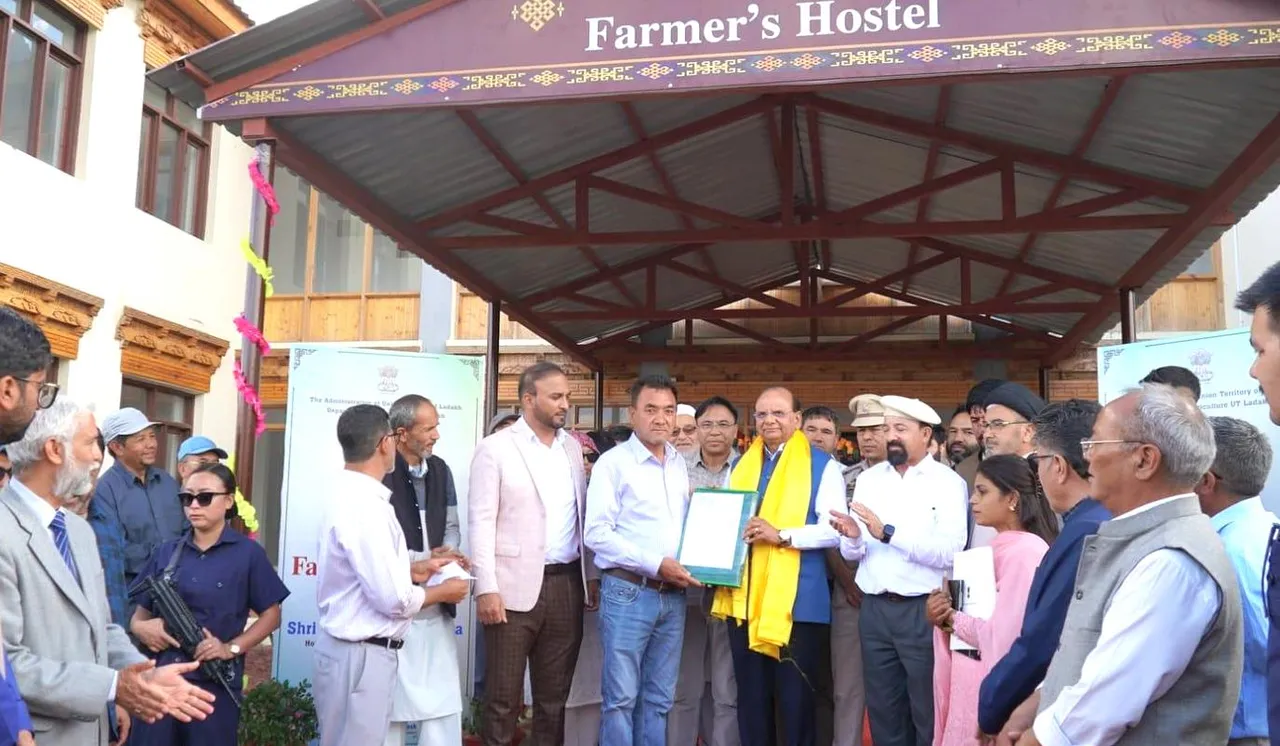
Beginning his engagements at Lower Kurbathang, the Lieutenant Governor inaugurated the newly constructed Farmers’ Hostel of the Agriculture Department, aimed at strengthening support infrastructure for the farming community in Kargil.
Following the inauguration, he interacted extensively with farmers, listening to their grievances, suggestions and aspirations concerning agricultural development. Assuring them of the Administration’s continued support, Saxena reiterated the commitment to promoting sustainable agriculture and improving farmers’ livelihoods.
The Lieutenant Governor also inspected the Agriculture Department’s Hi-Tech Greenhouses, where he appreciated both departmental efforts and the initiative shown by progressive farmers in adopting modern cultivation techniques. During the visit, he reviewed crop production, cultivation practices and the overall performance of the greenhouse units, encouraging farmers to maximise the use of advanced agricultural technologies to enhance productivity and increase income.
Later, he inaugurated the Automated Driving Testing Centre at Kurbathang, describing it as a significant milestone towards transparent, technology-driven and citizen-centric governance.
Developed under the guidance of the Ministry of Road Transport and Highways at an estimated cost of Rs 2.48 crore, the facility introduces a fully automated, scientific and objective system for assessing driving skills before the issuance of driving licences.
The centre is equipped with advanced technologies, including RFID-enabled applicant identification, laser and infrared sensors, an electronic sensor-based driving track, high-resolution CCTV surveillance, automated scoring software, computerised test monitoring, real-time data processing, digital result generation, automated pass-fail evaluation and seamless integration with the VAHAN and SARATHI platforms. These features eliminate human bias while ensuring that only qualified drivers receive driving licences.
The facility also includes a computerised testing and control room, automated driving test track, CCTV surveillance system and other essential infrastructure developed in accordance with Ministry guidelines.
Addressing the gathering, the Lieutenant Governor stressed that a driving licence represents far more than a legal document. “Safe roads begin with safe drivers,” he observed, adding that obtaining a driving licence should be regarded as a responsibility towards society rather than merely a legal requirement.
He said the Automated Driving Testing Centre reflects the Administration’s commitment to Digital India, e-Governance and Good Governance by making the licensing process faster, more transparent and efficient. According to him, improved driving standards would play a vital role in reducing road accidents and enhancing public safety across Ladakh.
Appealing to motorists, Saxena urged citizens to strictly observe traffic regulations, wear seat belts and helmets, adhere to speed limits and always drive responsibly, noting that a small act of caution can save precious lives.
In another landmark initiative, the Lieutenant Governor inaugurated Ladakh’s first Special School for Children with Special Needs in Kargil, calling it the beginning of a new chapter in the Union Territory’s journey towards equitable, inclusive and quality education.
Designed to cater to the educational, developmental and therapeutic requirements of children with special needs, the institution provides a dedicated learning environment aimed at enabling every child to learn, grow and lead a life of dignity and independence.
The school features barrier-free infrastructure with ramps, accessible classrooms and child-friendly facilities, supported by assistive technologies, specialised learning aids, dedicated resource rooms, therapy and rehabilitation services, as well as trained special educators and support staff.
Addressing the inaugural function, Saxena said the school demonstrates the Administration’s unwavering commitment to ensuring that no child is left behind irrespective of physical, intellectual, sensory or developmental challenges.
Referring to the vision of the National Education Policy (NEP) 2020, he emphasised that every child deserves equal opportunities to learn and succeed. He reiterated the Administration’s resolve to make every government school in Ladakh inclusive so that children with special needs can access quality education closer to their homes.
The Lieutenant Governor also highlighted ongoing investments in modern classrooms, science laboratories, ICT facilities, libraries, sports infrastructure and safe learning environments across government schools. He assured that the Administration would continue strengthening barrier-free infrastructure, accessible classrooms, assistive technologies, therapeutic support, resource rooms and specialised educators to ensure that every learner participates in education with dignity and confidence.
Calling for collective responsibility, he appealed to parents, local communities, School Management Committees, civil society organisations, healthcare professionals and volunteers to work together in creating a compassionate and inclusive environment where children with special needs are respected, welcomed and empowered to realise their full potential.
Expressing confidence that the institution would emerge as a centre of excellence for inclusive education, the Lieutenant Governor urged all stakeholders to join hands in building a Ladakh “where every child matters, every learner is valued and every dream is given the opportunity to flourish.”
The three inaugurations collectively reflect the Ladakh Administration’s multidimensional approach to development by simultaneously strengthening agricultural infrastructure, enhancing road safety through digital governance and expanding access to inclusive education, thereby advancing the Union Territory’s vision of sustainable, technology-enabled and people-centric growth.