





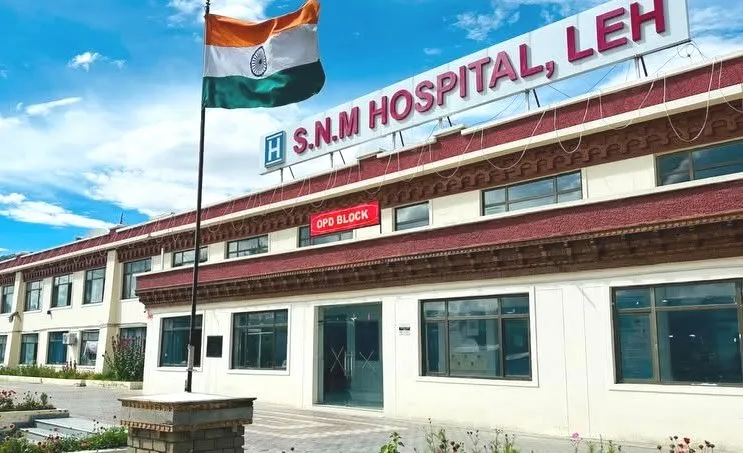
A first-of-its-kind facility at SNM Hospital Leh would bring advanced bone tissue banking to the Himalayan region; a major breakthrough for specialised medical care in one of the country’s most challenging terrains
LEH: In a remarkable medical milestone that puts Ladakh on India’s healthcare map in an unprecedented way, Leh is set to house the country’s highest-altitude Bone Bank, bringing a highly specialised medical facility to one of the world’s most challenging high-altitude inhabited regions.
The Directorate General of Health Services (DGHS), Government of India, has sanctioned Ladakh’s first Bone Bank at Sonam Norbu Memorial (SNM) Hospital, Leh. The National Organ and Tissue Transplant Organisation (NOTTO) announced the achievement, describing it as a landmark development for the region.
The significance of the initiative goes well beyond the establishment of another medical facility. It brings a specialised branch of modern medicine to Ladakh, where geographical remoteness, extreme climatic conditions and limited access to advanced healthcare have historically posed formidable challenges for patients requiring complex surgical interventions.
A Bone Bank is a specialised facility that collects, processes, preserves and stores donated human bone tissue for use in medically indicated transplant and reconstructive procedures. Such tissue can play a crucial role in repairing major bone defects, reconstructing damaged skeletal structures and supporting surgeries involving trauma, bone tumours and other complex orthopaedic conditions.
For patients in Ladakh, the availability of such a facility could mean access to specialised bone tissue banking services much closer to home, potentially reducing the need to travel to hospitals in distant cities for certain advanced treatments.
The development is particularly noteworthy given the unique geographical setting of Leh. Establishing specialised medical infrastructure at such an altitude is itself a significant institutional achievement and reflects an expansion of the healthcare capabilities being envisioned for the region.
It also opens up possibilities for strengthening the capacity of SNM Hospital to support advanced orthopaedic and reconstructive procedures, subject to the availability of trained medical personnel, specialised equipment, tissue-processing infrastructure and the necessary regulatory arrangements.
While the DGHS sanction marks a major step forward, details regarding the facility’s operationalisation, storage capacity, investment and commencement of services are yet to be announced.
Nevertheless, the proposed Bone Bank represents something considerably more significant than a routine addition to hospital infrastructure: a major advance in bringing specialised, technology-driven healthcare to the high Himalayas, where access to advanced medical treatment has long remained a challenge.

