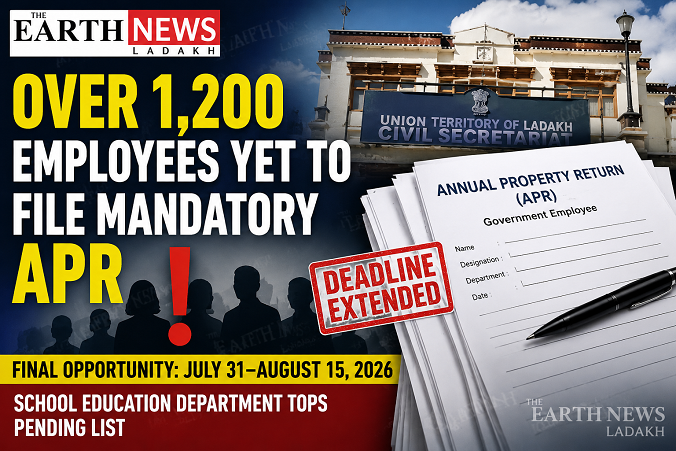
LEH: The latest Annual Property Return (APR) Filing Status Report of the UT Administration has revealed that 1,211 government employees across Ladakh have either failed to submit or have incompletely filed their mandatory Annual Property Returns (APR), despite the fact that deadline was extended on several occasions, highlighting the need for greater compliance with service conduct rules governing public servants.
However, final and last opportunity has been granted to all the defaulting employees to submit their APRs as the portal would reopen for the period July 31, 2026 to August 15, 2026
The report generated on 24 July 2026 shows that out of 17,293 registered government employees, 15,042 employees have successfully filed their Annual Property Returns, reflecting an overall compliance rate of nearly 87 per cent. However, 1,040 employees have not filed their returns at all, while 171 employees have submitted incomplete APRs, leaving a total of 1,211 pending cases requiring immediate attention.
Annual Property Returns are a mandatory requirement under government service conduct rules and require employees to disclose details of their movable and immovable assets. The exercise is aimed at promoting transparency, accountability and integrity in public service by ensuring that government servants periodically declare their property holdings.
The report indicates that the pendency is almost evenly distributed between the two districts of the Union Territory. Leh district accounts for 582 pending or incomplete cases, while Kargil has 578 such cases. In addition, 51 cases pertain to UT-level offices, underscoring that the issue cuts across departments and administrative units.
A department-wise analysis reveals that the School Education Department has recorded the highest number of pending APR submissions with 432 employees yet to complete the process, accounting for more than one-third of all pending cases in the Union Territory. The Home Department follows with 248 pending or incomplete returns, while the Health and Medical Education Department has 126 cases awaiting compliance.
Several other departments also reported significant pendency, including the Power Development Department (50), Rural Development Department (46), Public Health Engineering, Irrigation & Flood Control (PHE&I&FC) Ladakh (36), Revenue Department (28), Food, Civil Supplies & Consumer Affairs (27), Animal Husbandry Department (25) and Sheep Husbandry Department (22).
The report further lists pending cases in departments such as Urban Local Bodies, Youth Services & Sports, Social Welfare, Forest, Public Works (R&B), Agriculture, Finance, Higher Education, Industries & Commerce, Tourism, General Administration Department (GAD), LG Secretariat, LAHDC Leh and several other government establishments, indicating that APR compliance remains a concern across a wide spectrum of the administration.
The report also contains a separate assessment of employees who were 60 years of age or above as on December 31, 2025, categorising them as retired or at retirement age. It states that 1,040 such employees are reflected in the database, of whom 1,037 have not filed their Annual Property Returns while three have submitted incomplete returns. The report notes that these employees have been listed separately for administrative reference.
Apart from compliance issues, the IT Department has also highlighted a data-quality concern in the employee database. According to the report, 43 employee records contain implausible age details based on the dates of birth available in the system, and the concerned departments have been advised to verify and rectify these discrepancies to improve the accuracy of official records. The APR Filing Status Report is expected to serve as an important monitoring tool for the UT Administration, enabling departments to identify defaulting employees, ensure timely submission of mandatory property declarations and strengthen transparency and accountability in public administration. Departments are likely to take follow-up measures to clear the backlog of pending filings and improve compliance levels across the government workforce.