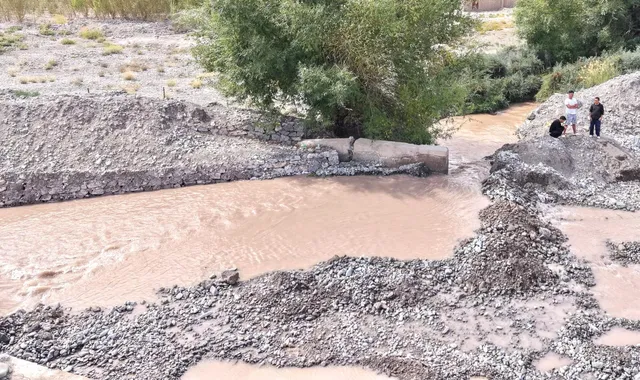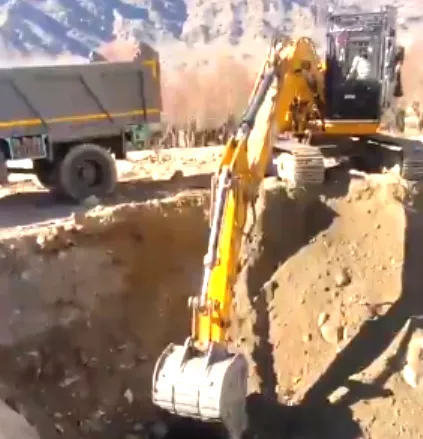
LEH: The UT Administration’s Project Amrit Him Sarovar has been extended to Karu in Leh district, where construction of two large water storage ponds with a combined capacity of 10 million litres has commenced, marking another step towards harnessing Ladakh’s perennial water resources for year-round utilisation.
The two ponds, each measuring 60 metres × 40 metres × 2 metres and having a storage capacity of five million litres, are being constructed by strategically diverting the perennial Karu Nallah through newly developed channels. The infrastructure is designed to cater to the water requirements of the Army areas situated on both sides of the stream, covering a command area of approximately 225 acres.
According to the project details, construction work commenced on November 10, 2026, and is targeted for completion by January 15, 2027.
A major feature of the initiative is the planned utilisation of the nallah’s substantial water discharge across different seasons. Karu Nallah records peak summer discharge of around 350 million litres per day, equivalent to 150 cusecs, while maintaining a steady winter flow of approximately 170 million litres per day, even under sub-zero temperatures.
The proposed storage facilities are expected to facilitate better management and utilisation of these flows, reducing the wastage of water and strengthening the availability of this vital resource throughout the year.
The project will serve an estimated 225-acre area, comprising 65 acres (25 hectares) on the right bank and 160 acres (65 hectares) on the left bank of the stream. Besides meeting the water requirements of the Army establishments, the initiative is expected to support the development of additional agricultural areas and contribute to the expansion of green cover in the region.
The extension of Project Amrit Him Sarovar to Karu is part of the UT Administration’s broader water conservation initiative, guided by Prime Minister Narendra Modi’s vision of securing water resources for future generations.
Beyond the creation of storage infrastructure, the initiative seeks to harness Ladakh’s seasonal and perennial water flows, improve resource management and strengthen water security in a region where water availability remains critical for human activities, agriculture and ecological sustainability.
With the construction of the two ponds, Karu is set to become another important location in Ladakh’s ongoing efforts to conserve water, utilise available resources more efficiently and create opportunities for sustainable agricultural development.