NEW DELHI: Defence Minister Rajnath Singh on Friday called upon the Indian Army’s senior leadership to develop a long-term strategic vision for the next 20-30 years while maintaining operational readiness to respond to immediate and emerging security challenges amid a rapidly changing geopolitical and regional environment.
Addressing the Army Commanders’ Conference in New Delhi, Singh stressed that military strategies must remain dynamic and flexible to accommodate changing circumstances, enabling the Army to anticipate future threats while remaining prepared for evolving operational requirements.
Highlighting the lessons of Operation Sindoor, the Defence Minister credited innovative thinking, enhanced synergy, superior coordination and advanced weaponry for the operation’s success. He said the operation had sent a clear message that India would not hesitate to take necessary measures to safeguard its national interests.
Singh also commended the armed forces for adapting to changing operational circumstances and emphasised the need to continuously strengthen military capabilities through modernisation, technological advancement and regular performance assessments.
Underscoring the growing role of technology in modern warfare, Singh called for accelerated efforts in artificial intelligence, autonomous systems, data analytics, cybersecurity and secure communication networks. He also appreciated the Army’s restructuring initiatives, particularly those focused on the integration of drones and modern technologies into military operations.
He emphasised that the armed forces must continuously evaluate their preparedness and introduce necessary improvements in response to emerging threats and changing battlefield requirements.
While acknowledging the growing significance of air, maritime, space and cyber domains, Singh maintained that land warfare and ground forces would continue to remain indispensable. He called for an integrated approach to modern warfare, stressing that operational success would increasingly depend on multi-domain capabilities and seamless coordination among the services during joint operations.
Highlighting India’s progress towards self-reliance in defence manufacturing, Singh said the Government, under Prime Minister Narendra Modi’s leadership, was prioritising “Aatmanirbharta” in defence amid changing global security dynamics.
He stated that defence production had reached a record ₹1.78 lakh crore during the financial year 2025-26, while defence exports touched an all-time high of approximately ₹38,000 crore.
The Defence Minister acknowledged the contribution of various stakeholders in expanding domestic defence manufacturing capabilities and urged the armed forces to maintain their focus on self-reliance and technological modernisation.
Referring to the ‘Year of Reforms – 2025’, Singh emphasised that reform was a continuous process whose success depended on effective implementation. He urged Army Commanders to take forward the reform agenda within their respective commands and formations, ensuring that the initiatives translated into tangible improvements in operational capabilities.
Singh also called for improved manpower management, greater participation of women in the armed forces and an integrated approach to national security. He credited the valour, discipline, preparedness and restraint of the defence forces, alongside the leadership and diplomatic efforts of the Prime Minister, for strengthening India’s standing globally.
He urged the military leadership to sustain its focus on operational preparedness, institutional reforms and self-reliance while adapting to the evolving character of warfare.
A key highlight of the conference was the release of the Land Warfare Doctrine, which provides an overarching framework for preparing the Indian Army to address the changing nature of warfare and future conflicts.
The doctrine is intended to guide the Army’s preparedness for emerging operational challenges as military technologies, battlefield dynamics and the character of conflict continue to evolve.
Singh also unveiled the annual United Nations Journal and felicitated Indian Army personnel who had made notable contributions while serving as United Nations peacekeepers. Their professionalism, exemplary service and contribution to international peace and security were recognised on the occasion.
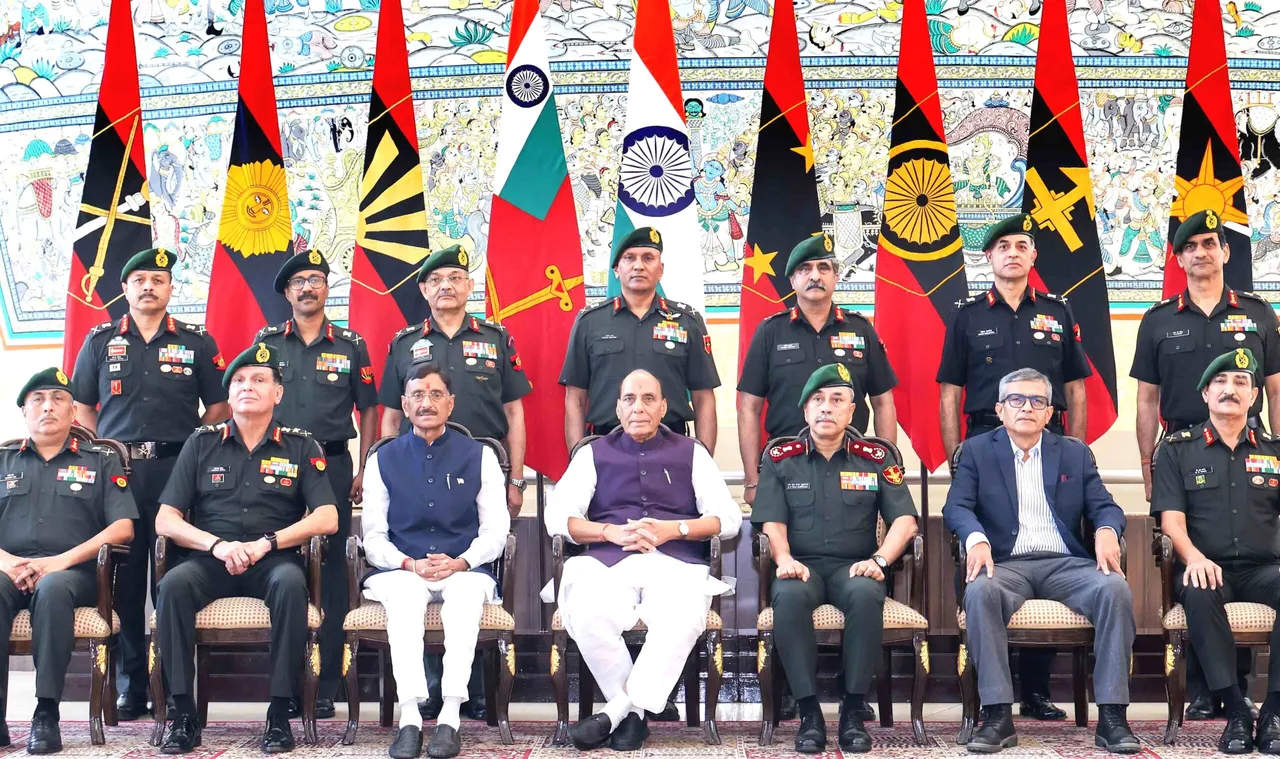
Raksha Rajya Mantri Sanjay Seth, Chief of Defence Staff General NS Raja Subramani, Chief of the Army Staff General Dhiraj Seth, Defence Secretary Rajesh Kumar Singh and other senior officials attended the conference.
The Army Commanders’ Conference serves as a platform for the force’s senior leadership to review ongoing initiatives, identify future priority areas and formulate policy directions aimed at building a progressive, adaptive, technologically enabled and future-ready Indian Army.