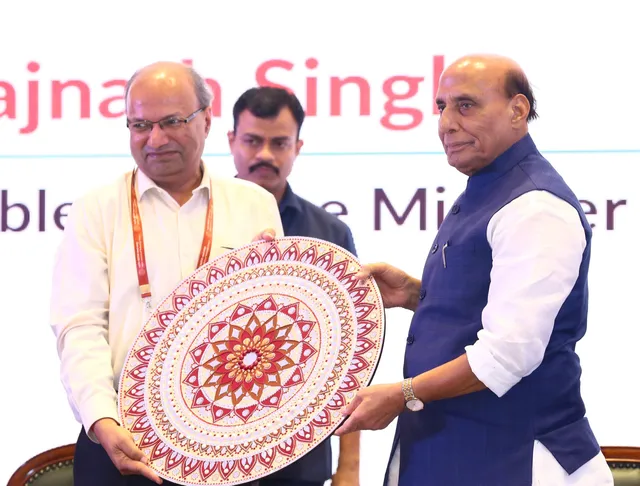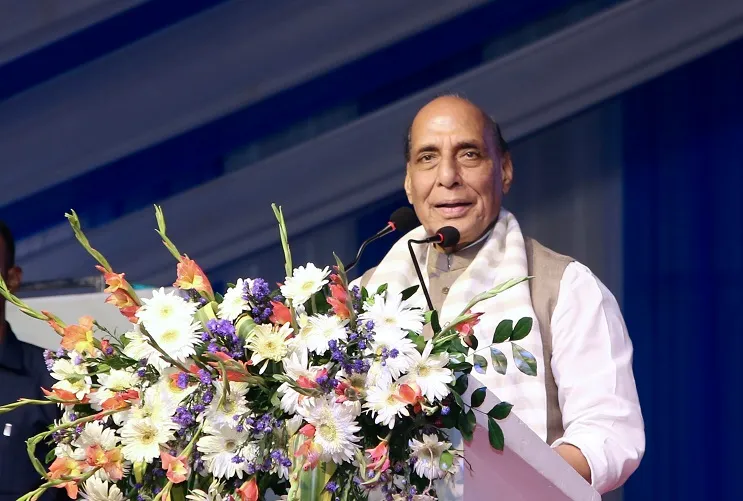
KORAPUT: Defence Minister Rajnath Singh on Tuesday announced a second production line for Shakti helicopter engines at Hindustan Aeronautics Limited (HAL), Koraput, as the division delivered its 2,000th aero-engine, while calling for greater indigenous capability in aircraft propulsion, from design and materials to manufacturing, testing and maintenance.
The new Shakti engine production line will entail an investment of ₹218 crore and will have the capacity to manufacture up to 100 engines annually. It is scheduled to be fully established by 2028-29 and will support indigenous helicopters, including the Dhruv Advanced Light Helicopter (ALH) and Prachand Light Combat Helicopter (LCH).
Singh witnessed the delivery of the 2,000th aero-engine by HAL’s Koraput Division and said the achievement reflected six decades of engineering expertise and technological experience since the division was established in 1964.
He congratulated HAL Koraput’s engineers, technicians, scientists and skilled workforce, and stressed that mastery of propulsion technology was central to building self-reliance in aerospace and defence.
The Defence Minister also announced that HAL is raising its annual production capacity for AL-31FP engines from 30 to 50, with an investment of ₹335 crore. The engines power the Su-30MKI fighter aircraft.
Singh noted that the Government had placed an order for 240 AL-31FP engines with HAL in 2024 for the Su-30MKI. Despite global supply-chain disruptions and challenges related to raw materials, HAL delivered the first engine ahead of schedule and had delivered 63 engines against a target of 60 by the end of the second year, he said.
The Koraput division’s engines have powered several frontline aircraft, including the MiG-21, MiG-27, MiG-29 and Su-30MKI. Singh also highlighted HAL Koraput’s indigenous repair and overhaul capability, with more than 9,000 engines overhauled so far.
He said engine production and overhaul were both essential to military preparedness, with overhaul extending the operational life of costly aviation assets. Indigenisation of components and shorter turnaround times, he added, were helping improve operational readiness.
Describing the aero-engine as the “heart” of an aircraft, Singh said advanced airframes, radars, weapons and avionics could be effectively utilised only when supported by reliable propulsion systems.
He pointed to the specialised expertise required in precision manufacturing, advanced materials, metallurgy, cooling technologies, engine testing and quality assurance, noting that modern aero-engines rely on technologies such as superalloys, thermal-barrier coatings and advanced cooling systems to withstand extreme operating conditions.
The Defence Minister said India’s push for aerospace self-reliance must extend to indigenous aero-engine capability, particularly for the Advanced Medium Combat Aircraft (AMCA) programme.
He highlighted a proposed investment of around ₹5,000 crore, efforts to indigenise raw materials in partnership with Mishra Dhatu Nigam Limited (MIDHANI) and the establishment of India’s first indigenous high-thrust engine testing facility.
A sovereign aerospace ecosystem, he said, would require domestic capabilities across the entire propulsion chain, including materials, design, manufacturing, testing and Maintenance, Repair and Overhaul (MRO).
Singh also called for greater participation of MSMEs, start-ups, private industry, universities and research institutions in the propulsion ecosystem. He urged HAL to develop Koraput beyond an engine manufacturing facility into a broader aerospace propulsion hub by nurturing suppliers, mentoring MSMEs, supporting young engineers and start-ups and developing indigenous capabilities for critical engine components.
He said aero-engine development was a long-term endeavour requiring sustained investment, specialised testing facilities, skilled manpower and a robust industrial ecosystem, with emphasis on reliable, repeatable and scalable production.
The Defence Minister also highlighted Odisha’s growing role in India’s defence and aerospace sector, citing its strategic location, long coastline, ports, mineral resources, industrial infrastructure and skilled workforce.
He referred to the DRDO Integrated Test Range at Chandipur and recent initiatives of the Odisha Government as providing a foundation for further expansion of defence and aerospace manufacturing in the State.
Singh also welcomed the approval for an Aerospace and Defence Equipment Manufacturing Complex at Gajamara, Dhenkanal, under the Odisha Government led by Chief Minister Mohan Charan Majhi.
He called upon HAL to develop Koraput as a nucleus of a wider propulsion ecosystem by developing suppliers, creating opportunities for skilled local youth and strengthening partnerships with industry, academia and research institutions.
Urging the HAL Koraput team to raise standards in quality, productivity, indigenisation, innovation and delivery timelines, Singh said the delivery of the 2,000th engine should provide the foundation for developing an Indian aerospace industry capable of designing, manufacturing and sustaining advanced propulsion systems.
Chief Minister Mohan Charan Majhi, Secretary (Defence Production) Sanjeev Kumar, Deputy Chief of the Air Staff Air Marshal Tejpal Singh, HAL Chairman and Managing Director Ravi K, MIDHANI Chairman and Managing Director Dr S.V.S. Narayana Murty, and Joint Secretary (Aerospace Wing & DOMW) Manisha Chandra were among those present.