First-ever bank linkage in Leh’s block marks major boost to women’s entrepreneurship and financial inclusion
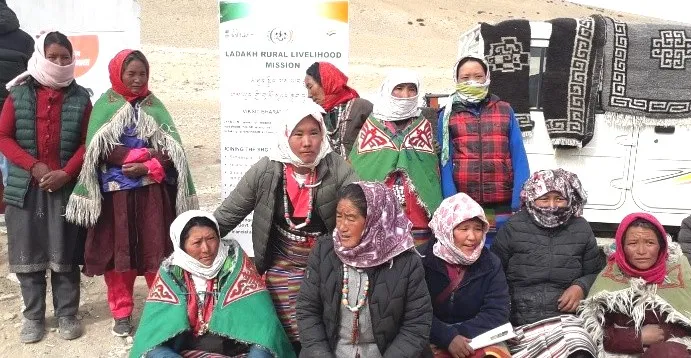
LEH: A significant step towards strengthening women-led development and financial inclusion in Ladakh’s remote areas has been achieved in Rupsho Block of Leh district, where a Self-Help Group (SHG) has secured the block’s first-ever bank credit linkage of Rs.1.5 lakh.
The milestone, highlighted by NITI Aayog, marks a major advancement in efforts to expand livelihood opportunities, promote entrepreneurship and improve access to formal financial services for women in the high-altitude block under the Aspirational Blocks Programme.
The credit linkage is expected to provide the SHG with greater access to working capital and create opportunities for income generation and enterprise development. More significantly, it demonstrates the growing role of women’s collectives in building financially resilient households and communities in geographically challenging areas such as Rupsho.
According to NITI Aayog, regular SHG meetings in the block are helping cultivate financial discipline, collective decision-making and greater community participation. The strengthening of these grassroots institutions is enabling women to move beyond savings and mutual support towards organised economic activity.
The initiative has also been complemented by Livelihood Melas, which provide women entrepreneurs and SHG members with platforms to showcase their products, connect with consumers and explore new markets. Such interventions are aimed at helping locally produced goods move towards wider commercial opportunities while encouraging women to develop sustainable sources of income.
Alongside market access, awareness and capacity-building programmes are being used to improve financial literacy, familiarise SHG members with government schemes and strengthen their entrepreneurial and livelihood-related skills. These measures are intended to ensure that access to credit is accompanied by the knowledge and capabilities required to use financial resources productively.
The emphasis on bank linkage is another important component of the intervention. By connecting SHGs with formal banking channels, the programme is helping women access institutional finance and gradually reducing dependence on informal sources of credit.
The Rs.1.5-lakh linkage therefore represents more than a financial transaction for Rupsho. It is being viewed as a breakthrough in integrating women’s grassroots collectives into the formal financial ecosystem and creating a foundation for future enterprise and livelihood initiatives.
The development comes against the backdrop of the Aspirational Blocks Programme, which seeks to accelerate development in identified blocks through targeted interventions and convergence across key sectors. In Rupsho, the focus on women’s collectives, livelihoods and financial inclusion is emerging as an important pathway towards more inclusive and resilient local development.
With SHGs gaining stronger institutional and financial support, Rupsho is witnessing a gradual shift towards women-led economic participation, where collective savings, access to credit, entrepreneurship and market linkages can reinforce one another and contribute to sustainable growth in one of Ladakh’s remote communities.