NEW DELHI: Renowned Ladakh-based climate activist, education reformer and innovator Sonam Wangchuk has ended his 26-day indefinite hunger strike at Medanta Hospital in Gurugram after receiving assurances from the Centre on several demands relating to the ongoing student protests over alleged irregularities in the NEET-UG 2026 examination.
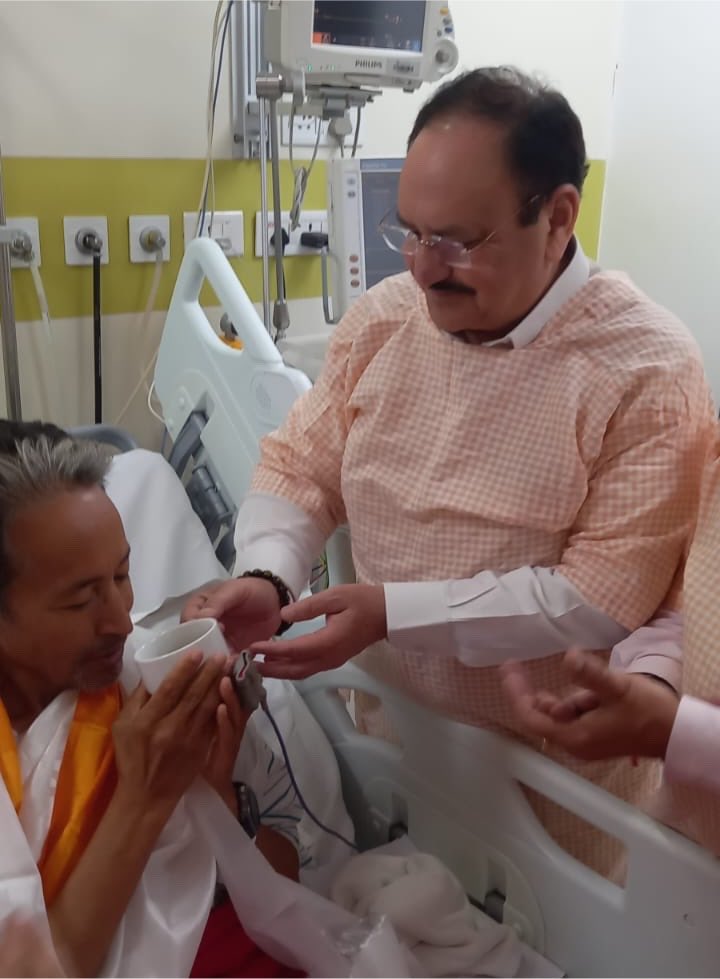
Wangchuk, who had been fasting since June 28, broke his fast in the presence of Union Ministers J.P. Nadda and Dr Jitendra Singh, along with senior leaders of the Apex Body of Leh. Visuals from the hospital showed the 59-year-old activist ending his fast by sipping a liquid drink, assisted by the two Union Ministers and his wife, Gitanjali Angmo.
In a post on X, Wangchuk said he had decided to end the fast after prolonged discussions with the government and appeals from public representatives across party lines.
“Just now, in the presence of Union Ministers Sh. JP Nadda, Dr. Jitendra Singh and senior leaders of Apex Body of Leh Ladakh, I finally broke my fast after 26 days,” he wrote.
Wangchuk said that 65 Members of Parliament from different political parties had either met him or appealed to him through letters to end his fast. He added that the decision followed “long negotiations” on various conditions and was also influenced by concerns over the possibility of violence. He said details of the discussions would be shared separately.
According to government sources, the Centre assured Wangchuk that no punitive legal action would be initiated against students who participated peacefully in the demonstrations at Jantar Mantar and the ‘Sansad Chalo’ march on July 20. The government is also understood to have conveyed that it would consider compensation for families of students who allegedly died by suicide in connection with the examination controversy and would take up issues relating to examination reforms, paper leaks and accountability during the ongoing Monsoon Session of Parliament.
The Prime Minister on Thursday also announced that the government would introduce legislation in Parliament next week providing for stringent action against examination paper leaks, while fast-track courts have already been established to expedite the trial of such cases.
Wangchuk had joined the student-led Cockroach Janta Party (CJP) agitation on June 28 in support of demands for accountability over alleged irregularities in competitive examinations, systemic reforms in the examination process and the resignation of Union Education Minister Dharmendra Pradhan.
His hunger strike, sustained on water and salt, drew nationwide attention and triggered widespread concern over his deteriorating health. On July 18, Delhi Police shifted him from the protest site at Jantar Mantar before he was admitted to Medanta Hospital under directions of the Delhi High Court, which permitted treatment at a hospital of his choice.
Throughout the protest, political leaders, civil society groups and public figures appealed to Wangchuk to end his fast, citing concerns over his health.
Even as he ended his fast, Wangchuk appealed to supporters of the movement to maintain peace and avoid any form of violence. In another message posted on X, he said he was distressed by reports that “anti-social elements” were attempting to provoke violence while the protest at Jantar Mantar had remained peaceful.
“Peace and only peace is my way,” Wangchuk said, urging protesters to respond with restraint regardless of provocation.
His appeal came in the wake of the July 20 ‘Sansad Chalo’ march, during which protesters alleged the use of tear gas, baton charges and other force by Delhi Police after they were prevented from marching towards Parliament. The police rejected allegations that excessive force had been used and also denied claims that the movement had been deliberately portrayed as violent.
Earlier in the day, Gitanjali Angmo defended the conduct of the protesters, saying it was “deeply painful” to see students being portrayed negatively. In a separate post, she praised the discipline, compassion and civic responsibility displayed by the young demonstrators, describing them as role models for the country.
The conclusion of Wangchuk’s fast marks a temporary breakthrough in the month-long agitation, although the broader movement for examination reforms and accountability is expected to continue as Parliament prepares to debate legislative measures aimed at curbing examination paper leaks.