Questions Apex Body-KDA’s reported opposition to LAHDC polls, highlights contradictions over district demands and continued agitation; backs Thupstan Chhewang’s appeal to Ladakhis
LEH: LAHDC Kargil councillor from Cha Constituency Stanzin Lakpa, who recently submitted his resignation as Councillor, has launched a sharp critique of the Apex Body Leh and Kargil Democratic Alliance (KDA), questioning their reported opposition to the delimitation and conduct of elections to the Ladakh Autonomous Hill Development Councils and alleging that their recent positions on the issue were difficult to reconcile with their earlier stand.
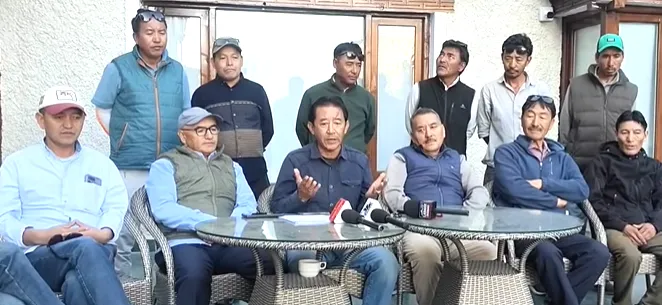
Addressing a press conference in Leh, Lakpa said he welcomed the outcome of the September 9 talks between Ladakhi representatives and the Ministry of Home Affairs (MHA), but said several statements emerging from the meeting and subsequent briefings had left him with “questions” that needed to be answered before the people of Ladakh.
His most pointed objection concerned the reported position that LAHDC elections should not be held. “If we talk about strengthening grassroots democracy, elections are necessary,” Lakpa said, arguing that Panchayat elections should be followed by strengthening the LAHDCs and then establishing a UT-level representative body.
He questioned why, at a time when Ladakh was demanding restoration and deepening of democracy, there should be opposition to holding elections to elected autonomous councils.
Lakpa said the issue had become particularly confusing because the Apex Body and KDA had previously maintained that their campaign was confined to their four-point agenda, with district status and extension of the LAHDCs not forming part of that agenda.
Yet, he pointed out, when the Government of India proposed extension of the LAHDCs to all districts of Ladakh during the May 22 discussions, the proposal was initially welcomed. According to Lakpa, however, the position subsequently changed.
He alleged that during the July 3 meeting with MHA officials in Leh, the issue of extension of the Hill Councils was removed from the minutes following objections raised by representatives, even though civil society groups and religious and community organisations from different parts of Ladakh had repeatedly demanded elected councils for all districts.
The Government eventually announced extension of the LAHDCs, Lakpa noted, but he said the latest reported demand that there should be no delimitation and no LAHDC elections had again raised questions.
Lakpa said he could not understand why elected representatives should be prevented from seeking a fresh mandate. He cautioned that any attempt to postpone or cancel the election process could undermine grassroots democracy at a time when Ladakh was simultaneously demanding stronger democratic institutions.
“Why are obstacles being created?” he asked, questioning the rationale behind repeatedly opposing the elections. He also took exception to the argument that elections at the grassroots or Hill Council level could divide Ladakh or lead to political confrontation.
If political competition was considered undesirable at the council level, Lakpa asked, how could the same logic be applied to a future UT-level election, where regional and national political parties would inevitably participate?
He said political differences could not be wished away by postponing elections and warned that the absence of democratic processes could create greater problems rather than resolve them. Lakpa also questioned the rationale behind continuing calls for agitation, marches and protests following what he described as significant decisions on recruitment, reservation, domicile and other safeguards.
He referred to the 95 per cent reservation in government jobs for Ladakh residents, domicile and residence-related provisions and the announced Ladakh Administrative Service and Ladakh Police Service, arguing that these developments represented substantial progress. “If so much has been achieved, why is there still a call for agitation?” he asked, saying the question was likely to arise in the minds of ordinary Ladakhis.
Lakpa further questioned the logic of demanding protection of business, employment and land for local people while simultaneously seeking to bring outsiders into agitation programmes. He said Ladakhis needed to seriously examine the direction of the ongoing movement and ensure that the region did not again descend into confrontation.
In one of his strongest warnings, Lakpa said the people of Ladakh needed to think collectively about the consequences of contradictory political positions. He cautioned against a situation in which “Ladakh again becomes a battleground”, saying the region’s interests should not be sacrificed to competing political positions or internal differences.
At the same time, he appealed to the Government not to adopt a policy whereby only those demands backed by agitation or pressure were accepted. He urged the authorities to listen equally to the demands being raised by communities and civil society organisations across Sham, Nubra, Changthang, Drass, Zanskar, Kargil and Leh.
Lakpa also questioned the apparent contradiction in the positions of some leaders on the demand for creation of additional districts. Without opposing the demand for district status, he pointed to the fact that the issue had earlier been described as outside the four-point agenda, while members associated with the Apex Body-KDA platform were now raising demands for additional districts.
He specifically referred to a recent statement by LAHDC Kargil CEC Dr Mohd Jaffer Akhoon, saying that while he was not opposed to the demand for a district for Sham, the apparent difference between positions taken by leaders within the broader movement needed explanation.
Lakpa recalled that when he had moved a resolution in the Hill Council seeking district status for Suru and extension of the LAHDCs to all districts, it had faced opposition in the Council. He questioned why some representatives who had opposed such proposals earlier were now supporting similar demands.
Despite his criticism of the current political strategy, Lakpa expressed strong support for former MP and former Apex Body chairman Thupstan Chhewang, saying he had worked with him for decades and knew him closely. Describing Chhewang as an “honest” and “dedicated” leader, Lakpa urged the people of Ladakh to listen seriously to the points raised by him in his recent press conference.
Lakpa said his intervention was not aimed at opposing any particular region or community but at seeking clarity, consistency and accountability from those representing Ladakh’s collective political aspirations.