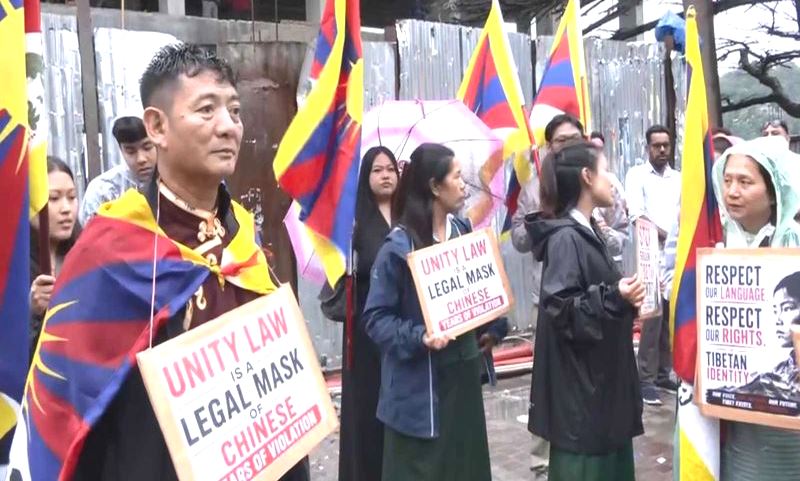
DHARAMSHALA: Tibetan activists representing four major non-governmental organisations on Wednesday staged coordinated demonstrations as China’s Law on Promoting Ethnic Unity and Progress came into force, alleging that the legislation institutionalises policies of forced assimilation and threatens Tibet’s linguistic, cultural and religious identity.
The protests, organised as part of a Global Day of Action, coincided with the law’s implementation on July 1. Demonstrators urged the international community to intervene, arguing that the legislation would further tighten state control over Tibetan society.
Addressing the gathering, Tenzin Yingsel of the Tibetan Women’s Association called on world leaders to publicly condemn the law and press for its repeal, alleging that it contravenes international human rights obligations.
“We demand that global leaders step up immediately to condemn the July 1 enforcement, publicly reject China’s ‘Law on Promoting Ethnic Unity and Progress’, and demand its immediate repeal,” Yingsel said, referring to concerns previously expressed by United Nations human rights experts.
According to the protesters, the legislation provides a legal framework that could be used to restrict the preservation and expression of Tibetan language, culture and traditional practices in the name of promoting national unity.
The law, passed by China’s National People’s Congress on March 12, comprises 62 articles and has been described by Beijing as legislation aimed at strengthening ethnic unity and national cohesion. Tibetan advocacy groups, however, contend that it formalises longstanding assimilation policies and expands state oversight in ethnic minority regions.
Tenzin Passang, Director of Students for a Free Tibet, alleged that the law transforms earlier administrative policies into a statutory framework, expressing concern over its implications for Tibetan cultural identity.
Human rights organisations have also voiced concerns over the legislation, while Chinese authorities have maintained that the law is intended to promote national integration and social stability.
The demonstrations in Dharamshala formed part of coordinated protests by Tibetan organisations seeking greater international attention to the implications of the legislation for Tibet’s cultural and linguistic heritage.