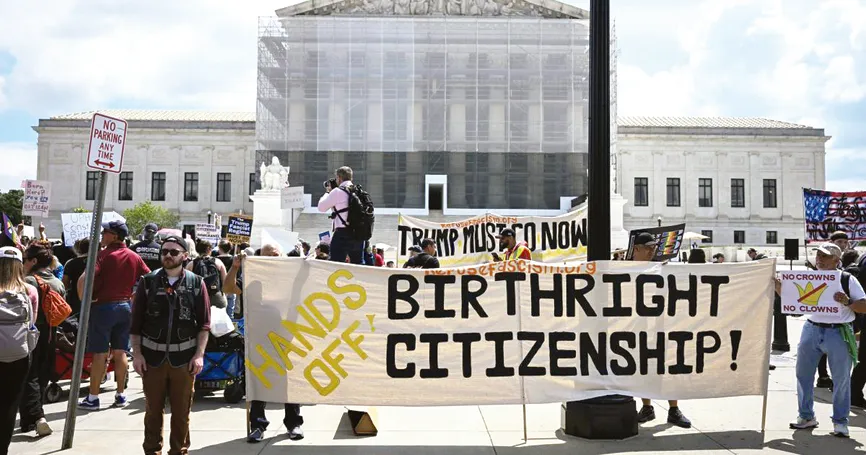
WASHINGTON: The United States Supreme Court on Tuesday upheld the constitutional guarantee of birthright citizenship, rejecting President Donald Trump’s executive order that sought to deny automatic citizenship to children born in the United States to parents residing in the country illegally or on temporary visas, in a ruling that reinforces a long-standing interpretation of the Fourteenth Amendment.
In a 6-3 decision, the court held that the Citizenship Clause of the Fourteenth Amendment, together with federal law, guarantees citizenship to virtually every person born on American soil, subject only to limited exceptions such as children of foreign diplomats. The ruling leaves intact decades of constitutional precedent and represents a major legal setback for the Trump administration’s immigration agenda.
Writing for the majority, Chief Justice John Roberts said the Fourteenth Amendment extended the promise of citizenship to “every free-born person in this land,” reaffirming that citizenship carries the right to participate fully in the nation’s political community. The majority relied on the historical understanding of the amendment, adopted after the Civil War, and subsequent federal legislation governing citizenship.
The majority opinion was joined by Justices Brett Kavanaugh and Amy Coney Barrett, along with the court’s three liberal justices. Dissenting were Justices Clarence Thomas, Samuel Alito and Neil Gorsuch. In a lengthy dissent, Thomas argued that the President’s order should not have been declared unconstitutional and maintained that the Fourteenth Amendment was intended to secure equal rights for formerly enslaved people rather than extend citizenship to children of temporary visitors or undocumented immigrants.
Trump’s executive order had directed federal agencies to deny recognition of citizenship to children born in the United States if neither parent was an American citizen nor a lawful permanent resident. The directive had been blocked by lower federal courts before it could take effect, with judges concluding that it conflicted with the Constitution and federal citizenship law. The case attracted nationwide attention when the Supreme Court heard oral arguments in April, with justices across the ideological spectrum questioning the constitutional basis of the administration’s position. Tuesday’s verdict effectively preserves the established interpretation of birthright citizenship that has remained in force for more than a century under the Fourteenth Amendment.