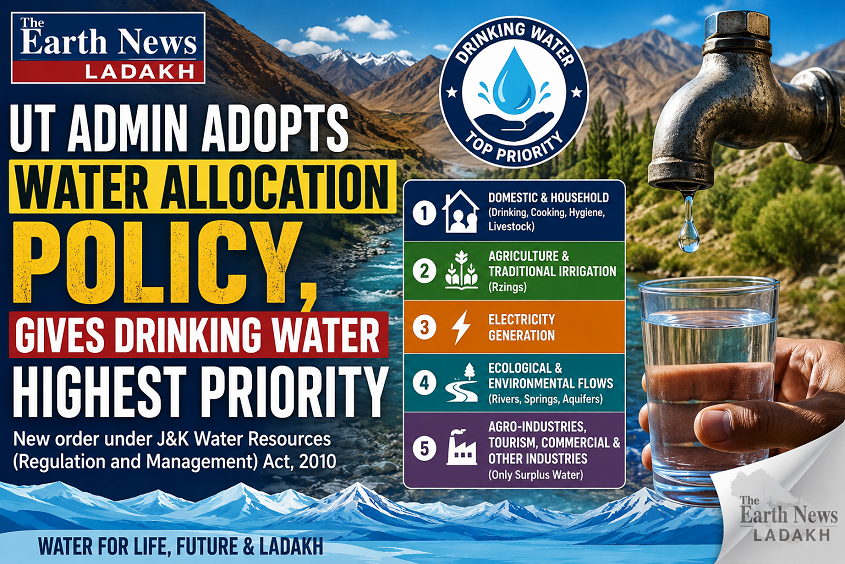
To ensure scientific and equitable water management, the Administration has prescribed a mandatory hierarchy for water allocation.
LEH: In a major policy decision aimed at safeguarding water security in the high-altitude region, the Administration of the Union Territory of Ladakh has accorded drinking water supply for domestic purposes the highest priority in the allocation and utilization of both surface water and groundwater resources across the Union Territory.
The order has been issued with immediate effect under the provisions of the Jammu and Kashmir Water Resources (Regulation and Management) Act, 2010, and the operational guidelines of Jal Jeevan Mission (JJM) 2.0.
Issued by the PHE/I&FC Department, the directive mandates that drinking water shall be the first charge on all available water resources in Ladakh. It requires every department, local authority, and agency involved in water planning, development, regulation, and management to reserve adequate quantities of water for household consumption before considering allocations for irrigation, power generation, industries, commercial establishments, or any other purpose.
To ensure scientific and equitable water management, the Administration has prescribed a mandatory hierarchy for water allocation. Domestic and household requirements, including drinking, cooking, hygiene, and livestock needs, have been placed at the highest priority. Agriculture and traditional community irrigation systems (Rzings) have been ranked second, followed by electricity generation.
Ecological and environmental flow requirements, including the protection of rivers, springs, and aquifers (Chumiks), have been placed fourth, while agro-industries, tourism, commercial establishments, and other non-agricultural industries will receive water only after the higher-priority needs have been fully met and subject to the availability of surplus water.
Recognising Ladakh’s fragile water ecosystem and the growing pressures of climate variability, the Administration has also prohibited any diversion or abstraction of water from public drinking water sources if such action could adversely affect the quantity, quality, sustainability, or reliability of potable water supply. The order further safeguards household water sources created under the Jal Jeevan Mission and the Public Health Engineering sector, particularly during the region’s harsh winter freeze, when water availability becomes critically constrained.
The order also warned that any violation of these directions will invite action under the Jammu and Kashmir Water Resources (Regulation and Management) Act, 2010, and other applicable laws. The directive has come into force with immediate effect and has been circulated to all Administrative Secretaries, Deputy Commissioners, Heads of Departments, and concerned agencies for strict implementation across the Union Territory.
The decision marks a major step towards strengthening Ladakh’s long-term water governance framework by placing human consumption and sustainable resource management at the centre of policy, while balancing agricultural, ecological, and developmental needs in one of India’s most water-sensitive regions.