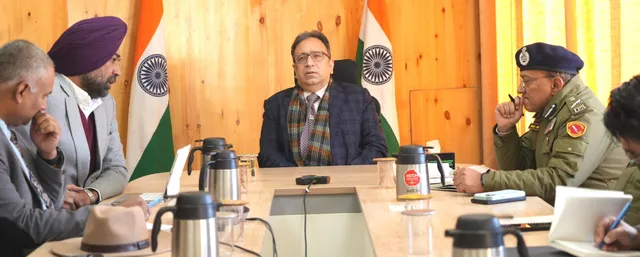
DCs to head district-level bodies; focus on identifying skill gaps, industry demand, job placements, apprenticeships and livelihood opportunities
LEH: Linking skill development programmes with actual employment opportunities and local economic requirements, the Ladakh Administration has ordered the constitution of District Skill Committees (DSCs) across all eight districts of the Union Territory, assigning them a broader role in identifying skill gaps, assessing industry requirements and facilitating employment and livelihood opportunities for local youth.
The committees, to be chaired by the respective Deputy Commissioners or Chief Executive Officers of the LAHDCs, will function as district-level focal points for planning, coordinating and sustaining skill development initiatives. Their mandate goes beyond conducting vocational training programmes, placing particular emphasis on ensuring that the skills imparted to young people correspond to the requirements of local industries, establishments and emerging livelihood sectors.
The order, issued by the General Administration Department on November 20, 2026, under Order No. 569-LA(GAD) of 2026, supersedes the earlier order of March 5, 2021, and provides for the constitution of committees in Leh, Kargil, Drass, Sankoo, Zanskar, Sham, Nubra and Changthang.
A significant responsibility assigned to the committees is the preparation and review of District Skill Development Plans (DSDPs). These plans will assess the nature and magnitude of skill gaps in each district through an analysis of labour-market requirements, demand and supply of skills, employment-generation capacity and proposed interventions.
The district plans will subsequently form the basis for identifying district-specific job roles and will be consolidated by the UT Administration into an aggregated State Skill Development Plan.
This approach is intended to make skill development more demand-driven rather than relying solely on conventional training programmes, by identifying what skills are actually required in different districts and the employment opportunities available for those possessing them.
The committees have also been tasked with assessing present and future skill requirements of industries and establishments in their respective districts. Based on this assessment, they will suggest appropriate vocational training and other measures to bridge identified skill gaps.
Another important component is the identification of future industry demand and exploration of methods to increase livelihood opportunities and facilitate employment generation at the district level.
The committees will work towards convergence of skill development schemes operated by the Central and UT Administrations, Government departments, Industrial Training Institutes (ITIs), PMKVY/PMKK centres, National Skill Development Corporation (NSDC) centres and other vocational training providers.
They will also review the infrastructure, machinery and other facilities available with government and private ITIs, PMKVY/PMKK centres and NSDC centres to ensure their optimal utilisation.
Significantly, the order places considerable emphasis on employment linkages, addressing an important aspect of skill development — translating vocational qualifications into actual jobs and sustainable livelihoods.
The committees will coordinate with industries and establishments to strengthen industry linkages, facilitate On-the-Job Training (OJT) and apprenticeship opportunities, and monitor the progress of apprenticeship schemes.
They will also facilitate placements of skilled youth in nearby industries and establishments and organise Kaushal Melas and Rozgar Melas at the district level. Entrepreneurship training, mentoring, handholding and linkages with financial institutions and relevant government schemes have also been included in their mandate.
The committees will further organise awareness and career-counselling activities for unemployed youth regarding industry demand, vocational trades, skill development programmes, employment opportunities, financial incentives and schemes available for financing local entrepreneurship.
The use of local media and suitable communication channels, along with registration on platforms such as the National Career Service (NCS) and Labour Market Information System (LMIS), will be encouraged to connect job seekers with available opportunities.
In a region where traditional occupations, local crafts and livelihood activities have considerable economic significance, the order specifically provides for coordination between government departments and industries to build and nurture a skilled workforce in local arts, crafts and trade.
The committees will also facilitate the mobilisation and engagement of unemployed youth through Panchayati Raj Institutions (PRIs), Urban Local Bodies (ULBs), NGOs, educational institutions and other local stakeholders.
Other responsibilities include developing a pool of trainers in various trades, organising convocations for vocational graduates to recognise their achievements and encourage self-employment, and undertaking regular field-level monitoring of skill development interventions.
The committees will also facilitate convergence of funds and resources available under various Central and UT Administration schemes to strengthen the district skill-development ecosystem. The composition of the committees brings together district administration, technical education, employment, industry, social welfare, tourism, banking and other relevant sectors.
Apart from the Deputy Commissioner/CEO LAHDC as Chairperson, the committees will include the General Manager of the District Industries Centre, Deputy Director Employment, Principals of Government Degree Colleges, Chief Education Officer, District Social Welfare Officer, Assistant Labour Commissioner, Assistant Director Tourism, Wildlife Warden, Manager District Lead Bank and Superintendent Government ITI, who will ordinarily function as Convenor.
The committees will also include one to three representatives from industrial clusters or prominent industries in the district, to be nominated by the concerned Deputy Commissioner, besides up to three other members who may be co-opted by the Chairperson.
The order also makes special transitional arrangements for newly created districts. Officers marked in the composition will continue to serve on the committees of the newly created districts that were previously part of the erstwhile districts until the corresponding district-level posts are filled. Principals of Government Degree Colleges in Nubra, Drass, Khaltsi and Zanskar have been designated as Convenors for their respective districts.
With this institutional arrangement, the Administration has sought to establish a district-specific mechanism that brings together training institutions, employers, government departments and local stakeholders, with the stated objective of making skill development more responsive to employment demand, local economic potential and livelihood opportunities across Ladakh.