LEH: The Ladakh Administration has directed government departments, drawing and disbursing officers (DDOs), local authorities and other eligible public bodies to strictly comply with provisions governing the deduction of tax at source (TDS) under Section 51 of the Central Goods and Services Tax (CGST) Act, 2017, warning that non-compliance could lead to interest, penalties and recovery of financial liabilities.
According to reports, the Finance Department of the Union Territory of Ladakh highlighted that GST-TDS provisions, in force since October 1, 2018, were not being uniformly implemented across the Union Territory. The instructions have been issued to ensure compliance with statutory requirements and prevent avoidable expenditure from public funds.
Under the prescribed provisions, GST-TDS is applicable where the total value of taxable supplies under a contract exceeds ₹2.50 lakh, excluding the central tax, Union Territory tax, integrated tax and cess indicated in the invoice. The applicable deduction rate is 1% CGST plus 1% UTGST for supplies within Ladakh, and 2% IGST for inter-State supplies, subject to the prescribed conditions.
The circular identifies departments and establishments of the Central Government and Ladakh Administration, local authorities, government agencies, specified boards and bodies, societies established by governments or local authorities, and public sector undertakings among the entities required to deduct tax where applicable. Societies, agencies and missions implementing Centrally Sponsored Schemes through Single Nodal Agency (SNA) or other bank accounts are also covered, even when payments do not pass through the Treasury.
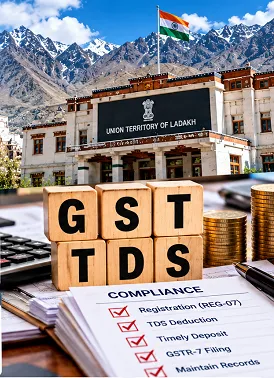
The Finance Department has directed all eligible deductors to obtain registration as tax deductors under Form GST REG-07, under the Union Territory of Ladakh, and to deduct tax at the time of payment or credit to the supplier. Entities continuing to operate under their erstwhile Jammu and Kashmir registration have been instructed to obtain fresh registration accordingly.
The tax deducted must be deposited within ten days after the end of the month in which the deduction is made. Deductors are also required to file returns in Form GSTR-7 by the 10th of the succeeding month, including nil returns for months in which no deduction is made. They must maintain registers of deductions, provide the prescribed TDS certificates to suppliers and furnish their GST identification number to the State Taxes Department within 30 days of the circular’s issuance.
The circular clarified that deduction under Section 51 is separate from and independent of tax deductible at source under the Income-tax Act. However, deductions are not required in specified cases, including certain supplies between eligible government departments or notified bodies, supplies between public sector undertakings, and wholly exempt or non-taxable supplies. Prescribed conditions relating to supplier location, place of supply and recipient registration will also apply.
The Administration has cautioned that violations may carry financial consequences. These include interest on tax deducted but not deposited, a penalty of ₹10,000 or the amount of tax not deducted or short-deducted or deducted but not deposited, whichever is higher, and late fees for delayed filing of GSTR-7, subject to applicable provisions and exemptions. Authorities may also initiate determination and recovery proceedings for amounts in default.
Emphasising accountability, the circular states that interest, penalties and late fees arising from default or negligence constitute avoidable expenditure from public funds. Where such liabilities arise from the failure or negligence of a Drawing and Disbursing Officer or another official, personal responsibility is to be fixed and the loss recovered in accordance with Rule 33 of the General Financial Rules, 2017, without prejudice to applicable conduct and disciplinary proceedings.
All Heads of Departments have been instructed to circulate the directions among officials handling bills and payments. Treasury Officers must ensure that bills attracting Section 51 are not passed without the required deduction.