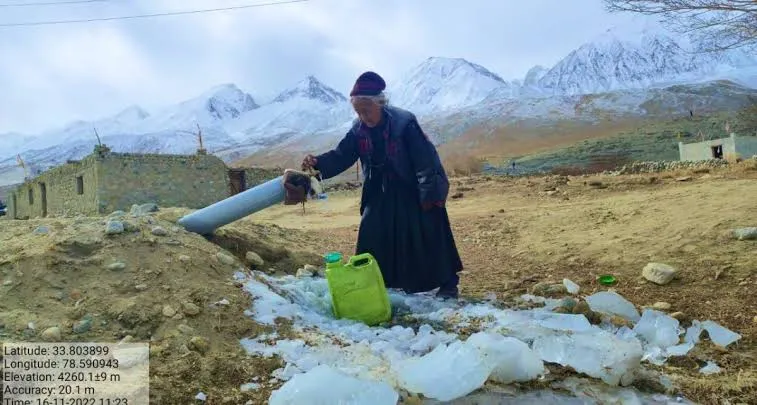
- New 100-mark assessment framework sets 55 LPCD water supply benchmark, over 98% functional household tap connections and winter resilience down to -30°C*
HABEEL SAGAR
LEH: In a move aimed at strengthening the sustainability, accountability and efficiency of rural drinking water supply systems, the Administration of Union Territory of Ladakh has introduced a biannual performance benchmarking mechanism for Village Water and Sanitation Committees (VWSCs), designating them as Micro-Utilities under the Jal Jeevan Mission (JJM) 2.0.
The PHE/I&FC Department has directed that every VWSC functioning as a Micro-Utility shall undergo a performance assessment twice during each financial year. The exercise will be conducted by the respective District Technical Units (DTUs) to evaluate the functioning of village-level water supply systems, service delivery, maintenance practices and financial management.
The initiative follows the signing of a Memorandum of Understanding between the Ladakh PHE/I&FC Department and the National Jal Jeevan Mission under the Department of Drinking Water and Sanitation, Ministry of Jal Shakti, for implementation of JJM 2.0 in the Union Territory.
The new framework seeks to shift the emphasis from merely providing household tap connections to ensuring reliable, sustainable and accountable water supply services, with particular attention to Ladakh’s challenging climatic conditions.
Under the prescribed assessment framework, each Micro-Utility will be evaluated on a maximum of 100 marks through a detailed checklist covering six major performance parameters: governance and institutional performance (15 marks), service delivery (25 marks), water quality and public health (20 marks), operation and maintenance (20 marks), financial management (10 marks), and sustainability and climate resilience (10 marks).
Significantly, the service delivery component carries the highest weightage of 25 marks. The framework sets a benchmark of more than 98 per cent functional household tap connections, daily water supply on 100 per cent of days, and a minimum service level of 55 litres per capita per day (LPCD), or as prescribed in the scheme design.
It also stipulates that more than 95 per cent supply reliability should be maintained, over 90 per cent of water supply breakdowns should be restored within 24 hours, and more than 90 per cent of consumer complaints should be resolved within 72 hours. Household satisfaction has similarly been assigned a benchmark of over 90 per cent.
Governance and institutional performance will be assessed through the constitution and notification of VWSCs, representation of at least 50 per cent women members, conduct of 12 meetings annually, maintenance of meeting proceedings, approval of annual operation and maintenance plans, and upkeep of village water security plans, asset registers and complaint registers.
The water quality and public health component places emphasis on maintaining residual chlorine as per prescribed standards, conducting weekly Field Testing Kit (FTK) tests, completing laboratory testing on a monthly or quarterly basis, carrying out half-yearly sanitary inspections and implementing Water Safety Plans. Committees will also be assessed on their response to water contamination and public awareness activities.
Under operation and maintenance, the assessment will examine preventive maintenance, monthly pump maintenance, prompt repair of leakages within 48 hours, cleaning of storage reservoirs twice a year, quarterly inspection of distribution networks and regular monitoring of energy consumption.
Financial accountability will also form an important part of the exercise. The framework requires each VWSC to maintain a separate operational bank account, update its cash book monthly, collect more than 80 per cent of user charges, prepare annual financial statements and maintain updated records of operation and maintenance expenditure.
A particularly significant feature of the framework is its focus on climate resilience and Ladakh-specific requirements. The assessment will examine whether water sources are sustainable, catchment protection measures are implemented, snow harvesting and recharge systems are functional, and greywater management arrangements are in place.
The framework also introduces additional observations specifically suited to Ladakh’s harsh winters, including protection of pipelines against freezing, adequate insulation of exposed pipelines and storage reservoirs, functionality of solar pumping systems, availability of backup power and emergency water storage, and continuity of water supply during winter.
Monitoring of spring and glacier-fed water sources and regular supply to remote habitations will also be recorded as part of the assessment. The accompanying checklist outlines winter-resilient service-level benchmarks, including 55 LPCD water supply and 100 per cent functionality of systems down to minus 30 degrees Celsius.
For performance evaluation, the framework introduces a graded classification system. Micro-Utilities scoring 90–100 marks will receive Platinum grade, while those scoring 80–89 will be placed in the Gold category. Scores of 70–79 and 60–69 will qualify for Silver and Bronze grades, respectively. Utilities scoring below 60 marks will be categorised as requiring improvement, with corrective action prescribed.
The order further mandates the DTUs to prepare detailed assessment reports for individual Micro-Utilities after every assessment cycle. Findings, observations and recommendations will be submitted to the concerned District Water and Sanitation Mission (DWSM), which will review the reports and issue necessary directions to the respective VWSCs for improving service delivery and operation and maintenance.
The DTUs will also submit consolidated district-wise performance reports to the State Water and Sanitation Mission (SWSM)/PHE and I&FC Department after each assessment cycle.
The concerned VWSCs will be required to undertake corrective measures within timelines prescribed by the DWSM, with compliance to be verified during subsequent assessments.
The assessment exercise will be undertaken during two cycles — April to September and October to March. The Executive Engineer of the PHE/I&FC Department will serve as the verification authority, while the DTUs will prepare an annual assessment calendar to ensure that every Micro-Utility is evaluated twice a year.
The checklist also provides for recording major strengths, deficiencies, corrective actions, capacity-building requirements and timelines for compliance, with certification by the DTU assessor, VWSC chairperson and Gram Panchayat representative.
The order has been issued in pursuance of the JJM 2.0 Operational Guidelines and its Comprehensive Implementation and Reform Plan (CIRP) Reform Matrix 2.2.4 on performance benchmarking of water utilities.
The new mechanism is intended to strengthen village-level institutional responsibility for rural drinking water systems and ensure that the infrastructure created under Jal Jeevan Mission translates into dependable, quality and year-round water supply, particularly in remote and high-altitude settlements of Ladakh.