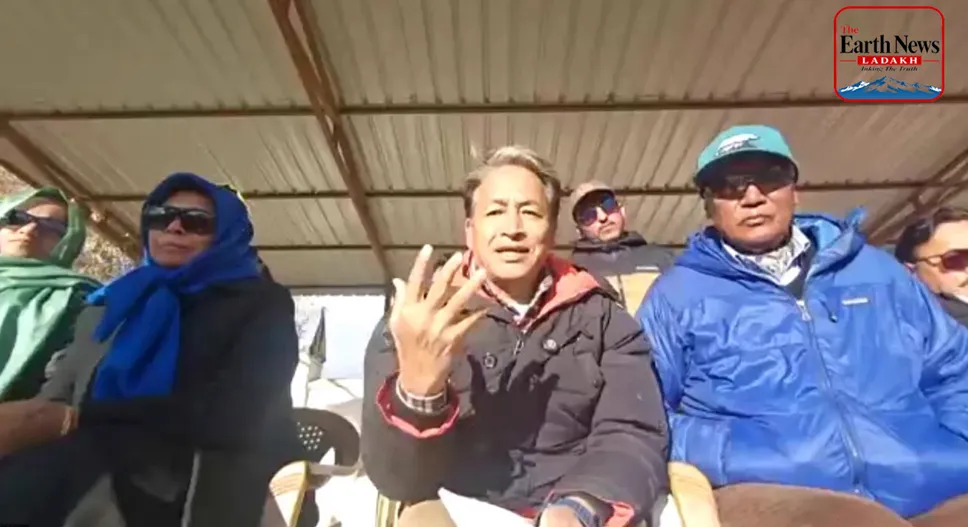
LEH: A fresh confrontation between climate activist Sonam Wangchuk and the Ladakh administration unfolded on Saturday as the activist joined the Leh Apex Body (LAB)-led protest in Leh, alleging that he had been kept under effective house arrest for 10 days and that police personnel deployed outside his residence were withdrawn only after the matter came under judicial scrutiny.
Addressing a press conference alongside LAB chairman Chering Dorje Lakruk at the protest site, Wangchuk questioned the legality of the restrictions imposed on his movement, accused the administration of using police personnel to carry out unjustified actions and sought intervention from President Droupadi Murmu and Prime Minister Narendra Modi, saying constitutional freedoms and democratic values must be protected.
The activist’s allegations came a day after Leh district police announced the withdrawal of security arrangements outside his residence, maintaining that the deployment had been made to ensure compliance with a prohibitory order issued by the Additional District Magistrate (ADM), Leh, and clarifying that he had not been placed under house arrest.
Wangchuk, however, disputed the police version, describing the statement as bizarre and questioning how the administration could deny restricting his movement when, according to him, he had been prevented from stepping outside his residence.
Recounting the events of November 11, Wangchuk alleged that he was forcibly picked up while preparations were underway for an indefinite protest aimed at pressing for the resumption of dialogue with the Centre and seeking deferment of the Hill Council elections scheduled for December 4.
Describing the circumstances surrounding his alleged detention, Wangchuk claimed that the personnel who arrived to take him away were wearing masks and hoodies, with their faces concealed.
“Those who came were wearing masks and hoodies, with their faces concealed. I would hesitate to even call them policemen because they looked more like goons,” he said.
He alleged that although he had agreed to go to jail, he was instead taken to his residence at the Himalayan Institute of Alternatives, Ladakh (HIAL), where nearly two dozen personnel from the local police and Central Reserve Police Force (CRPF), dressed in commando fatigues and carrying firearms, were deployed.
Wangchuk said he subsequently decided to challenge the restrictions through legal channels, with assistance from lawyers in Delhi and Ladakh. According to him, an appeal was filed before the High Court bench in Leh on November 17 and listed for hearing the following day.
He claimed that no government representative appeared during the November 18 hearing, following which the court granted the government time until November 19 to submit its response.
The activist further stated that Solicitor General of India Tushar Mehta appeared before the court on November 19 and sought additional time until November 23, a request that was granted.
“Taking advantage of this time, the authorities withdrew all the personnel deployed outside my residence Friday night,” Wangchuk alleged, linking the withdrawal to the ongoing court proceedings.
In a post on X, Leh district police stated that arrangements made to ensure compliance with the prohibitory order had been withdrawn. The police clarified that the Additional District Magistrate, Leh, had issued the order against Wangchuk and maintained that he had not been placed under house arrest, contrary to the claims being made.
Rejecting the police clarification, Wangchuk accused the administration of effectively denying restrictions on his movement when confronted with judicial scrutiny, alleging a contradiction between the ground situation and the official position.
“This is an extremely strange way for a government to function. The State is behaving like a rogue state, where anyone can simply be picked up and detained. But when it is required to face the truth in a court of law, it suddenly claims that nothing happened and that there was no such detention,” he said, referring also to his earlier arrest under the National Security Act (NSA).
Wangchuk also expressed sympathy for the police personnel and administrative officers deployed outside his residence, alleging that they were being made to carry out actions that could compromise their professional responsibilities.
“I hope that when they joined the civil services, whether the IPS or IAS, they did so with great aspirations and a genuine desire to serve the country. Today, however, they are being used and misused like pawns in what resembles a mafia gang,” he said.
Appealing to people across the country, Wangchuk said such practices must stop, asserting that India, as the world’s largest democracy, must uphold constitutional values and ensure that government officials and police personnel function within the bounds of the law.
“I have appealed to President Murmu and the prime minister to put an end to this lawlessness and ensure that our officers and police personnel are allowed to discharge their duties with dignity and within the bounds of the law,” he said.
Meanwhile, reiterating his support for the ongoing agitation, Wangchuk said he had joined his colleagues at the LAB-led protest site, where the sit-in had continued for 10 days. He maintained that the demonstration was peaceful and authorised, and asserted that the protesters were seeking dialogue with the Centre rather than confrontation.
The activist also renewed his opposition to holding the upcoming Ladakh Autonomous Hill Development Council (LAHDC) elections during the winter season, arguing that the timing could disenfranchise a sizeable section of the electorate and place additional logistical burdens on election personnel.
Wangchuk maintained that the people of Ladakh were not opposed to elections but wanted the democratic exercise to be conducted at a time when residents, including those temporarily outside the region, could participate without being hindered by harsh weather conditions.
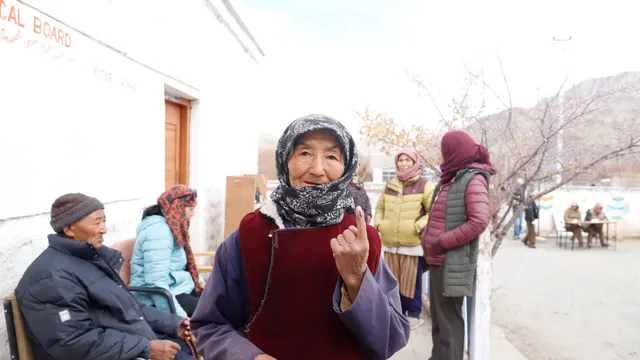
“On the one hand, we send a message to the world that we take democracy to the last citizen, even flying helicopters to polling stations where there are just two voters. On the other hand, we are excluding 40 to 50 per cent of the population and conducting elections during winter, amid snowfall, while also subjecting government officials to immense hardship,” he said.
He argued that a substantial section of Ladakh’s population would be outside the region during winter, potentially affecting voter participation, while snowfall and difficult weather conditions could make election management particularly challenging in remote and snowbound areas.
Wangchuk said the administration should reconsider its approach and ensure that electoral processes remained inclusive, allowing people to exercise their franchise without geographical or seasonal constraints.
The press conference thus brought two contentious issues back into focus — the alleged restrictions on Wangchuk’s movement and the timing of the forthcoming Hill Council elections — with the activist calling for government intervention and a reconsideration of the administration’s approach towards the ongoing political demands in Ladakh.