Karbalie seeks holistic MHA proposal while Kargili questions land policies and warns that assurances alone will not protect Ladakh
KARGIL: The Kargil Democratic Alliance (KDA) has suspended its proposed Kargil-to-Leh Pad Yatra, citing the Leh Apex Body’s decision to suspend the Leh leg of the programme ahead of the September 9 meeting of the Ministry of Home Affairs (MHA) sub-committee.
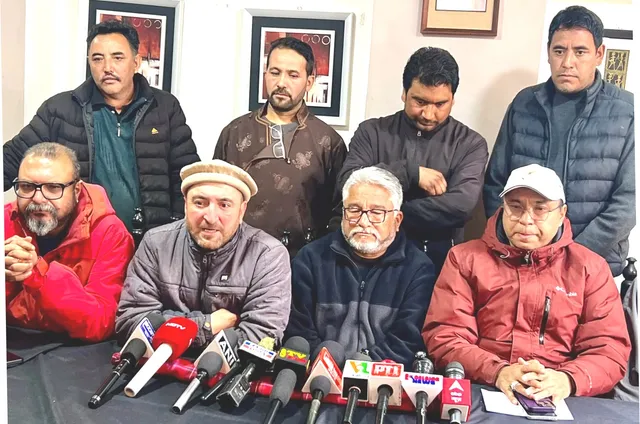
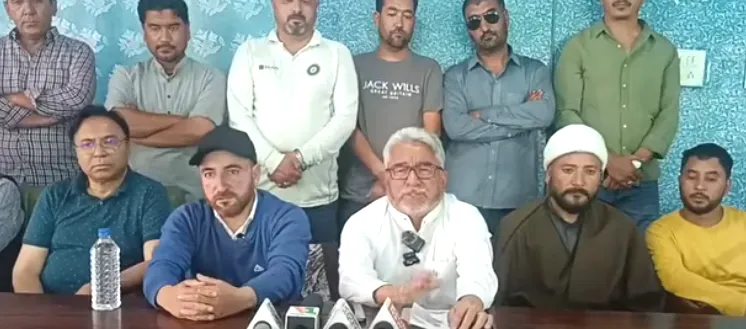
Addressing a press conference, KDA Co-Chairman Asgar Ali Karbalie said the proposed march was conceived as a joint expression of support for Ladakh’s long-pending demands, including statehood, Sixth Schedule safeguards and justice for the victims of the September 24, 2025 violence. The KDA had extended logistical support to the programme after consultations with its stakeholders and the organisers.
Karbalie said that after the LAB decided to suspend the Leh portion of the march in view of the September 9 MHA meeting, the KDA held its own deliberations and concluded that continuing with only half of the proposed journey would not serve its intended purpose.
“Halfway” continuation of the Pad Yatra would have made little sense, he indicated, announcing that the KDA was therefore suspending its own programmes linked to the march, including the rally planned for September 10 and the subsequent Pad Yatra.
The KDA leader, however, stressed that the decision should not be interpreted as a retreat from Ladakh’s demands. He thanked political, religious, student and civil society groups, traders, transporters, lawyers, contractors, councillors, village representatives and other stakeholders who had already made preparations and offered logistical support for the proposed mobilisation.
While announcing the suspension, Karbalie struck an optimistic note on the forthcoming MHA talks, saying the KDA was awaiting a “concrete” and “holistic” draft on the safeguards being sought for Ladakh.
According to him, earlier discussions had indicated that the proposed framework would address legislative, executive and financial powers, along with constitutional safeguards. He said the KDA was expecting the September 9 meeting to produce a concrete draft spelling out the proposed structure and powers.
The KDA leadership said it remained hopeful because, according to its account, commitments on these issues had already been recorded during earlier discussions and the MHA was expected to bring a draft to the meeting.
At the same time, Karbalie made it clear that the KDA would not endorse what it described as unilateral decisions by the UT Administration.
He alleged that decisions concerning land, culture, recruitment and structural changes were being taken without consultation with the LAB and KDA. Describing these as “bureaucratic” and “unilateral” decisions, he said the very safeguards being demanded by Ladakh’s leadership were intended to prevent such decisions from being imposed on the region without local consultation.
KDA Co-Chairman Sajjad Kargili gave a sharper political edge to the briefing, questioning whether the September 9 meeting itself could be treated as a guarantee of any major announcement.
He said the timing of the MHA meeting, coming after the announcement of the Pad Yatra, should not automatically be taken as evidence that a breakthrough was certain. According to him, the MHA had in the past held meetings when protests or mass programmes were announced.
Kargili particularly targeted recent land-related measures, alleging that while safeguards under Article 371 were being discussed, orders affecting land were simultaneously being issued.
He questioned the rationale of seeking constitutional safeguards if, in his view, protections over land were being weakened through administrative decisions. He demanded that unilateral land-related rules be withdrawn and argued that no such decisions should be taken until consultations between the LAB and KDA take place.
The KDA leadership also objected to what it described as unilateral decision-making by the administration and called for future decisions concerning Ladakh’s core issues to be taken through joint consultation between the two principal political bodies.
Responding to questions over the cancellation of the march, Kargili said the proposed Pad Yatra was not intended to project a separate Kargil agenda.
He said the march was conceived as a larger Ladakh-wide programme, including demands relating to the four people killed and those injured in the September 2025 violence, as well as compensation and release of people who had been arrested in connection with the episode.
Kargili said the idea of the march had originally emerged during consultations involving Socialist Party of India general secretary Sandeep Pandey and other civil society representatives. He said the proposal was subsequently discussed with Ladakh leaders and the dates and route were finalised after consultations.
He regretted that the march could not now proceed as originally planned but maintained that the KDA remained committed to continuing a peaceful movement over Ladakh’s demands.
Asked whether years of talks with the Centre had yielded tangible results, the KDA leadership acknowledged several developments, including reservation-related measures and other decisions concerning Ladakh, while arguing that major safeguards remained unresolved.
The leadership pointed to 95 per cent reservation for Ladakhis, proposed measures relating to the Ladakh cadre, Ladakh Civil Service and Ladakh Police Service, and commitments regarding greater legislative, executive and financial powers as outcomes of sustained negotiations and agitation. The KDA said the crucial question now was whether the commitments discussed earlier would be translated into a formal framework.
It said the September 9 meeting would be particularly significant because the proposed draft is expected to clarify the structure and powers of the legislative body, the executive mechanism, financial powers and the role of the bureaucracy. The KDA reiterated that it would continue to oppose administrative steps it considers detrimental to Ladakh’s interests, particularly those relating to land and recruitment. The leadership said that while it remained hopeful about a positive outcome from the September 9 meeting, any unilateral measures introduced by the UT Administration in the interim would not be endorsed.