Ladakh leaders submit detailed constitutional framework; insist May 22 understanding must be honoured in full, seek withdrawal of all Sept 24 cases and dignified compensation; formal Delhi meeting expected in first week of September
YASH KHAJURIA
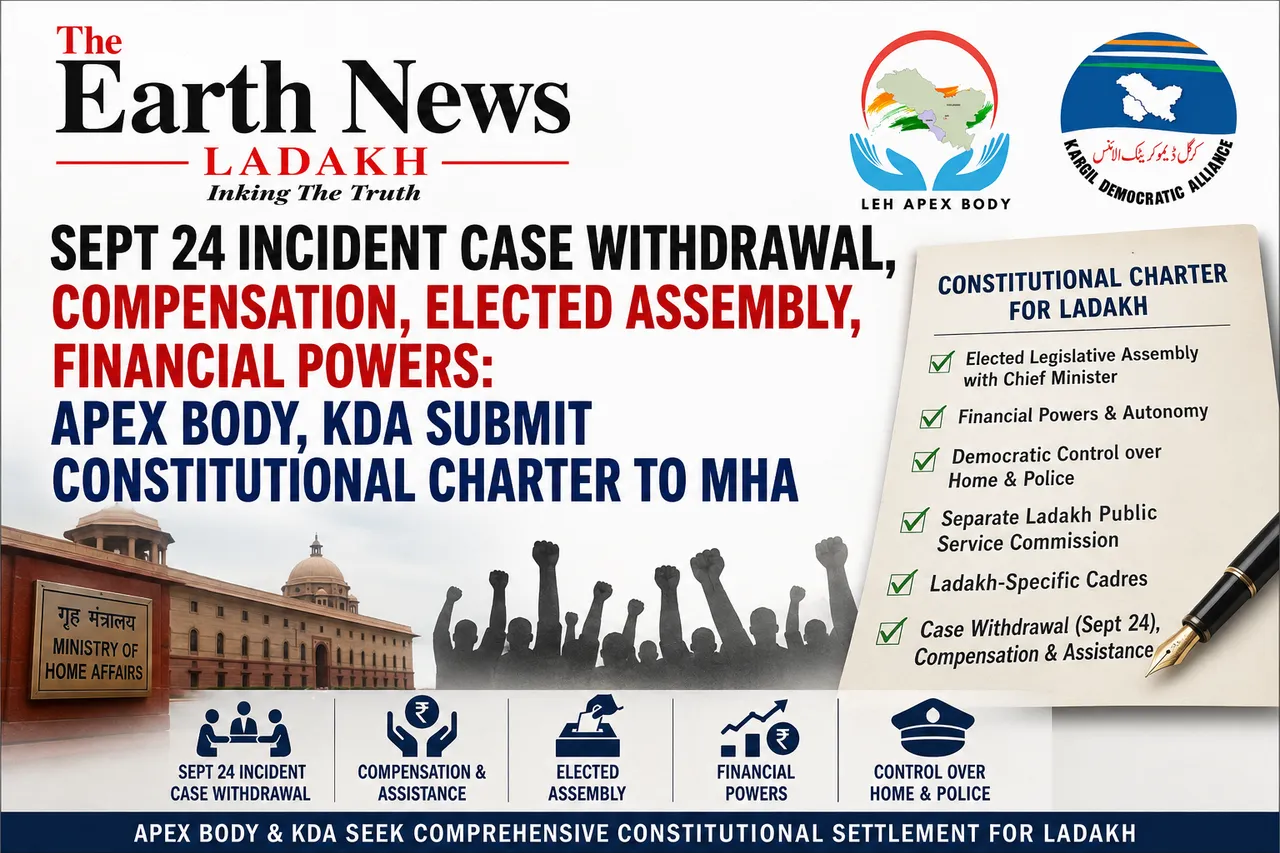
LEH: The Leh Apex Body (ABL) and Kargil Democratic Alliance (KDA) placed a detailed set of “important and non-negotiable” demands before the Ministry of Home Affairs (MHA), including an elected Ladakh Legislative Assembly headed by a Chief Minister, substantial control over finances, democratic control over Home and Police, a separate Ladakh Public Service Commission and Ladakh-specific administrative and police cadres.
The charter, submitted during a meeting held today with the MHA team in Leh, also sought immediate withdrawal of cases arising from the September 24, 2025 violence, including FIR No. 144, besides dignified compensation and assistance for the families of those killed, the injured and other victims.
The demands assume significance as the two bodies made it clear that they will not accept dilution or selective implementation of the understanding reached with the MHA on May 22, 2026, and have sought a formal high-level meeting in New Delhi in the first week of September to take up their constitutional proposals.
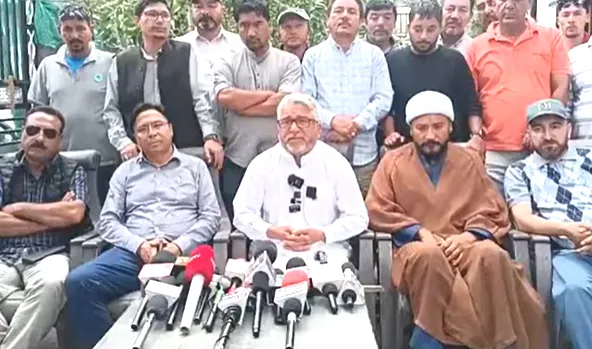
Co-Chairman of the Kargil Democratic Alliance, Asgar Ali Karbalie, said the meeting held in Leh was the second informal interaction and that the Apex Body and KDA had insisted on sticking to their core agenda instead of allowing the discussion to be diverted primarily towards developmental issues.
According to Karbalie, the delegation had expected a higher-level MHA representation but nevertheless used the meeting to formally submit its detailed “important and non-negotiable” memorandum covering the proposed legislative, executive and financial architecture for Ladakh.
“We are on our agenda,” Karbalie said, explaining that the delegation wanted detailed discussions on the proposed Legislature, financial powers, executive structure and constitutional safeguards for Ladakh.
The document submitted to the authorities proposes that the future arrangement should have an Assembly called the Ladakh Legislative Assembly, headed by a Chief Minister and a Council of Ministers, with members directly elected from constituencies created through a constitutionally recognised delimitation mechanism.
It further demands that the powers and functions of the proposed setup be based substantially on Lists II and III of the Seventh Schedule of the Constitution, with necessary reference to the Union Territories Act, 1963.
Significantly, the document proposes that the Lieutenant Governor of Ladakh should act on the aid and advice of the elected Assembly, citing the need to prevent conflicts that have emerged in some Union Territories.
The charter also makes a strong case for constitutional protection of the Legislature’s powers, drawing upon constitutional arrangements applicable to states and safeguards associated with provisions such as Articles 371A, 371F and 371G.
Financial autonomy forms one of the four principal pillars of the proposed democratic arrangement. The Apex Body and KDA have demanded that the elected Ladakh Legislative Assembly have meaningful and constitutionally protected control over taxation, budget, appropriation, expenditure, borrowing and public funds.
They have also sought constitutionally protected Consolidated and Contingency Funds for Ladakh and provisions corresponding to Articles 198 to 209 concerning Money Bills, annual financial statements, grants, appropriation and financial procedure. The document further called for extending the relevant provisions of Article 246 and the Seventh Schedule to the proposed Ladakh framework.
Another major demand is substantial democratic control over Home Affairs, public order and police. The groups have proposed that Home Affairs be placed substantially under the control of the elected government and the Ladakh Legislative Assembly, with the constitutional framework drawing upon Articles 162, 163 and 166(3) and relevant provisions of the Seventh Schedule.
The document cites arrangements applicable to Puducherry and the erstwhile Union Territory of Mizoram as constitutional reference points for Ladakh.
The charter also sought a separate Ladakh Public Service Commission, along with distinct Ladakh Administrative and Police Services and appropriate Ladakh-specific cadres. For this purpose, it proposes necessary constitutional and legislative amendments, including changes concerning Section 93(2) of the J&K Reorganisation Act, 2019 and Article 315 of the Constitution.
The stated objective is to create an appropriate constitutional framework for Ladakh’s public services in the event of establishment of a UT-level elected Legislature.
Pending a final constitutional settlement, the two bodies have also demanded interim safeguards to protect Ladakh’s land, economic and demographic interests. The document proposed that a valid Ladakh Residence Certificate should be mandatory for registration of business units, establishment and regulation of commercial activities and grant or renewal of trade licences.
It further calls for Ladakh-specific Scheduled Tribe certification to govern benefits and protections meant for Scheduled Tribes. A particularly significant demand is that, pending the constitutional settlement, allotment, transfer or disposal of land to persons who do not fulfil prescribed Ladakh residence requirements should remain in abeyance, with the stated objective of preventing any irreversible alteration of Ladakh’s land and economic interests.
The groups have simultaneously linked the constitutional negotiations with unresolved issues arising from the September 24, 2025 incident. Their submitted document calls for dignified compensation and appropriate assistance to the families of those killed, injured persons and other victims affected by firing and lathi-charge.
It specifically demands comprehensive and uniform withdrawal of all cases arising from the incident, including FIR No. 144, and says there should be no “selective, phased or discriminatory” withdrawal of cases.
Karbalie said the delegation had pressed for immediate action rather than a prolonged timeline, arguing that those detained or facing cases in connection with the September 24 events should not have to wait for months for relief.
He also described September 24 as a “black day” in Ladakh’s history and said the demand for case withdrawal and dignified compensation was non-negotiable for the Apex Body and KDA.
According to Karbalie, Chief Secretary Ashish Kundra, who was present during the meeting, assured the delegation that its non-negotiable and important points would be submitted to the MHA. The parties are now expected to meet formally in New Delhi during the first week of September, with the precise format—whether a committee or a high-powered committee—to be decided by the MHA.
The proposed agenda, according to Karbalie, will centre on the structure and powers of the Legislature, the executive functioning of the proposed arrangement, financial powers and constitutional safeguards.
The charter makes an important political distinction: while proposing a “sui-generis” or tailor-made democratic model in the immediate term, it retains full statehood as the ultimate goal.
The document stated that the May 22 understanding with the MHA envisaged such a mutually acceptable model because Ladakh may presently lack the revenue resources considered necessary for full-fledged statehood.
Karbalie, however, said the Apex Body and KDA had made it clear during Wednesday’s meeting that if the proposed settlement does not materialise, they would return to their demand for statehood and Sixth Schedule protection.
He warned that continued delays or dilution of the commitments could eventually force the organisations to mobilise people at the grassroots level. “We have made it clear that we will not leave our demands,” Karbalie said, indicating that the September meeting could therefore become a decisive test of whether the May 22 understanding can be translated into a concrete constitutional and administrative framework.
With the two regional bodies now formally placing their demands on record in a detailed written charter, the next round of talks in New Delhi is likely to determine whether Ladakh’s prolonged demand for an empowered democratic structure moves towards a concrete constitutional roadmap or enters another phase of negotiations.