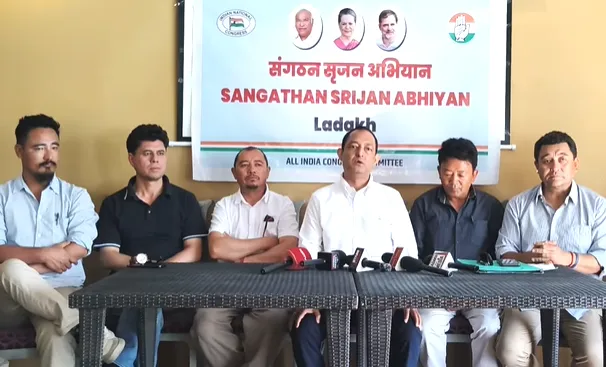
LEH: The Congress on Tuesday announced an intensified political campaign in Ladakh, placing Sixth Schedule protection, restoration of democratic institutions, withdrawal of cases related to last year’s agitation and employment at the heart of its strategy for the Union Territory.
Addressing a press conference in Leh, senior Congress leader and former NSUI president Nadeem Javed, who is overseeing the party’s organisational creation campaign in Ladakh, said the Congress would spend the next two years strengthening its grassroots organisation and taking up what it described as the fundamental concerns of the people.
Javed said the party’s national-level organisational drive was aimed at rebuilding the Congress from the ground up, with greater emphasis on direct engagement with workers and communities rather than relying solely on organisational structures at district headquarters. He said the team had undertaken extensive consultations in Ladakh, including meetings in remote areas and interactions with civil society members, intellectuals and opinion-makers.
The strongest political message from the Congress was its renewed demand for immediate implementation of the Sixth Schedule in Ladakh, which Javed said was part of the party’s manifesto and represented a commitment of its central leadership.
He argued that Sixth Schedule protection was necessary to safeguard Ladakh’s cultural identity, fundamental rights, historical interests and rights over land. Drawing parallels with Meghalaya, Nagaland and Tripura, he said the Congress would seek to work out a similar constitutional protection mechanism for Ladakh.
Responding to a question on how the party proposed to fulfil the demand, Javed said the Congress leadership would work out a constitutional and political route for implementing the commitment, reiterating that the issue was part of the party’s manifesto rather than an assurance being made for the first time at the press conference.
The Congress also made a strong pitch for restoration of an elected Assembly in Ladakh, arguing that the creation of the Union Territory had not been accompanied by adequate democratic representation.
He demanded that Ladakh adopt a model that provides for a legislative Assembly and said democratic institutions must have greater authority in representing the aspirations of the people. He pointed to the absence of Assembly elections as well as pending local elections and alleged that decision-making had become excessively bureaucratic.
The party also opposed any delimitation exercise that, according to Javed, could alter the character of constituencies to favour a particular political interest. While stating that Congress was not opposed to delimitation as such, he insisted that the exercise must ensure equal political opportunity and fair representation.
Javed alleged that four people were killed during the agitation and several others injured, while more than 80 people faced cases. He demanded withdrawal of cases against all those booked in connection with the movement, saying only a portion of the cases had so far been withdrawn.
He also recalled the participation of Ladakh-based civil society representatives in the movement and said the Congress had supported the agitation. The remarks put the issue of cases and accountability alongside Sixth Schedule and democratic safeguards as a major part of the party’s political agenda in Ladakh.
Javed said the Congress would now undertake a sustained “every household, every door” campaign across Ladakh over the next two years, seeking to reconnect with people and strengthen the party’s grassroots base.
He said the campaign would focus on democracy, Sixth Schedule, unemployment and other basic concerns, while simultaneously building a wider public movement around these issues.
The Congress leader also indicated that the party was seeking to rebuild its organisational machinery through consultations with workers rather than simply imposing office-bearers from the top. He said observers had been sent to different areas to assess potential candidates for district-level leadership and that the selection process was expected to be completed soon.
Javed said the organisational exercise was part of a larger Congress effort to respond to what the party sees as a transformed political landscape since 2014. He said Rahul Gandhi had tasked senior leaders with organisational responsibilities across states, with the objective of rebuilding the party at the grassroots level.
He also sought to connect Ladakh’s political concerns with the Congress’s wider campaign on students, youth and democratic rights, referring to the party’s support for protests over issues including examination irregularities and unemployment.
For Ladakh, however, the political significance of the Congress intervention lies principally in its attempt to consolidate several long-standing demands—constitutional safeguards, an elected legislature, protection of land and cultural identity, withdrawal of cases and employment—into a single sustained political campaign.
With the party promising a two-year grassroots mobilisation, Tuesday’s press conference signalled that the Congress intends to make these issues central to its political engagement with Ladakh rather than confining them to periodic statements or negotiations.