Identical voter particulars appear against five consecutive serial numbers at Ibex polling station; discrepancy surfaces on polling day despite months-long exercise to prepare accurate electoral rolls
LEH: Five entries carrying identical particulars of what appears to be the same voter in the electoral roll at a polling station in Leh have triggered questions over the accuracy of voter lists and the efficacy of the months-long verification exercise undertaken ahead of the crucial elections in Ladakh.
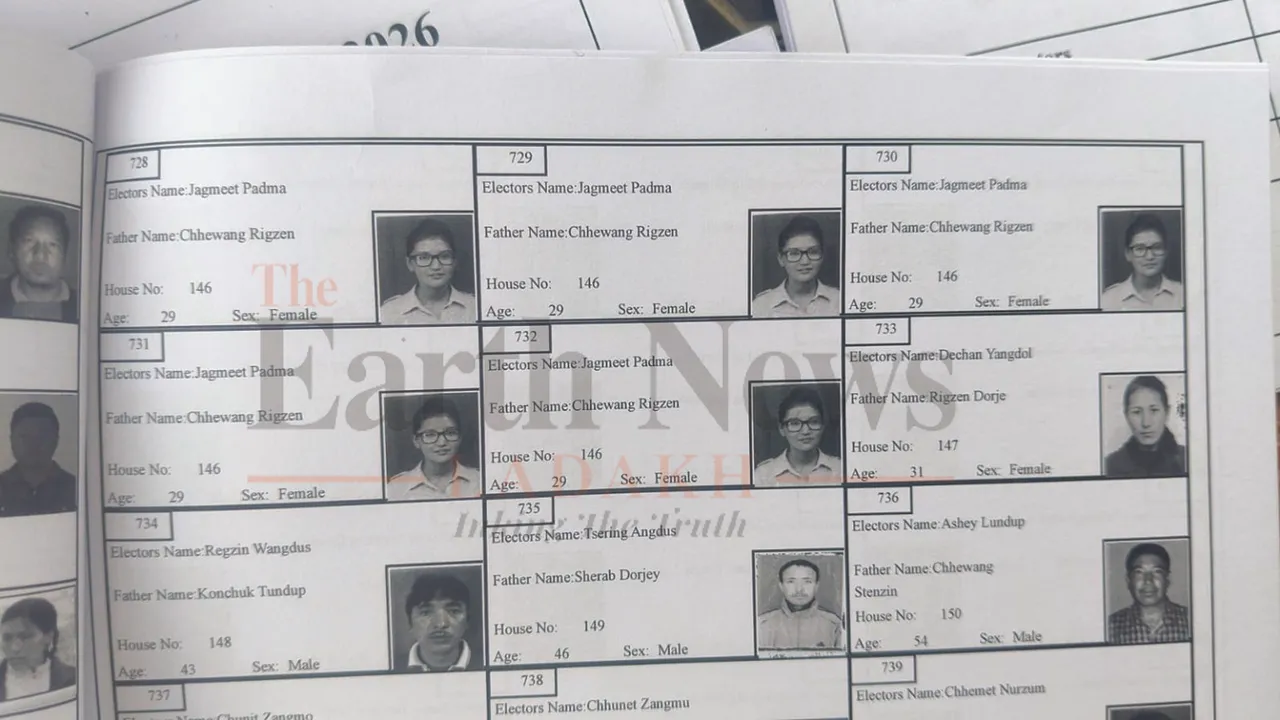
The apparent duplication came to light on polling day after a local resident, Anchok, flagged five consecutive entries at the Government Primary School polling station in Ibex, all bearing identical particulars of one individual.
The entries, listed against serial numbers 728, 729, 730, 731 and 732, carry the name of Jangmet Padma, daughter of Chhewang Rigzen, with house number 146. All five entries also mention the same age of 29 years and gender as female, raising questions over how identical voter particulars found their way into multiple entries in the electoral roll.
The discrepancy has brought the preparation and scrutiny of electoral rolls under renewed focus, particularly at a time when the administration has undertaken an extensive exercise to revise, verify and update voter lists to ensure that eligible electors are correctly recorded and discrepancies eliminated before polling.
What makes the episode particularly concerning is that the apparent duplication has surfaced on polling day itself, when electoral rolls serve as the primary reference for establishing voter eligibility and facilitating the exercise of franchise. The presence of five consecutive entries carrying precisely the same particulars raises questions about the scrutiny mechanisms in place and whether the duplication escaped detection during successive stages of verification.
Sharing images of the electoral roll, Anchok questioned how five separate entries corresponding to what appears to be a single individual could feature in the same polling station’s voter list. The discrepancy has also brought into focus the responsibility of the officials and machinery involved in the preparation, revision and finalisation of electoral rolls.
The episode raises questions about the effectiveness of the verification process, including the identification of duplicate entries, cross-checking of individual voter particulars and removal of discrepancies before the final electoral roll is put into use.
However, the presence of multiple entries bearing identical particulars does not, by itself, establish that multiple votes were cast or that electoral malpractice took place. Whether the entries represent a duplication in the electoral database, an error during compilation or a lapse in the verification process can only be established after examination by the competent election authorities.
The immediate questions are whether all five entries remain active in the electoral roll, whether the duplication was detected during the revision exercise, and what corrective measures have been initiated, if any, to address the discrepancy.
An official clarification from the election authorities regarding the apparent duplication, the status of the five entries and the action taken to address the matter was awaited at the time of filing this report.