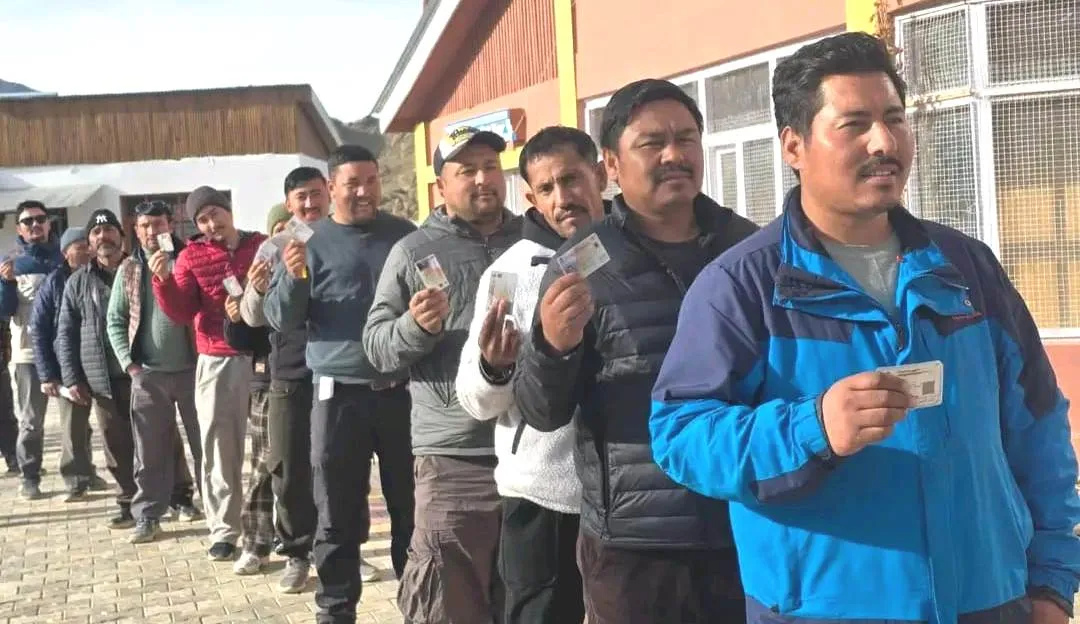
First grassroots elections since UT formation conclude with substantial participation; helicopters airlift polling teams to three remote and inaccessible polling stations in Zanskar
LEH: Ladakh on Saturday recorded 70.03 per cent voter turnout in Panchayat elections and 52.40 per cent in Municipal Council elections, marking the conclusion of its first grassroots electoral exercise since the formation of the Union Territory in August 2019.
After an eight-year gap since the previous Panchayat and Municipal elections in 2018, voters across the region participated in the electoral exercise, which covered 192 Panchayat Halqas across eight districts and the Municipal Councils of Leh and Kargil.
The participation reflected the return of electoral representation at the village and urban levels, with voters exercising their franchise to elect representatives responsible for local development, civic amenities and delivery of public services.
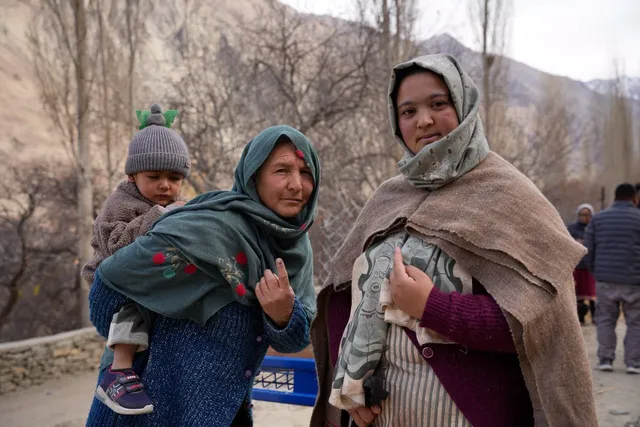
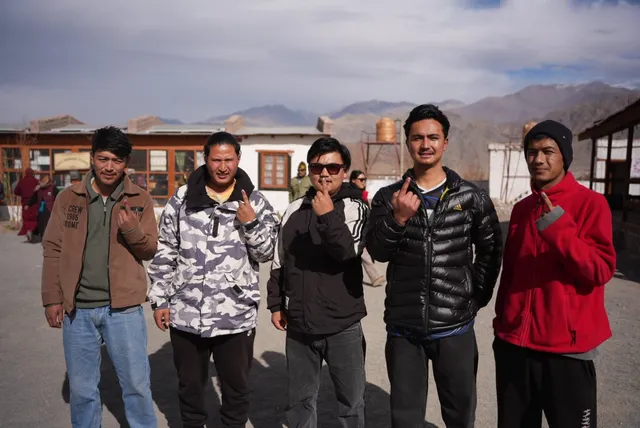
The electoral exercise witnessed participation across different sections of society, including women, first-time voters, monks and people from various walks of life. The administration described the polling as a celebration of democratic participation and grassroots self-governance.
One of the defining features of the elections was the substantial number of candidates elected unopposed, particularly in Panch constituencies. Of the 192 Sarpanch positions across Ladakh, 55 candidates were elected unopposed, while polling was conducted for the remaining 137 positions.
Similarly, out of 1,428 Panch positions, as many as 1,186 candidates were elected unopposed, leaving only 242 seats for which voting was required.
Thus, 1,241 of the total 1,620 Sarpanch and Panch positions were filled without a contest, accounting for approximately 76.6 per cent of the rural positions. The remaining 379 positions were decided through polling.
The figures indicate that while the electoral exercise covered the entire rural administrative landscape, direct electoral contests were concentrated in a relatively small proportion of constituencies.
The Municipal Council elections covered 38 wards, comprising 21 in Leh and 17 in Kargil. Polling was conducted in all 21 wards of Leh, while four wards in Kargil were filled unopposed, leaving 13 wards for direct electoral contests.
Unlike the non-party-based Panchayat elections, the Municipal Council polls witnessed political competition, giving the urban electoral exercise an additional political dimension. The overall municipal turnout of 52.40 per cent was lower than the 70.03 per cent recorded in the Panchayat elections, reflecting a difference of 17.63 percentage points between rural and urban electoral participation.
Beyond the turnout figures, the conduct of elections in Ladakh’s difficult geographical terrain remained a major administrative undertaking.
In one of the most significant logistical arrangements, helicopter services were deployed in Zanskar to airlift polling teams to three remote and road-inaccessible polling stations.
The deployment enabled election officials to reach isolated settlements where conventional road transportation was not feasible, ensuring that the electoral process could be conducted even in geographically challenging locations.
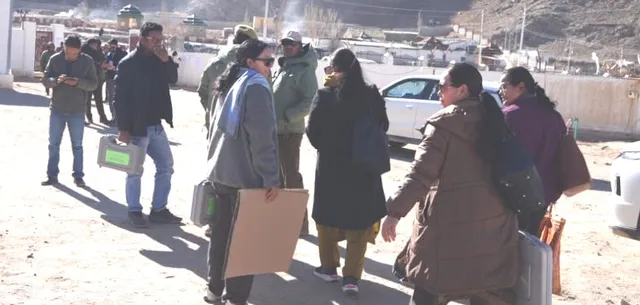
Across the Union Territory, polling personnel, security agencies and officials from various departments worked in coordination to transport election material, deploy polling teams and provide necessary facilities at polling stations.
The arrangements assumed particular importance given Ladakh’s high-altitude terrain, scattered settlements, long distances and the challenges associated with conducting elections towards the onset of winter. The successful deployment of polling teams to inaccessible locations also demonstrated the logistical requirements of extending electoral participation to some of the most remote habitations in the country.
The November 21 elections mark an important institutional development for Ladakh, where elected Panchayats and Municipal Councils had remained absent after the completion of the previous electoral cycle.
The last Panchayat and Municipal elections were held in 2018, when Ladakh was part of the erstwhile State of Jammu and Kashmir. The Panchayat bodies completed their terms in 2023, while the Municipal bodies completed their terms in early 2024.
The prolonged absence of elected grassroots institutions had left a gap in representative local governance, particularly in matters concerning village development, local infrastructure, sanitation, drinking water, civic amenities and other public services.
With the completion of polling, the process of constituting elected Panchayats and Municipal Councils has moved towards its next stage. The institutions are expected to provide formal representative platforms for identifying local priorities, monitoring development works and strengthening accountability in public service delivery.