Six-month campaign conserves 3,445 million litres, builds five Himalayan rock check dams, revives 43-km irrigation canal and channels 90 million litres of Stok Glacier runoff daily to farms; 100 more water bodies and 50 check dams planned
LEH: In a landscape where every drop of water determines the survival of villages, farms and fragile ecosystems, Ladakh is attempting a fundamental reset of its water management strategy—capturing snow and glacier melt, storing it in new reservoirs, raising river water levels, reviving abandoned canals and diverting massive volumes of glacier runoff to parched agricultural land.
In just six months, under the leadership of LG Vinai Kumar Saxena, the UT Administration has put in place a string of interventions that, taken together, represent a major push towards long-term water security in the cold desert.
The scale of the initiative is reflected in the numbers: 50 village water bodies already operational, five Himalayan rock check dams constructed, a 43-km defunct irrigation canal revived, another high-altitude canal completed, 90 million litres of glacier runoff a day channelised towards farms, and an ambitious project underway to replenish the shrinking Tso Kar lake.
The details are contained in a 25-page booklet, “Climate Resilience in the Cold Desert: Strategies for Long-term Water & Agricultural Sustainability in Ladakh,” documenting initiatives undertaken under Lieutenant Governor Vinai Kumar Saxena during the past six months. The publication says the interventions have been designed in response to the twin challenges of melting glaciers and declining snowfall, with the focus on sustainable and locally suited solutions.
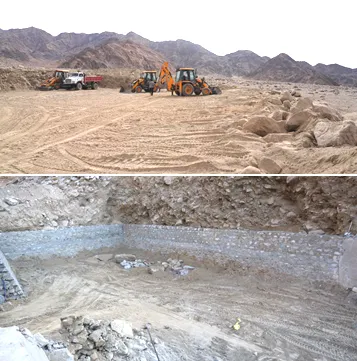
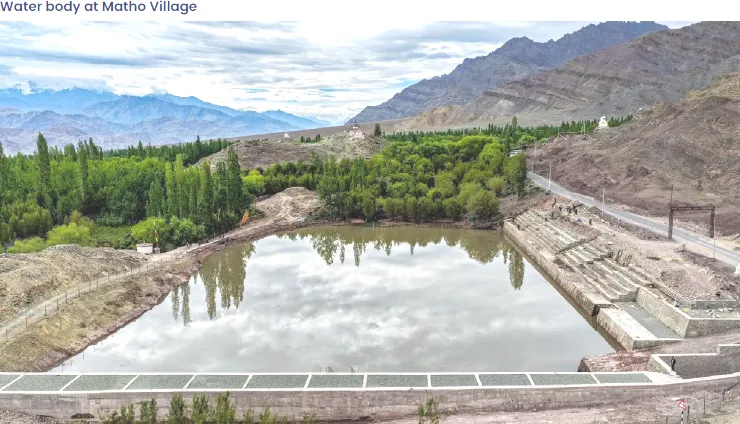
At the heart of the campaign is Project Him Sarovar, launched on April 10 to harvest snow, rainwater and glacier melt and store it in village water bodies. The first phase has already delivered 50 operational water bodies, with a combined reported capacity of about 185 million litres. The Administration has set a target of creating 100 more water bodies in the next year.
The first structure under the project came up at Stok, where a water body with a capacity of approximately 35 lakh litres was completed in just 21 days. At Spituk Farka, four large water bodies have been created, while another facility at Matho has added a further 30 lakh litres of storage capacity.
The significance lies beyond the individual ponds. The strategy seeks to retain water within Ladakh instead of allowing valuable seasonal meltwater to disappear downstream before it can be used for agriculture and community needs.
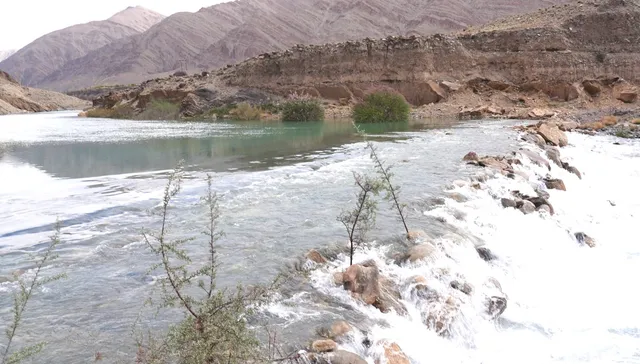
The Administration’s second major intervention is the Sindhu Jal Samriddhi Abhiyan, under which Ladakh has constructed what the booklet describes as India’s first Himalayan Rock Check Dam at Upshi, at an altitude of 11,400 feet. The first structure alone is capable of creating an estimated 40 million litres of pondage, with water backing up around 500 metres upstream. It is 200 feet long and was constructed in seven days.
The concept is simple but significant: rather than allowing river levels to fall too low during critical agricultural periods, rock barriers create upstream pondage from which water can be lifted towards fields. Five such rock check dams have now been constructed, with the booklet putting the water conserved through them at approximately 200 million litres.
One of the most striking examples of the new approach is the revival of the 43-km Igoo-Phey Irrigation Canal. Completed in 2005 but subsequently rendered non-functional by siltation and deterioration, the canal was restored and operationalised on May 15 after only 20 days of restoration work. The canal has the potential to irrigate around 10,000 acres and benefit 12 villages, giving new importance to an irrigation network that had effectively remained idle.
At Changthang, meanwhile, the stalled Mahey Tokpo-Raldho canal, located at more than 14,000 feet, has been completed to its full 2.10-km length. Of the 2.10 km, only 1,250 metres had been completed by March this year; the remaining 850 metres were constructed in two months after work resumed. The canal serves a command area of nearly 100 acres.
But the most ambitious intervention documented in the booklet is taking place around the Stok Glacier stream.
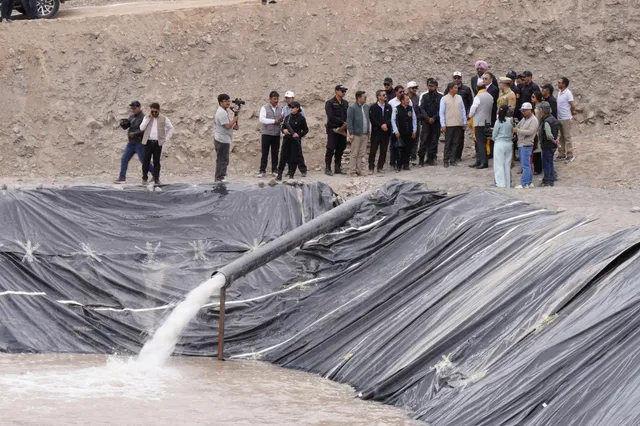
At peak discharge, the stream was carrying approximately 90 million litres of water every day. Instead of allowing that water to flow into the Indus, the Administration created two earthen channels to redirect it towards irrigation networks.
Around 80 million litres a day is being diverted to the Igoo-Phey Canal and another 10 million litres to the Chuchot Canal, with the intervention expected to support irrigation over approximately 1,500 acres across 13 villages.
The booklet estimates that the intervention conserved approximately 1.8 billion litres between August 20 and September 10, followed by another estimated 165 million litres as winter reduced the flow.
The water-security strategy has now moved beyond agriculture to ecological restoration, with an ambitious attempt to revive Tso Kar, one of Ladakh’s most important high-altitude wetlands. The project proposes to bring approximately 320 million litres of glacier water every day from the Rupsho Kharnak stream through an 11.5-km earthen channel to Tso Kar.
Before reaching the lake, the water will pass through three natural depressions that together are projected to hold around 1.23 billion litres, effectively creating three additional water bodies. The booklet says approximately 20 cusecs of water had already been diverted to the first pond from September 9.
The stakes are considerable. The publication states that Tso Kar, once spread across approximately 11,000 acres, has shrunk by 70 per cent over the past decade, affecting migratory birds including the Black-Necked Crane and forcing Pashmina herders to travel farther in search of grazing grounds.
The booklet places the entire campaign in the context of Ladakh’s enormous but difficult-to-access water resources.
According to its assessment, Ladakh has an estimated 3.60 crore million litres of glacial and snow-melt water, while current drinking and irrigation consumption stands at approximately 6.64 lakh million litres.
The publication calculates that only 1.85 per cent of available glacial and snow-melt resources were being utilised, and says the interventions undertaken during the past six months have increased effective utilisation to 2.35 per cent. It puts total water conserved through the initiatives at approximately 3,445 million litres.
And the expansion is not stopping here. The next phase envisages 100 additional water bodies under Project Him Sarovar and 50 more Himalayan Rock Check Dams in the coming six months.
For Ladakh, where a short agricultural season, extreme altitude and changing snowfall patterns make water availability a perennial challenge, the emerging strategy is clear: retain the meltwater, raise its utility, put it into the irrigation network and, where possible, restore the ecosystems that depend upon it.
The six-month figures documented in the booklet suggest that Ladakh’s water story is increasingly shifting from one of scarcity and seasonal dependence to active capture, storage, diversion and conservation of its most precious natural resource.