Ladakh’s political future, proposed elected Assembly and powers, constitutional safeguards and pending issues linked to September 24, 2025 violence expected to figure prominently in discussions
YASH KHAJURIA
LEH: Ladakh’s long-running political dialogue with the Centre enters another crucial phase on Wednesday, with the Union Ministry of Home Affairs (MHA) scheduled to hold a fresh round of talks with representatives of the Union Territory in New Delhi amid mounting expectations for a concrete roadmap on democratic governance and constitutional safeguards.
The September 9 meeting comes at a particularly sensitive juncture. While the Leh Apex Body (LAB) and Kargil Democratic Alliance (KDA) have agreed to keep their proposed agitation on hold to give the dialogue another chance, both organisations have made it clear that assurances alone will no longer suffice and that tangible progress will determine their next course of action.
Sources have indicated that the September 9 meeting is likely to include senior officials of the Ladakh Administration, three representatives each from LAB and KDA, Ladakh Lok Sabha member Mohd Hanifa Jan, former MP Thupstan Chhewang, LAHDC Kargil Chairman Mohd Jaffar Akhoon and former Leh Hill Council chief Tashi Gyalson, besides MHA representatives.
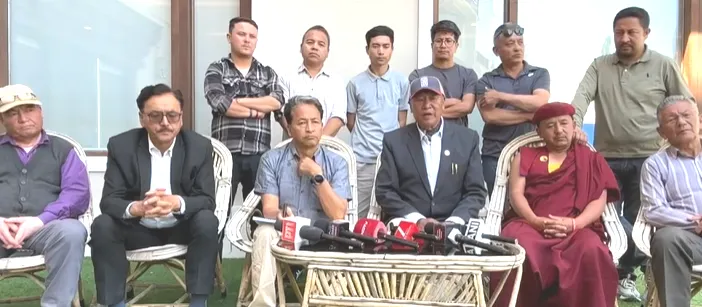
The proposed participation of Chhewang and Gyalson has itself generated debate within Ladakh, particularly among sections of the Buddhist community. A group of prominent Buddhist religious, political and social figures has separately urged Union Home Minister Amit Shah to ensure their participation, arguing that their institutional experience and political representation would make the dialogue more inclusive.
The meeting is of the MHA’s Sub-Committee on issues concerning Ladakh, rather than a fresh session of the High-Powered Committee (HPC) headed by Union Minister of State for Home Nityanand Rai. This distinction has itself been a point of concern for the LAB and KDA, which have been seeking discussions at the higher HPC level on the remaining substantive issues.
The immediate backdrop to Wednesday’s talks is the May 22 meeting between the Centre and Ladakh representatives, the minutes of which were eventually finalised and signed in Leh on July 3 after a dispute over the recording of provisions relating to bureaucratic accountability.
The finalised minutes represented an important shift in the dialogue. They recorded an in-principle understanding on establishing a Union Territory-level elected body with legislative, executive and financial powers, besides developing a customised constitutional safeguards framework for Ladakh under Article 371. The revised record also provided for control and supervision, including APAR-related authority, by the proposed elected executive body over civil servants dealing with subjects under its jurisdiction.
According to sources, the significance of Wednesday’s meeting therefore lies less in whether the broad principles discussed earlier will be acknowledged again and more in how those principles are translated into an actual institutional framework.
Meanwhile, Ladakh representatives have been seeking clarity on the composition, powers and jurisdiction of the proposed legislature, its relationship with the Lieutenant Governor and bureaucracy, financial autonomy and constitutional protection of the arrangement.
In August, LAB and KDA representatives submitted a list of what they described as “non-negotiable” demands, including an elected legislature, executive and financial powers and safeguards for land, jobs and other interests of Ladakh’s people. They also demanded withdrawal of cases linked to the September 24, 2025 violence and compensation for those killed and injured. ([The News Now][4])
The August 19 meeting with MHA officials in Leh, however, reportedly failed to produce a major breakthrough, with Ladakh representatives insisting that the discussion should remain focused on the political commitments recorded in the May minutes rather than being diverted towards development issues. ([The News Now][4])
At the heart of the broader movement remain the demands for statehood, constitutional safeguards including the Sixth Schedule or an equivalent tailor-made arrangement, political representation and protection of land and employment interests.
The Centre has, meanwhile, been pursuing a different but potentially significant route: a sui generis constitutional and governance framework within the existing Union Territory structure, rather than an immediate restoration of statehood. The May-July understanding on an elected UT-level body and Article 371-type safeguards is consequently being viewed as the most substantive opening in the negotiations since the dialogue began.
The Centre has already pointed to some outcomes from the earlier dialogue process, including an increase in Scheduled Tribe reservation from 45% to 84%, one-third reservation for women in the councils and recognition of Bhoti and Purgi as official languages. But LAB and KDA have maintained that these measures do not substitute for a durable political and constitutional settlement.
The other major issue likely to figure prominently is the aftermath of the September 24, 2025 violence in Leh, when four people were killed and dozens injured during clashes amid protests over Ladakh’s political demands. The subsequent judicial inquiry and cases against protesters have remained contentious issues in the Centre-Ladakh dialogue.
The Centre has already withdrawn cases against 25 people booked in connection with last year’s violence, but LAB leaders have demanded a wider withdrawal of cases, along with compensation for victims and their families and publication of the inquiry commission’s report.
The timing is politically significant. September is being observed by the movement as a period of remembrance ahead of the first anniversary of the September 24 deaths.
A proposed Kargil-Leh Peace and Justice Padyatra, planned around the anniversary, has been deferred following the scheduling of Wednesday’s talks. LAB and KDA leaders have, however, made clear that postponement should not be interpreted as abandonment of the agitation.
Wednesday’s meeting consequently carries significance beyond another round of consultations. For the Centre, it offers an opportunity to consolidate the progress recorded in the May-July dialogue and demonstrate that the proposed constitutional and democratic framework can move from an “in-principle” understanding towards a concrete draft.
For LAB and KDA, it is a test of whether the Centre is prepared to put specific institutional powers, constitutional safeguards and a time-bound implementation process on the table.
LAB has already warned that failure to secure meaningful progress could lead to an intensification of its peaceful agitation. The Kargil-Leh march has merely been put on hold, not abandoned.
After years of mobilisation since Ladakh became a Union Territory without a legislature in 2019, the central question on Wednesday will therefore be whether the dialogue produces another set of assurances—or the first concrete blueprint for Ladakh’s future political architecture.